
Daily brief
Agentic AI Platforms
By Steven Sorensen · 16 Jun 2026
At a glance
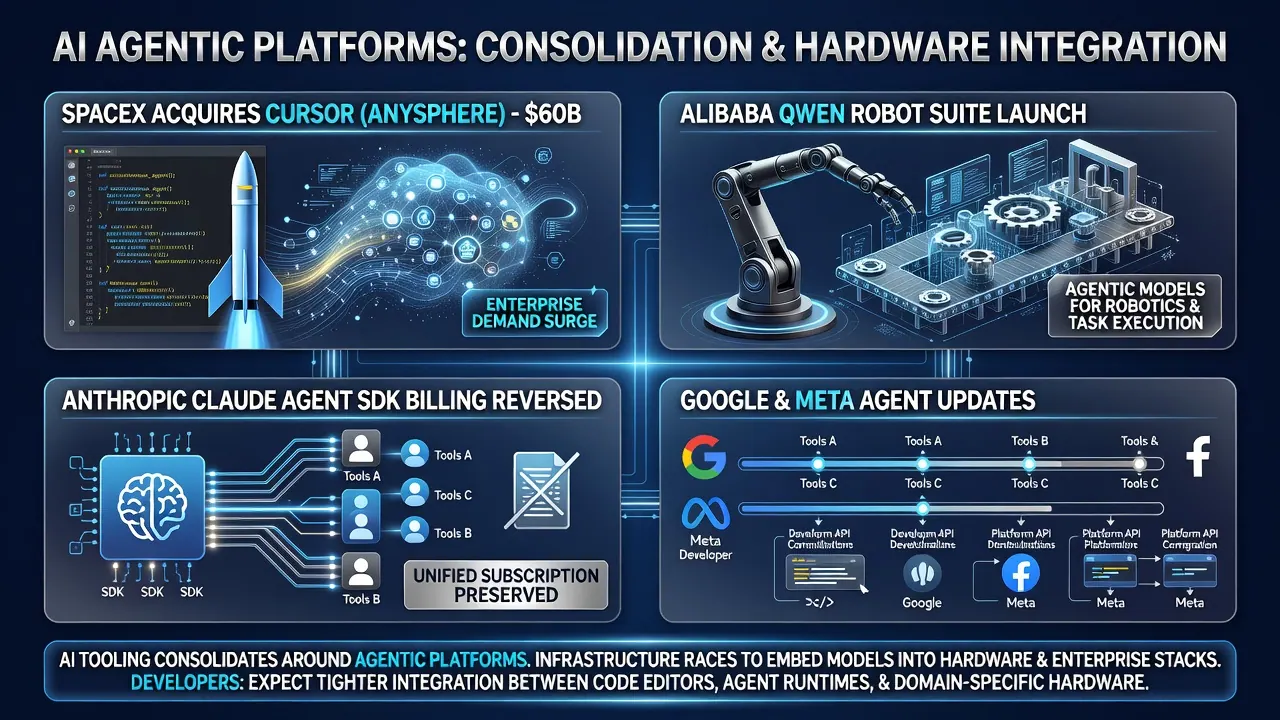
## At a glance – SpaceX is acquiring Cursor (Anysphere) for $60B, signaling massive enterprise demand for autonomous AI coding agents. – Alibaba launched the Qwen Robot Suite, its first family of agentic AI models targeted at robotics and complex task execution. – Anthropic reversed planned billing changes for the Claude Agent SDK, preserving unified subscription access for third-party tools. – Google and Meta continue rolling out incremental agent and platform updates that directly affect developer workflows.
Today’s news cycle highlights how AI tooling is consolidating around high-value agentic platforms while infrastructure players race to embed models deeper into hardware and enterprise stacks. The Cursor acquisition stands out as a direct signal that autonomous coding agents have moved from experimental to core infrastructure, with valuation multiples that will shape hiring, funding, and integration decisions for every team building on top of these systems. At the same time, Alibaba’s pivot toward robot-oriented models underscores a broader industry shift from chat interfaces to agents that can act in physical and simulated environments. Developers should expect tighter integration between code editors, agent runtimes, and domain-specific hardware over the coming months. These moves also reinforce the importance of stable SDK pricing and open standards as companies compete for developer mindshare.
Top Stories
SpaceX to acquire Cursor for $60 billion Practical dev impact: Teams relying on Cursor for large-scale autonomous coding will gain deeper enterprise features and potential SpaceX-internal tooling synergies, while smaller users may see pricing or feature tiering changes post-acquisition.
Alibaba releases Qwen Robot Suite for agentic robotics Practical dev impact: Developers working on embodied AI or industrial automation can now pilot production-grade models that combine vision, planning, and physical actuation in a single API family.
Anthropic reverses Claude Agent SDK billing changes Practical dev impact: Third-party agent builders and IDE integrations can continue using a single subscription credit pool instead of managing separate agent credits, reducing operational friction.
SoftBank launches OpenAI-powered infrastructure patching service Practical dev impact: Japanese enterprises gain an automated, model-driven approach to securing critical systems; global teams can study the architecture for similar internal agent deployments.
Practical Impact Analysis
The Cursor acquisition accelerates the trend of AI coding environments becoming strategic assets rather than simple productivity tools. Expect rapid iteration on multi-agent orchestration inside the editor and tighter coupling with enterprise identity and compliance layers. Alibaba’s robotics models expand the surface area for agent frameworks beyond software-only tasks, forcing developers to consider new evaluation benchmarks that include physical simulation and safety constraints. Anthropic’s pricing decision preserves accessibility for smaller teams building on Claude, which remains one of the strongest models for long-context reasoning and code review. Collectively these moves compress the experimentation window: production-grade agentic systems are now available from both pure-play startups and hyperscalers, making architectural choices around model routing, observability, and fallback strategies more urgent. Teams that standardize early on stable SDK surfaces and portable agent runtimes will have an advantage as consolidation continues.
Recommended Tutorial Idea
Build a lightweight multi-agent patch-review workflow that routes code changes through a local Claude Agent SDK call and a Qwen vision model for diagram validation.
from anthropic import Anthropic
from qwen_vl import QwenVL  # illustrative; use official SDK when available

client = Anthropic()
vl_client = QwenVL()

def review_pr(pr_diff: str, diagram_path: str):
    code_review = client.messages.create(
        model="claude-3-5-sonnet-20241022",
        max_tokens=2048,
        messages=[{"role": "user", "content": f"Review this diff for security and style:\n{pr_diff}"}]
    )
    diagram_analysis = vl_client.analyze(diagram_path, prompt="Check for architectural drift against the diff")
    return {"code": code_review.content, "diagram": diagram_analysis}
Grok Deep Dive
Given today’s Cursor acquisition, Alibaba’s robot models, and Anthropic’s SDK pricing stability, what architectural patterns should teams adopt now to future-proof agentic coding and robotics workflows against further consolidation?
New: The AI-Dev Prompt Pack, 40 tested prompts for Claude Code, Cursor, and Gemini CLI.
See the Prompt Pack