Daily brief
LangGraph Dominates Agent
By Steven Sorensen · 27 Jun 2026
At a glance
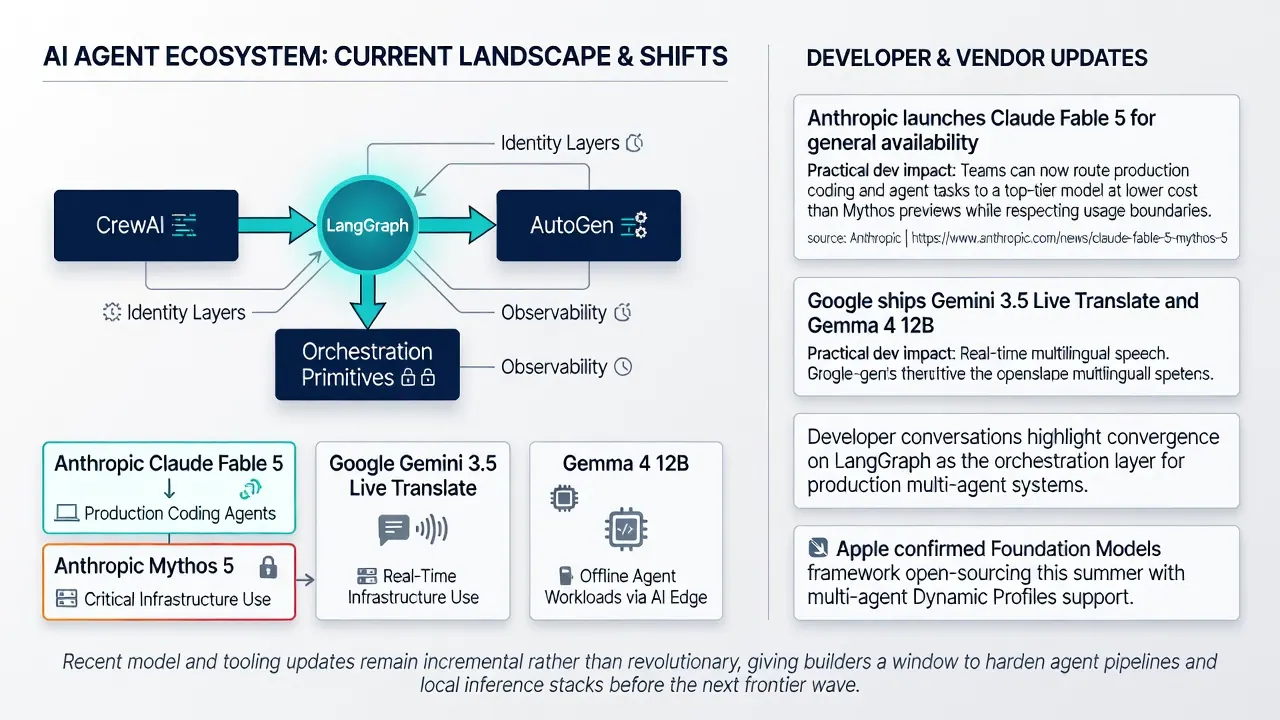
## At a glance – Anthropic expanded access to Claude Fable 5 while gating Mythos 5 for critical infrastructure use, shifting production options for coding agents. – Google rolled out Gemini 3.5 Live Translate and Gemma 4 12B for offline agent workloads via AI Edge. – Developer conversations highlight convergence on LangGraph as the orchestration layer for production multi-agent systems. – Apple confirmed Foundation Models framework open-sourcing this summer with multi-agent Dynamic Profiles support.
Recent model and tooling updates remain incremental rather than revolutionary, giving builders a window to harden agent pipelines and local inference stacks before the next frontier wave. Anthropic’s tiered Claude releases underscore the growing split between broadly available high-capability models and restricted infrastructure-grade ones, directly affecting how teams design reliable coding and reasoning agents. Google’s emphasis on real-time translation and edge-optimized Gemma variants signals stronger support for latency-sensitive, offline-first developer workflows. Meanwhile, community threads on LangGraph, CrewAI, and AutoGen reveal a maturing stack where orchestration primitives are stabilizing even as identity and observability layers lag. Apple’s move to open-source its Foundation Models framework with Swift-native multi-agent tooling adds another credible local and hybrid option for iOS and macOS developers. The net effect is a market favoring pragmatic integration over raw benchmark chasing.
Top Stories
Anthropic launches Claude Fable 5 for general availability Practical dev impact: Teams can now route production coding and agent tasks to a top-tier model at lower cost than Mythos previews while respecting usage boundaries.
Google ships Gemini 3.5 Live Translate and Gemma 4 12B Practical dev impact: Real-time multilingual speech agents and fully offline 12B models become viable for edge and mobile developer tooling.
LangGraph emerges as dominant orchestration primitive in 2026 agent stacks Practical dev impact: Builders gain clearer guidance on stateful multi-agent workflows that integrate cleanly with existing observability and identity layers.
Apple confirms open-source release of Foundation Models framework Practical dev impact: iOS/macOS developers gain zero-cost access to on-device models plus Swift APIs for third-party model calls and dynamic multi-agent profiles.
Practical Impact Analysis
The latest releases reinforce a two-speed AI landscape: frontier capability remains gated or expensive, while mid-tier and edge models accelerate practical adoption. Anthropic’s Fable 5 availability lets teams standardize on a single high-quality coding model without jumping through enterprise approvals required for Mythos variants. Google’s edge-focused Gemma 4 12B and Live Translate lower the barrier for always-on, privacy-preserving agents in consumer apps. Agent framework discussions show LangGraph winning on production readiness because it provides explicit state management and easy integration with existing monitoring stacks—reducing the custom glue code that plagued earlier CrewAI and AutoGen experiments. Apple’s open-source commitment further democratizes local inference on Apple silicon, particularly for developers already embedded in the Swift ecosystem. Collectively these moves reward teams that invest in abstraction layers and evaluation harnesses rather than chasing the newest flagship model.Recommended Tutorial Idea
Build a minimal LangGraph multi-agent system that routes between a local Gemma 4 12B instance and Claude Fable 5, with persistent state and basic observability hooks.from langgraph.graph import StateGraph, END
from langchain_core.messages import HumanMessage
from typing import TypedDict, List
class AgentState(TypedDict):
messages: List[HumanMessage]
next: str
def router(state: AgentState):
# Simple routing logic based on task type
last_msg = state["messages"][-1].content.lower()
if "code" in last_msg or "debug" in last_msg:
return "claude_node"
return "gemma_node"
# Placeholder nodes – replace with actual model calls
def gemma_node(state):
# Call local Gemma 4 via Ollama or AI Edge
return {"messages": state["messages"] + [HumanMessage("Gemma response")]}
def claude_node(state):
# Call Claude Fable 5 via Anthropic SDK
return {"messages": state["messages"] + [HumanMessage("Claude response")]}
workflow = StateGraph(AgentState)
workflow.add_node("router", router)
workflow.add_node("gemma_node", gemma_node)
workflow.add_node("claude_node", claude_node)
workflow.set_entry_point("router")
workflow.add_conditional_edges("router", lambda x: x["next"])
workflow.add_edge("gemma_node", END)
workflow.add_edge("claude_node", END)
app = workflow.compile()
Grok Deep Dive
Given the recent stabilization around LangGraph orchestration, tiered Claude access, and Google’s edge releases, how would you design a production-grade agent evaluation harness that measures both capability and cost across local Gemma 4, Claude Fable 5, and a fallback GPT variant while tracking state consistency and latency SLOs?New: The AI-Dev Prompt Pack, 40 tested prompts for Claude Code, Cursor, and Gemini CLI.
See the Prompt Pack