
Daily brief
Compliance and Migration
By Steven Sorensen · 30 Jun 2026
At a glance
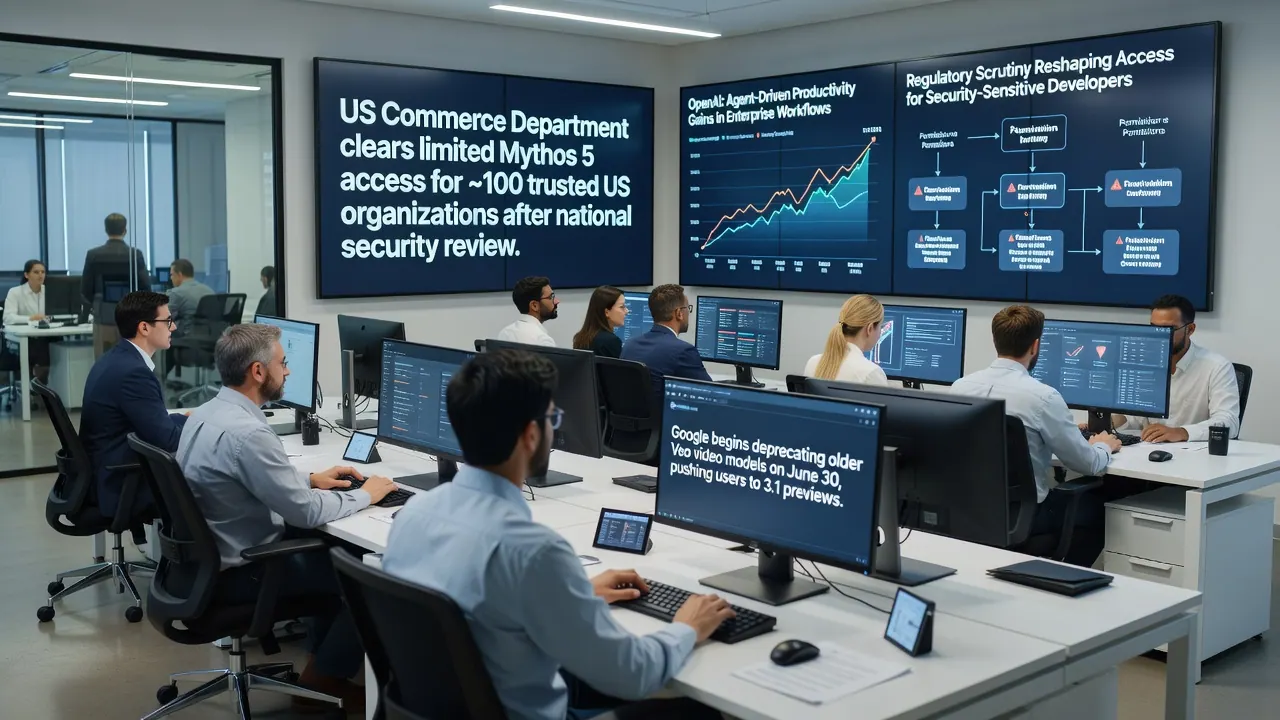
- US Commerce Department clears limited Mythos 5 access for ~100 trusted US organizations after national security review.
- Google begins deprecating older Veo video models on June 30, pushing users to 3.1 previews.
- OpenAI research highlights agent-driven productivity gains across complex enterprise workflows.
- Regulatory scrutiny on frontier models is reshaping access patterns for developers in security-sensitive sectors.
US developers woke up to a clearer but still constrained path for Anthropic’s most capable cybersecurity-focused model. After a two-week export-control standoff, the Trump administration green-lit Mythos 5 for a curated set of roughly 100 US companies and federal agencies focused on critical infrastructure. The move restores production-grade access for vetted partners while leaving broader availability and Fable 5 still restricted.
Parallel infrastructure shifts are landing today. Google’s Gemini API changelog confirms that several Veo 2.0/3.0 video-generation endpoints reach end-of-life on June 30, forcing immediate migration to the 3.1 family. Meanwhile, OpenAI’s latest agent research paper underscores measurable productivity lifts when long-running, multi-step agents handle real enterprise tasks—data that matters as teams evaluate which frontier models they can actually run in production.
The net signal for builders is governance first, capability second. Access, compliance, and migration planning now dominate the daily decision matrix more than raw benchmark numbers.
Top Stories
Anthropic secures partial Mythos 5 reinstatement for trusted US entities Practical dev impact: Enterprise teams working on cybersecurity, infrastructure defense, and regulated workloads can now request restored access to the model via Anthropic’s approved partner list, enabling previously blocked agentic security tooling.
Google deprecates Veo 2.0/3.0 video models effective today Practical dev impact: Any production pipelines still calling the older `veo-2.0-generate-001` or `veo-3.0` IDs must switch to Veo 3.1 preview or GA endpoints before service interruption.
OpenAI publishes research on agents transforming enterprise work Practical dev impact: The paper quantifies gains from long-horizon agents on multi-step tasks, giving teams concrete benchmarks for evaluating LangGraph-style or custom agent frameworks against real productivity metrics.
Practical Impact Analysis
The Mythos 5 clearance signals a maturing export-control regime: frontier models with strong cyber capabilities are now treated like dual-use technologies. Developers at cleared organizations gain a powerful new option for autonomous security analysis and defensive tooling, but everyone else faces continued friction. Migration work on the Veo side is straightforward yet time-sensitive—teams running video-generation features have a hard deadline today.OpenAI’s agent findings reinforce that production value now comes less from single-turn inference and more from reliable, stateful orchestration. Builders should audit their current agent stacks for checkpointing, human-in-the-loop hooks, and observability before scaling further. Overall, June 30 feels like a consolidation day: regulatory clarity for a narrow set of users, deprecation housekeeping, and fresh empirical data on agent ROI. The practical takeaway is to prioritize compliance mapping and migration scripts over chasing the next headline model.
Recommended Tutorial Idea
Migrate a simple video-generation pipeline from deprecated Veo endpoints to the 3.1 family while adding basic error handling and logging.1. Update your client library and replace the old model ID. 2. Add retry logic and structured logging around the generate call. 3. Test with a short prompt and verify output format.
from google import genai
import logging

logging.basicConfig(level=logging.INFO)
client = genai.Client()

def generate_video(prompt: str):
    try:
        response = client.models.generate_videos(
            model="veo-3.1-generate-preview",
            prompt=prompt,
            config={"duration": 5}
        )
        logging.info(f"Generated video: {response.video_uri}")
        return response
    except Exception as e:
        logging.error(f"Generation failed: {e}")
        raise

# Example usage
generate_video("A serene mountain lake at sunrise")
Grok Deep Dive
Given today’s limited Mythos 5 reinstatement for vetted US organizations, the Veo 3.0 deprecation deadline, and OpenAI’s new agent productivity data, what concrete steps should a security-focused engineering team take this week to evaluate whether Mythos 5 (if accessible) or alternative frontier models deliver measurable advantages in autonomous defensive workflows versus current LangGraph or Copilot-based setups?New: The AI-Dev Prompt Pack, 40 tested prompts for Claude Code, Cursor, and Gemini CLI.
See the Prompt Pack