Daily brief
OpenAI GPT-5.6 xAI Grok 4.5
By Steven Sorensen · 10 Jul 2026
At a glance
## At a glance
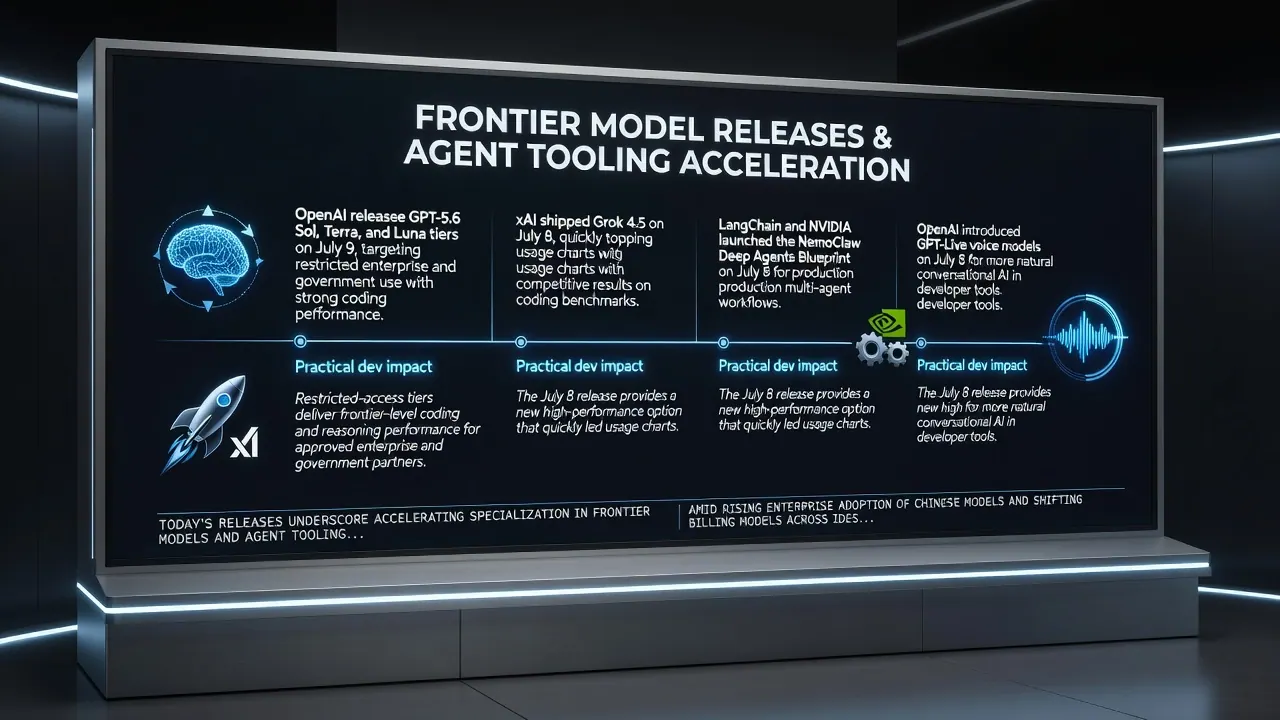
- OpenAI released GPT-5.6 Sol, Terra, and Luna tiers on July 9, targeting restricted enterprise and government use with strong coding performance.
- xAI shipped Grok 4.5 on July 8, quickly topping usage charts with competitive results on coding benchmarks.
- LangChain and NVIDIA launched the NemoClaw Deep Agents Blueprint on July 8 for production multi-agent workflows.
- OpenAI introduced GPT-Live voice models on July 8 for more natural conversational AI in developer tools.
Today’s releases underscore accelerating specialization in frontier models and agent tooling, giving builders immediate access to higher-capability reasoning and orchestration layers. OpenAI’s tiered GPT-5.6 rollout and xAI’s Grok 4.5 emphasize differentiated performance on real-world coding tasks, while the LangChain-NVIDIA collaboration targets reliable, observable agent systems. Voice advancements in GPT-Live open new interfaces for interactive coding assistants. These updates arrive amid rising enterprise adoption of Chinese models and shifting billing models across IDEs, pushing developers to optimize for both capability and cost in agentic workflows.
Top Stories
OpenAI releases GPT-5.6 Sol, Terra, and Luna Practical dev impact: Restricted-access tiers deliver frontier-level coding and reasoning performance for approved enterprise and government partners starting July 9.
xAI ships Grok 4.5 Practical dev impact: The July 8 release provides a new high-performance option that quickly led usage charts and matched or exceeded prior leaders on SWE-bench-style coding evaluations.
LangChain and NVIDIA release NemoClaw Deep Agents Blueprint Practical dev impact: The July 8 blueprint supplies production-grade patterns, observability hooks, and NVIDIA-optimized runtimes for building durable multi-agent systems.
OpenAI launches GPT-Live voice models Practical dev impact: New conversational voice capabilities released July 8 improve natural interaction in ChatGPT and will extend to the API, enabling voice-driven developer workflows.
Practical Impact Analysis
The simultaneous arrival of specialized GPT-5.6 variants and Grok 4.5 gives teams more choice when routing tasks by cost, latency, or domain strength—particularly for long-running coding agents where benchmark gains translate directly to fewer iterations. LangChain’s NVIDIA-backed blueprint addresses the observability and durability gaps that have limited production agent deployments, offering concrete patterns for state management and error recovery that complement the new models. GPT-Live adds a practical interface layer for interactive debugging or pair-programming sessions. Together these changes reward teams that already instrument their agent pipelines and maintain model-agnostic routing layers; organizations still relying on flat-rate or single-provider setups will see both capability gains and pressure to refactor for usage-based pricing and multi-model orchestration.
Recommended Tutorial Idea
Build a minimal multi-agent coding reviewer that routes between Grok 4.5 and a GPT-5.6 tier using the new NemoClaw patterns for state persistence and LangSmith tracing.
from langgraph.graph import StateGraph, END
from langchain_nvidia import ChatNVIDIA  # or appropriate connector
import os

# Define state
class ReviewState(dict):
    code: str
    review: str
    approved: bool

def reviewer_agent(state):
    llm = ChatNVIDIA(model="grok-4.5")  # or gpt-5.6 variant
    review = llm.invoke(f"Review this code for bugs and improvements:\n{state['code']}")
    return {"review": review.content, "approved": "approved" in review.content.lower()}

workflow = StateGraph(ReviewState)
workflow.add_node("review", reviewer_agent)
workflow.set_entry_point("review")
workflow.add_conditional_edges("review", lambda s: END if s["approved"] else "review")
app = workflow.compile()

result = app.invoke({"code": "def hello(): print('world')"})
print(result)
Grok Deep Dive
Given the July 8–9 releases of Grok 4.5, GPT-5.6 Sol/Terra/Luna, the NemoClaw Deep Agents Blueprint, and GPT-Live, what concrete architecture and routing strategy would you recommend for a production code-review agent that maximizes benchmark gains while controlling token spend across these new models?
New: The AI-Dev Prompt Pack, 40 tested prompts for Claude Code, Cursor, and Gemini CLI. See the pack