Daily brief
Grok 4.5 GPT-5.6 Claude Cowork
By Steven Sorensen · 12 Jul 2026
At a glance
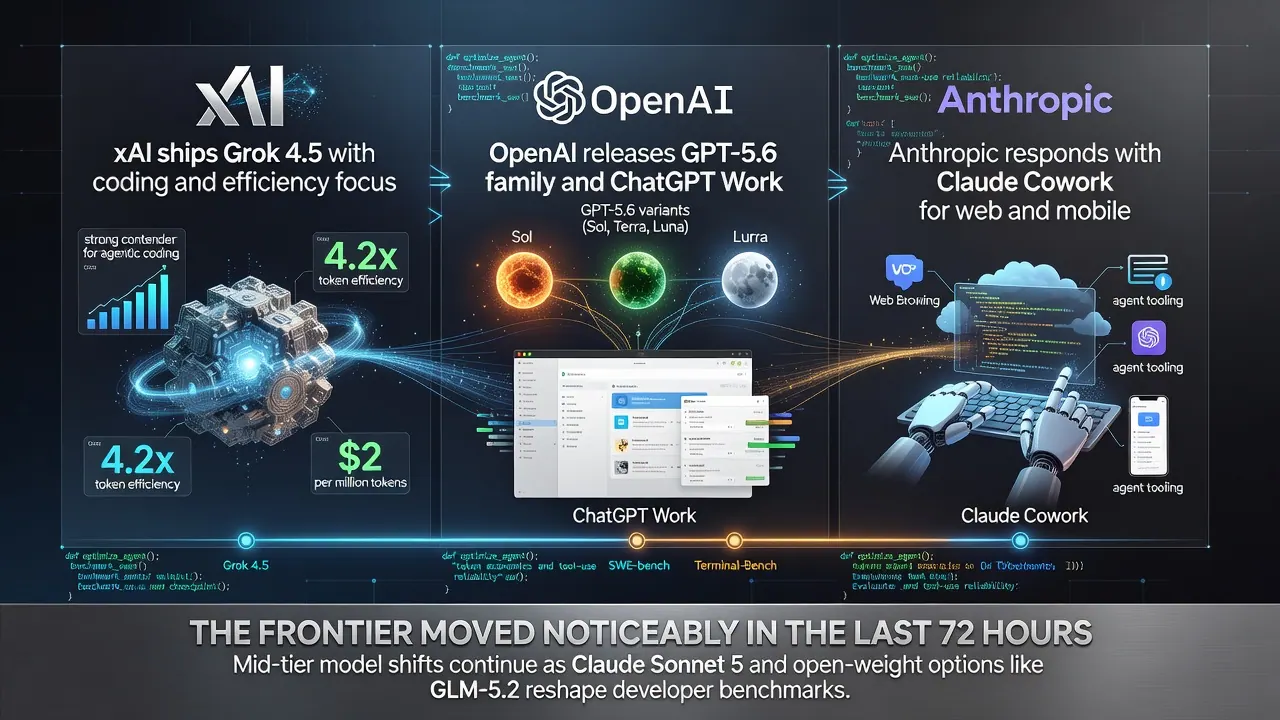
## At a glance – xAI released Grok 4.5 this week, emphasizing strong coding performance and 4.2x token efficiency at competitive pricing. – OpenAI launched GPT-5.6 variants (Sol, Terra, Luna) on July 9 alongside ChatGPT Work for agentic productivity. – Anthropic responded with Claude Cowork for web and mobile on the same day, extending its agent tooling. – Mid-tier model shifts continue as Claude Sonnet 5 and open-weight options like GLM-5.2 reshape developer benchmarks.
The frontier moved noticeably in the last 72 hours. xAI, OpenAI, and Anthropic all shipped meaningful updates that directly affect how developers build, test, and ship agentic systems. Grok 4.5 arrives with explicit claims around coding workflows and lower inference costs, while OpenAI’s GPT-5.6 family and unified ChatGPT Work desktop experience push toward longer-running, multi-app agents. Anthropic’s Claude Cowork launch keeps the competitive pressure high on the productivity layer. These releases land against a backdrop of already-shifting benchmarks where mid-tier models are closing gaps on agentic tasks like SWE-bench and Terminal-Bench. Builders now have fresher options for balancing capability, cost, and integration depth in production agents and IDE extensions. The practical takeaway is immediate: evaluate token economics and tool-use reliability on the newest checkpoints before locking in next-quarter architecture decisions.
Top Stories
xAI ships Grok 4.5 with coding and efficiency focus Practical dev impact: Early benchmarks position it as a strong contender for agentic coding workloads at roughly $2 per million tokens and significantly better token efficiency than prior frontier models.
OpenAI releases GPT-5.6 family and ChatGPT Work Practical dev impact: The new models plus the unified desktop app that merges Codex capabilities enable longer-running, multi-step projects across files and third-party tools directly from the ChatGPT interface.
Anthropic launches Claude Cowork on web and mobile Practical dev impact: The new agentic interface competes directly with OpenAI’s productivity push and gives developers another polished option for mobile-first or collaborative agent sessions.
Claude Sonnet 5 continues to reshape mid-tier agent benchmarks Practical dev impact: Launched late June and still the default mid-tier recommendation for many teams, Sonnet 5 delivers strong Terminal-Bench and SWE-bench Pro scores that developers are already using to right-size agent stacks.
Practical Impact Analysis
These coordinated releases compress the decision window for teams choosing between proprietary APIs and self-hosted options. Grok 4.5’s efficiency claims matter most for high-volume agent loops where token spend previously dominated costs. OpenAI’s move to a unified desktop environment with Codex integration lowers the barrier for developers who want agentic workflows without switching contexts between IDE, browser, and chat. Anthropic’s parallel Cowork launch ensures no single vendor captures the entire productivity layer. On the benchmark side, Sonnet 5’s continued strength in coding evals gives teams a reliable, lower-cost alternative to the newest flagships for many internal tools. The net effect is a more competitive market on both capability and price, forcing architects to re-run cost and latency models on fresh checkpoints rather than relying on last month’s defaults. Observability and guardrail choices will also need updating to handle the longer-horizon agents now shipping in these platforms.Recommended Tutorial Idea
Build a minimal multi-step coding agent that routes between Grok 4.5 and Claude Sonnet 5 based on task type, using the new tool-use strengths of each model.from openai import OpenAI
import anthropic
# Simple router
def route_task(task: str):
if "refactor" in task.lower() or "test" in task.lower():
return "grok"
return "claude"
def run_agent(task):
provider = route_task(task)
if provider == "grok":
client = OpenAI(base_url="https://api.x.ai/v1", api_key="...")
resp = client.chat.completions.create(model="grok-4.5", messages=[{"role": "user", "content": task}])
else:
client = anthropic.Anthropic(api_key="...")
resp = client.messages.create(model="claude-sonnet-5", max_tokens=4096, messages=[{"role": "user", "content": task}])
return resp
print(run_agent("Refactor this function and add unit tests"))
Grok Deep Dive
Compare the token efficiency, tool-calling reliability, and long-horizon agent performance of Grok 4.5 versus GPT-5.6 Sol/Terra and Claude Sonnet 5 on a real SWE-bench subset or internal codebase task; include cost-per-successful-run calculations and any observed differences in reasoning depth or hallucination patterns.New: The AI-Dev Prompt Pack, 40 tested prompts for Claude Code, Cursor, and Gemini CLI. See the pack