Daily brief
Anthropic MHS, Gemini Transcribe, Cowork Browser, and Granite 4.2 Expand Agent Runtimes
By Steven Sorensen · 27 Aug 2026
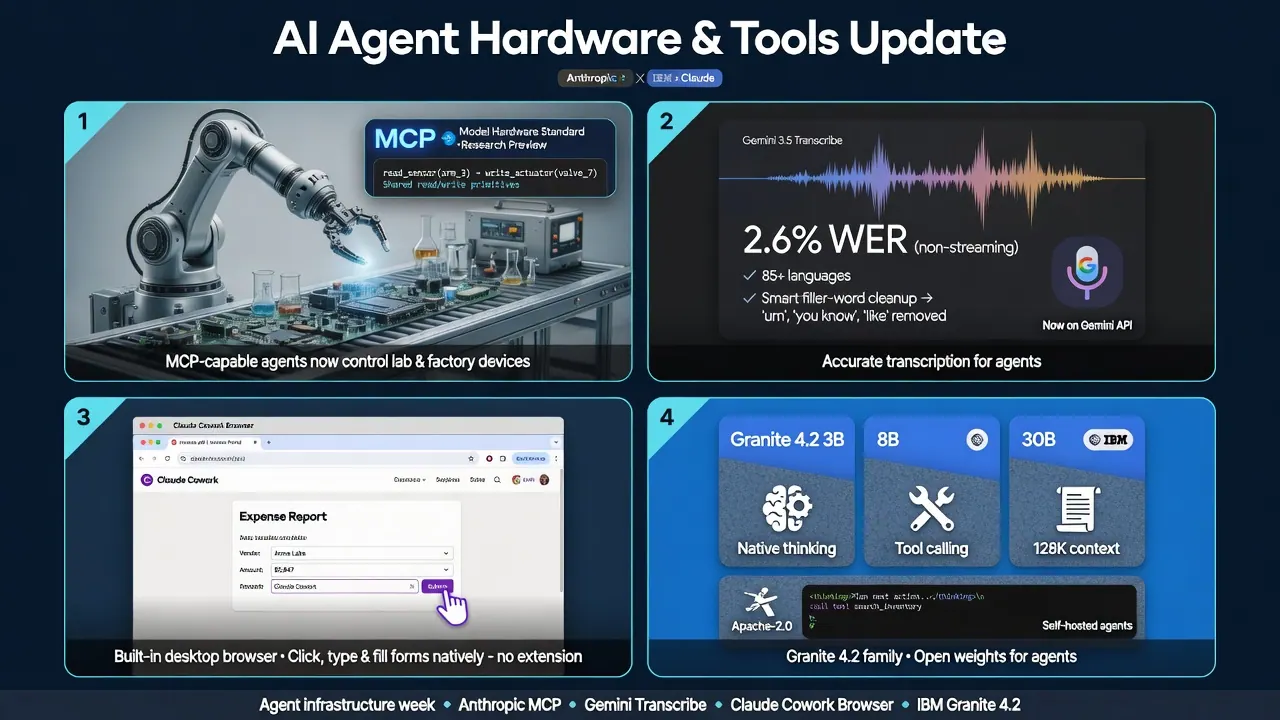
At a glance
- Anthropic opened a Model Hardware Standard research preview so MCP-capable agents can operate lab and factory devices with shared read/write primitives.
- Google put Gemini 3.5 Transcribe on the Gemini API with 2.6% non-streaming WER, 85+ languages, and smart filler-word cleanup.
- Claude Cowork now drives a built-in desktop browser, so agents can click, type, and fill forms without a Chrome extension.
- IBM’s Apache-2.0 Granite 4.2 family (3B, 8B, 30B) adds native thinking, tool calling, and 128K context for self-hosted agents.
The last two days were not a frontier-model dump. They were an interface dump. Agents are being given hardware drivers, a speech stack, a private browser, and an open-weight reasoning core you can actually host.
This morning Anthropic opened a research preview of the Model Hardware Standard: a shared driver so any MCP-capable harness can read and write programmable instruments instead of waiting weeks for a custom integration. Yesterday Google put Gemini 3.5 Transcribe on the Gemini API and Gemini Enterprise Agent Platform, with streaming and file endpoints, 85-plus languages, and a smart mode that strips ums while keeping jargon you supply. Claude Cowork, on the same calendar day, stopped needing your Chrome profile for web work; a side-panel browser now clicks and types inside the desktop app. IBM’s Granite 4.2, posted a day earlier, gives enterprises a 3B/8B/30B Apache-2.0 thinking family with 128K context and tool calling aimed at software-engineering agents.
Builders should treat today as a runtime story. The models were already good enough. The bottleneck is how they attach to the world.
Top Stories
Anthropic opens Model Hardware Standard research preview for agent-operated hardware Practical dev impact: If you already speak MCP, the next integration target is not another SaaS connector—it is a microscope, liquid handler, or robot arm behind a standardized driver. Anthropic’s Aug 27 research preview of the Model Hardware Standard (MHS) is a model-agnostic spec for agents to discover and operate programmable lab and manufacturing gear in parallel. The driver exposes simple read/write primitives, attaches natural-language device metadata, and then hands control to MCP, a CLI, or generated code files so long-running sequences do not need a model in the loop at every step. Early partners include Genentech, Carnegie Mellon, HHMI Janelia, and QuEra; AWS is wiring it through a pre-release Strands Robots package. It is not open source yet, spatial reasoning still needs a human in the loop, and devices without a programmable interface are out of scope—but the direction is unmistakable: agent harnesses are leaving the browser.
Google introduces Gemini 3.5 Transcribe on the Gemini API Practical dev impact: Voice agents, captioning, and post-call pipelines can swap Chirp-class STT for `gemini-3.5-transcribe` (files) and `gemini-3.5-transcribe-live` (Live API streaming) without standing up a separate speech vendor. Google’s Aug 26 launch positions 3.5 Transcribe as a speech-to-text specialist: 85-plus language auto-detect, custom vocabulary biasing, speaker diarization, word-level timestamps, and a smart mode that drops filler and resolves spoken self-corrections. Artificial Analysis numbers cited by Google: 2.6% WER non-streaming, 4.0% streaming, and about 70% faster time-to-final versus the prior stack. It is in public preview in AI Studio, Antigravity, and Gemini Enterprise Agent Platform; LiveKit, Pipecat, LangChain, and Vercel already list Live API paths. Chrome talk-to-type is still “coming soon,” so treat this as an API and first-party surface ship, not a universal OS dictation switch.
Claude Cowork adds a built-in desktop browser for unattended web tasks Practical dev impact: Cowork jobs that used to stall on “no connector for that portal” can now open a side-panel browser, click, type, and submit forms without installing Claude in Chrome or sharing your everyday profile. Anthropic’s Aug 26 product post is explicit: the built-in browser is Claude’s, not yours—no tabs, bookmarks, or passwords unless you import logins site by site (Chrome/Edge/Firefox on macOS; Firefox on Windows and Linux). It is rolling out this week to Pro, Max, and Team on the desktop app (Linux still beta); Enterprise owners enable it under Organization settings → Cowork. Claude in Chrome remains the right tool when the work is the tab you already have open. Prompt-injection risk is unchanged—Anthropic says the same action-vs-intent checks apply and still cannot be total—so start on trusted sites and keep SSO/banking imports off unless you mean it.
IBM Granite 4.2 ships open-weight reasoning models for enterprise agents Practical dev impact: Teams that need on-prem or air-gapped agents get an Apache-2.0 dense family—3B, 8B, 30B—with native `` traces, per-query thinking modes, 128K context (512K extension on 30B), and reasoning-before-tool-call behavior aimed at coding and terminal workflows. IBM Research posted the drop on Aug 25; weights are on Hugging Face, Ollama (`granite4.2`), and GitHub. IBM’s own table puts granite-4.2-30b at 57.00 pass@1 on SWE-Bench Verified and 61.39 on BFCL v4. The 8B and 30B went through an extra agentic RL stage; the 3B is the edge/high-throughput option. Serve with vLLM 0.20+ and IBM’s `granite_thinking_parser` if you want OpenAI-compatible harnesses (OpenHands, OpenCode, Pi) without rewriting prompts. Pair it with the new 470M Granite Speech 5.0 Turbo CTC models only if you need local ASR, not as a Gemini 3.5 Transcribe substitute.
Practical Impact Analysis
Four surfaces moved in 48 hours, and they compose. MHS is the physical analog of MCP: a driver contract, device cards in natural language, then deterministic scripts when the model should stop “thinking” and just run a laser lock or a plate-reader loop. That is the same pattern Cowork’s built-in browser encodes for the web—give the agent a sandbox that is not your personal session, watch the actions, keep SSO optional. If your 2026 roadmap still assumes “the agent lives in chat and we add tools later,” these two posts are the rebuttal.
Gemini 3.5 Transcribe is the ear for that stack. Streaming Live API for voice agents; unary file jobs for incident reviews and standups, with custom vocabulary so `OpenTelemetry` and `error budget` survive the smart formatter. Do not treat 2.6% WER as a license to skip evals: timestamps and diarization are documented to trade some accuracy, file jobs cap at 30 minutes when those features are on, and live sessions are 10 minutes. Wire jargon lists from your runbooks; keep a verbatim path for legal or compliance audio.
Granite 4.2 is the self-hosted brain when those loops cannot leave the building. Thinking-on for planning and tool choice, thinking-off for cheap classification, 3B for edge workers, 30B for SWE-style agents. IBM’s SWE-Bench number is vendor-run—benchmark it on your repo before you retire a closed coding model. The practical architecture for the next quarter is boring and strong: Transcribe in, Granite or a frontier model to plan, MCP/MHS or Cowork’s browser to act, code files for the parts that must be deterministic. Agents are no longer waiting on a better chat completion. They are waiting on you to give them a runtime with limits.
Tutorial
Wire Gemini 3.5 Transcribe into an incident-review pipeline: upload the recording, bias the recognizer toward your jargon, and request speaker labels plus word timestamps so you can jump to the minute someone said “rollback.” Install `google-genai`, export `GEMINI_API_KEY`, and point the script at an m4a/mp3 from the call. Default transcription is verbatim; this snippet stays on the documented `verbatim` mode so diarization and timestamps actually attach, then you can add a second `smart` pass later if you want filler stripped.
from google import genai

client = genai.Client()
audio = client.files.upload(file="incident-review.m4a")

interaction = client.interactions.create(
    model="gemini-3.5-transcribe",
    input=[
        {
            "type": "audio",
            "uri": audio.uri,
            "mime_type": audio.mime_type,
        }
    ],
    generation_config={
        "transcription_config": {
            "language_codes": ["en-US"],
            "custom_vocabulary": [
                "SLO",
                "error budget",
                "PagerDuty",
                "OpenTelemetry",
                "canary",
                "feature flag",
            ],
            "mode": {
                "type": "verbatim",
                "diarization_mode": "speaker",
                "timestamp_granularities": ["word"],
            },
        }
    },
)

print(interaction.output_text)
Drop diarization and timestamps if you need the full hour of audio—those features shrink the unary cap to 30 minutes. For interactive voice UIs, switch the model id to `gemini-3.5-transcribe-live` on the Live API instead of this file path.
Grok Deep Dive
Today’s stack is interfaces, not another chat checkpoint: Anthropic’s Aug 27 Model Hardware Standard research preview (MCP plus read/write drivers for lab and factory gear), Google’s Gemini 3.5 Transcribe on the Gemini API (`gemini-3.5-transcribe` / `gemini-3.5-transcribe-live`, 2.6% non-streaming WER, custom vocab, diarization), Claude Cowork’s built-in desktop browser versus Claude in Chrome, and IBM Granite 4.2 (3B/8B/30B, Apache 2.0, native thinking, 128K). Design a reference architecture for an on-call engineering team that transcribes incident calls, plans with a self-hosted Granite 4.2-30B agent, takes web actions in an isolated Cowork-style browser, and—where hardware exists—issues deterministic MHS command files instead of keeping the model in the loop. Call out safety limits (prompt injection, physical-world oversight, 10-minute live / 30-minute diarized file caps) and what you would eval before trusting any of it in production.
New: The AI-Dev Prompt Pack, 40 tested prompts for Claude Code, Cursor, and Gemini CLI. See the pack