Daily brief
Claude Fable 5.1 and Gemini Flash slash agent costs as Astra stays gated
By Steven Sorensen · 2 Sept 2026
At a glance
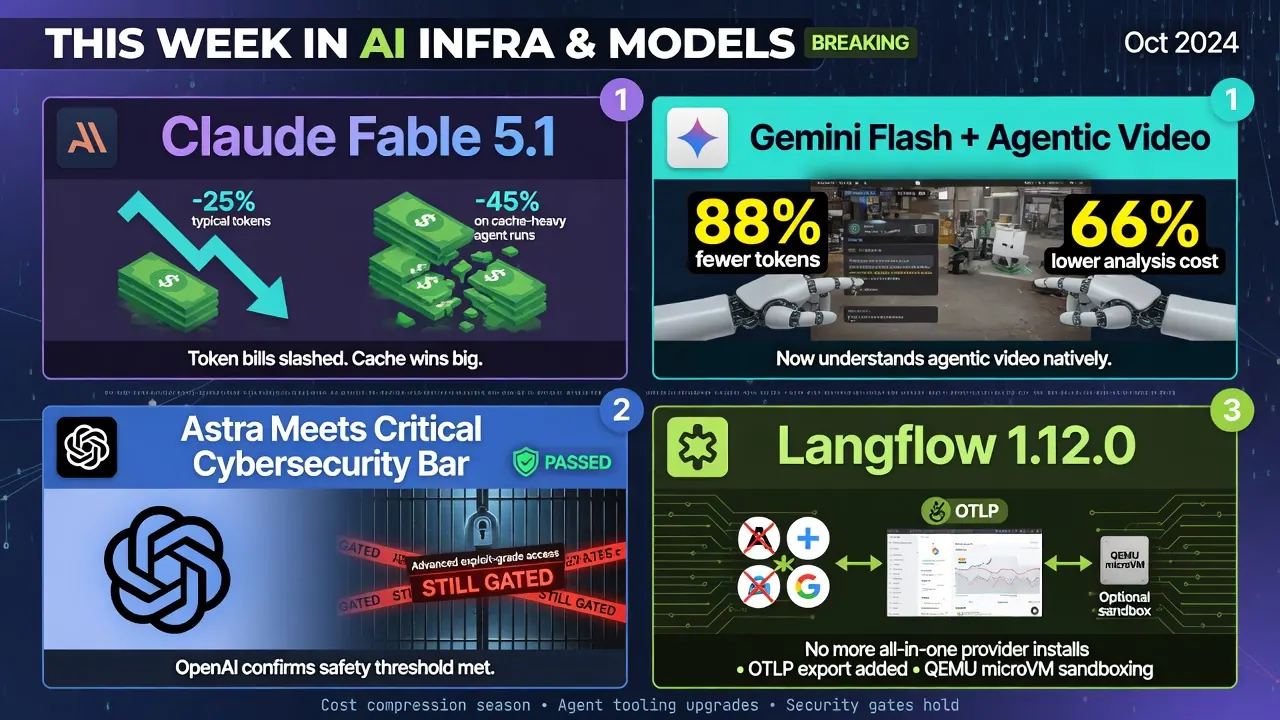
- Anthropic introduces Claude Fable 5.1, cutting typical token bills about 25% and up to ~45% on cache-heavy agent runs.
- Gemini Flash models gain agentic video understanding, claiming up to 88% fewer tokens and 66% lower analysis cost.
- OpenAI confirms Astra meets its Critical cybersecurity bar; advanced exploit-grade access stays gated.
- Langflow 1.12.0 ends all-in-one provider installs, adds OTLP export, and optional QEMU microVM sandboxing.
The last 24 hours were a billing and control event, not a quiet one. Anthropic put Claude Fable 5.1 on the general Claude Platform and the major clouds, pairing a new coding and research frontier with cheaper cache reads and a customer-owned review path still rolling out this fall. Google made the same move in another modality: instead of stuffing every frame of a lecture into context, Gemini 3.7 Flash, 3.6 Flash, and 3.5 Flash-Lite can now hunt the relevant seconds. OpenAI, in parallel, confirmed that Astra crosses its Preparedness Framework’s Critical cybersecurity threshold and will not ship those capabilities wide-open. The open-source layer moved too. Langflow 1.12.0 finally splits provider bundles, exports traces over OTLP, and can isolate Python Interpreter jobs in a microVM.
Treat today as a routing day. If your agents already live on Fable-class or Opus-class loops, the cache-read cut is the difference between keeping a frontier model on code review versus parking it for greenfield work. If you analyze video, the agentic processing flag is a one-line config change with documented double-digit token savings. And if you run Langflow in production, 1.12 is a breaking install: pin `langflow-base` correctly, install only the bundles you use, and decide whether untrusted code belongs in a sandbox before you cut over.
Top Stories
Anthropic introduces Claude Fable 5.1 and trusted-access Mythos 5.1 Practical dev impact: Point Claude Code, Devin-style agents, and API traffic at Fable 5.1 on the Claude Platform, Amazon Bedrock, Google Cloud, or Microsoft Foundry and expect roughly 25% lower typical token cost—up to about 45% on cache-heavy agent loops—while Claude Code defaults to High effort. Fable 5.1 and Mythos 5.1 are the same underlying model with different safeguards; Fable is generally available, Mythos stays in trusted-access programs. Official evals put Fable 5.1 at 55.8% on Terminal-Bench 4.0 (60.9% for Mythos) versus 42.0% for Fable 5, and 73.4% on CursorBench 3.2.0. Cognition said it is moving Opus 5 traffic in Devin onto Fable 5.1 on launch day because cache-read pricing finally makes a Fable-class model economical for code review. Cyber false positives drop, and Fable can now be used to find software vulnerabilities in source—not to write exploits. Enterprise Frontier Safeguards (customer-controlled storage, ZDR-equivalent privacy) start later this fall; eligible customers can use Fable 5.1 with zero data retention until then. API customers still need the Fallback API so biology and cyber flags do not silently land on Opus without your harness noticing.
Google launches agentic video understanding on Gemini Flash Practical dev impact: Set `processing` to `”agentic”` on Gemini 3.7 Flash, 3.6 Flash, or 3.5 Flash-Lite in the Gemini API (AI Studio and Gemini Enterprise Agent Platform) to stop paying for every frame of long recordings. Google says the agentic loop—native video tools that search, scan, and inspect only the needed windows across frames, audio, and transcripts—cuts token consumption by up to 88%, analysis cost by up to 66%, and lifts accuracy by up to 7% versus static 1 FPS ingestion. That is the difference between skipping a 90-minute lecture and actually indexing it. Sub-second moment retrieval, needle-in-a-haystack search on multi-hour video, anomaly re-sampling, and object/action counting are the documented use cases. No surcharge: you pay standard Gemini token rates. The Gemini app follows later; YouTube’s “Ask YouTube” is slated to pick this up in the coming months.
OpenAI designates Astra at Critical cyber capability, keeps the sharp edge gated Practical dev impact: Do not design product features that assume a generally available, unrestricted cyber-agent API from OpenAI this week. Astra is the first model OpenAI has placed at the Critical cybersecurity threshold under its Preparedness Framework: with the right tools, it can find previously unknown flaws and develop exploits across many hardened systems without step-by-step human guidance. OpenAI says safeguards now meet its bar for release, but advanced cybersecurity workflows will start with a small tester group, then Daybreak Blue for defensive use. Jailbreak refusals on its cyber eval set rise to 91.5% versus 59% for GPT-5.6 Sol; production monitoring is meant to halt unauthorized actions. The large frontier RL run that had been paused after the Hugging Face incident restarted on August 28. Plan for refusals, delayed GA of the dangerous slice, and a system card at launch—not for dropping Astra into an open coding agent tomorrow.
Langflow 1.12.0 splits bundles, exports OTLP, and sandboxes Python in a microVM Practical dev impact: Upgrade in a fresh venv or VM, not in place. `langflow-base` is now a complete, version-aligned install—replace any `langflow-base~=0.x` pins with `~=1.12.0`. `uv pip install langflow` no longer pulls every provider; missing packages show in the editor but the flow will not build until you install them (for example `uv pip install lfx-exa`). New production knobs: OTLP export of traces, metrics, and logs; `LANGFLOW_SANDBOX_BACKEND=exec-sandbox` plus `uv pip install ‘langflow[sandbox]’` to run the Python Interpreter in a QEMU microVM; `LANGFLOW_DEPLOYMENT_PROFILE=prod` preflight checks; `LANGFLOW_MCP_SSE_ENABLED=false` to kill the legacy SSE transport; and catalog/model policy APIs so superusers can allow-list providers. The in-app Admin Page is gone—user management is API-only.
Practical Impact Analysis
The through-line is no longer raw SWE-bench. Labs are competing on the cost of a long-running agent turn and on who is allowed to hold the sharpest tools.
Fable 5.1’s cache-read cut is the number that should move production routers this week. Cognition is already shifting Devin’s Opus 5 code-review traffic onto it because a Fable-class model finally pencils out for high-volume loops. That is a routing decision, not a research paper: if your system prompt and repo index already sit in cache, leaving Fable 5 or Opus 5 in the default slot is leaving money on the table. Pair that with Anthropic’s fallback behavior—cyber queries can still land on Opus 4.8, biology on Opus 5—and you need explicit Fallback API settings so a silent model swap does not surprise your eval harness. Claude Code’s High-effort default will also change latency and spend versus Medium on claude.ai; set effort deliberately per surface.
Google’s agentic video flag is the same idea in another modality. Static 1 FPS ingestion made hour-long recordings a budget problem. `processing: “agentic”` lets the model fetch only the windows it needs. If you already pay Gemini Flash for meeting recaps, QA on recorded demos, or support-ticket screen captures, this is a config change, not a rewrite. 3.7 Flash is the quality/cost default Google recommends.
Astra is the opposite signal: capability without general availability. OpenAI will talk about the model, but the exploit-grade surface stays behind testers and Daybreak Blue. Do not plan customer-facing security agents on unrestricted Astra APIs. Plan for refusals, chain-of-thought monitoring, and a delayed GA of the dangerous slice. The Hugging Face incident is now baked into that posture.
Langflow 1.12 is the install-time reminder that agent platforms are growing up. Bundle separation, OTLP, production preflight, and a QEMU sandbox are what you add after the demo works. Export projects first, upgrade isolated, then cut over.
Tutorial
Turn on agentic video understanding for long-form Gemini analysis. You need a Gemini API key, `google-genai` installed, and one of Gemini 3.7 Flash, 3.6 Flash, or 3.5 Flash-Lite. The agentic path is live for uploads and public YouTube URLs in Google AI Studio and the Gemini Enterprise Agent Platform; you pay standard token rates with no extra fee.
1. Install the current Google Gen AI SDK and export `GEMINI_API_KEY`. 2. Prefer gemini-3.7-flash unless you are optimizing purely for cost (then 3.5 Flash-Lite). 3. Pass a video part with `”processing”: “agentic”` so the model searches instead of ingesting every frame at 1 FPS. 4. Ask a needle-in-a-haystack question (announcements in a keynote, a sub-second UI glitch, a count of repeated actions). 5. Log `usage` on a twin request without `processing: “agentic”` if you want a before/after token delta on your own footage.
from google import genai

client = genai.Client()

interaction = client.interactions.create(
    model="gemini-3.7-flash",
    input=[
        {
            "type": "video",
            "uri": "https://youtu.be/7Z5Vy9JBANs",
            "processing": "agentic",
        },
        {
            "type": "text",
            "text": "What are the 3 most important announcements in this keynote?",
        },
    ],
)

print(interaction.output_text)
For local files, upload with `client.files.upload`, wait until state is `ACTIVE`, then pass `uri` and `mime_type` with the same `”processing”: “agentic”` field. Keep static 1 FPS only when you truly need a uniform sample of the entire timeline.
Grok Deep Dive
I just read today’s AI-for-developers brief (2026-09-02): Anthropic introduced Claude Fable 5.1 / Mythos 5.1 with ~25% typical token savings from cheaper cache reads (up to ~45% on agentic work), Terminal-Bench 4.0 at 55.8% vs 42.0% for Fable 5, Cognition moving Devin Opus 5 code-review traffic onto Fable 5.1, EFS later this fall, and a Fallback API for cyber/biology routing; Google launched agentic video understanding on Gemini 3.7 Flash / 3.6 Flash / 3.5 Flash-Lite (`processing: “agentic”`) claiming up to 88% fewer tokens and 66% lower cost; OpenAI confirmed Astra meets Critical cybersecurity capability and will gate advanced cyber access behind testers and Daybreak Blue; Langflow 1.12.0 broke all-in-one bundle installs and added OTLP plus an optional QEMU microVM for the Python Interpreter. Help me design a concrete migration plan for a production coding agent plus a video-QA pipeline: when to switch default traffic to Fable 5.1 versus keep Opus 5, how to measure cache-read savings and effort-level spend, how to A/B agentic vs static Gemini video on a 60–90 minute recording, and what I should not build against Astra until the system card and access program are public.
New: The AI-Dev Prompt Pack, 40 tested prompts for Claude Code, Cursor, and Gemini CLI.
See the Prompt Pack