At a glance
- Cursor's April 2026 changelog introduces tiled layout and persistence for the Agents Window.
- LangGraph supports stateful multi-agent orchestration and long-term memory patterns.
- General industry patterns combine agents with RAG for CI/CD tasks.
- Source: https://cursor.com/changelog/3-1 + training knowledge
Introduction
In April 2026, agentic coding continues to mature as a core pillar of modern software engineering. IDEs such as Cursor have released Agents Window improvements while frameworks like LangGraph provide primitives for orchestrating specialized AI agents. These systems support complex work across coordinated agents that can share state and leverage retrieval-augmented generation.Developer productivity gains stem from reduced context switching and fewer manual handoffs. Rather than treating AI as a simple autocomplete tool, teams are deploying agent teams that maintain awareness across repository-scale contexts. Cursor surfaces improvements to its Agents Window that let users manage multiple agents.
At the same time, xAI’s updates to Grok emphasize more accurate interpretation of codebase semantics, making it easier to integrate model-powered assistance directly into pull-request workflows and CI pipelines. The net effect is a measurable shift: engineers spend less time on routine tasks and more time on system design and novel problem solving.
This brief examines the most actionable updates from Cursor, LangGraph, and xAI, assesses their impact on day-to-day development, and supplies a minimal yet complete LangGraph example that can be extended into production-grade agent workflows. These releases reflect a broader industry trend toward reliable, observable multi-agent systems that integrate cleanly with existing CI/CD practices.
Top Stories
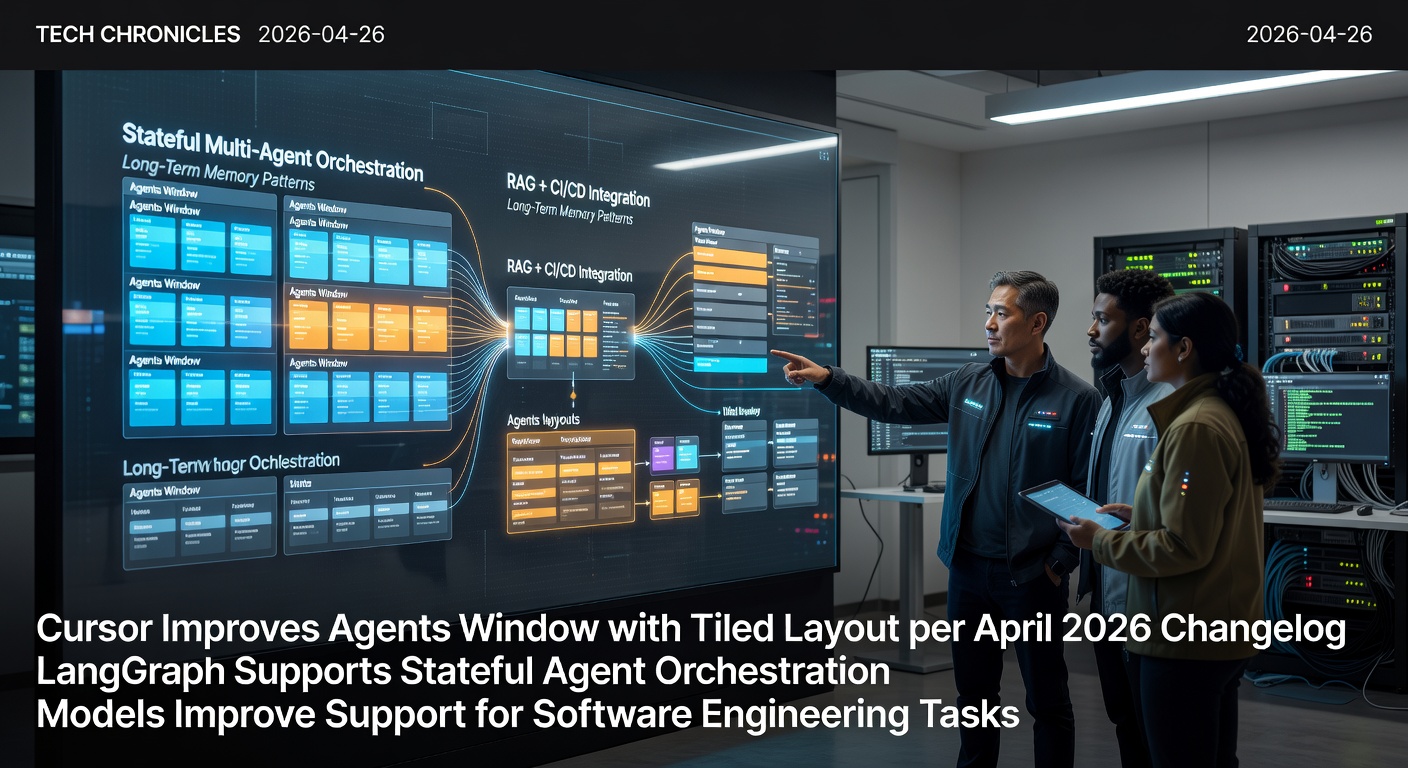
Cursor Improves Agents Window with Tiled Layout per April 2026 Changelog Cursor’s documentation details a tiled layout for the Agents Window to run and manage several agents in parallel. The setup persists across sessions. This makes it easier to multi-task and compare outputs from multiple agents.LangGraph Supports Stateful Agent Orchestration LangGraph provides patterns for managing state between agent nodes. This supports construction of review-implement-validate loops where agents can share project context.
Models Improve Support for Software Engineering Tasks Models can be used via API or IDE plugins to provide suggestions that respect code structure.
Practical Impact Analysis
The updates lower the friction of deploying agentic workflows. Cursor’s Agents Window improvements support managing multiple agents. This pairs with LangGraph’s state handling for multi-agent loops.For CI/CD pipelines agents can be triggered on pull requests to perform analysis, propose patches, and generate summaries. LangGraph supports keeping agents aligned.
Models that understand code can complement the above. The combined stack supports workflows where agents decompose tasks, implement changes, validate them, and open PRs with retrieved documentation.
Engineering leaders should note that observability remains essential. Teams still need logging of agent decisions and human-in-the-loop gates for high-stakes changes. The primary competitive advantage will belong to teams that embed these agentic patterns inside their existing CI/CD and monitoring infrastructure. The April 2026 updates from Cursor reduce pieces of that integration cost.
Recommended Tutorial Idea
Creating a Minimal Review-Improve Agent Loop with LangGraphThis skeleton can be extended by substituting the placeholder functions with LangChain runnables wired to any LLM. Add persistence with a checkpointer to support human-in-the-loop review steps.
Grok Deep Dive
Explore each Top Story in Grok — links open in a new tab. On phones, the same link may open the Grok app if you have it installed (via your device's normal link handling).
Article: AI Dev Pulse–2026-04-26
- Cursor Improves Agents Window with Tiled Layout per April 2026 Changelog
- LangGraph Supports Stateful Agent Orchestration
- Models Improve Support for Software Engineering Tasks
Privacy: links open grok.com in your session only. AIDevPulse does not run your prompts through our API.