
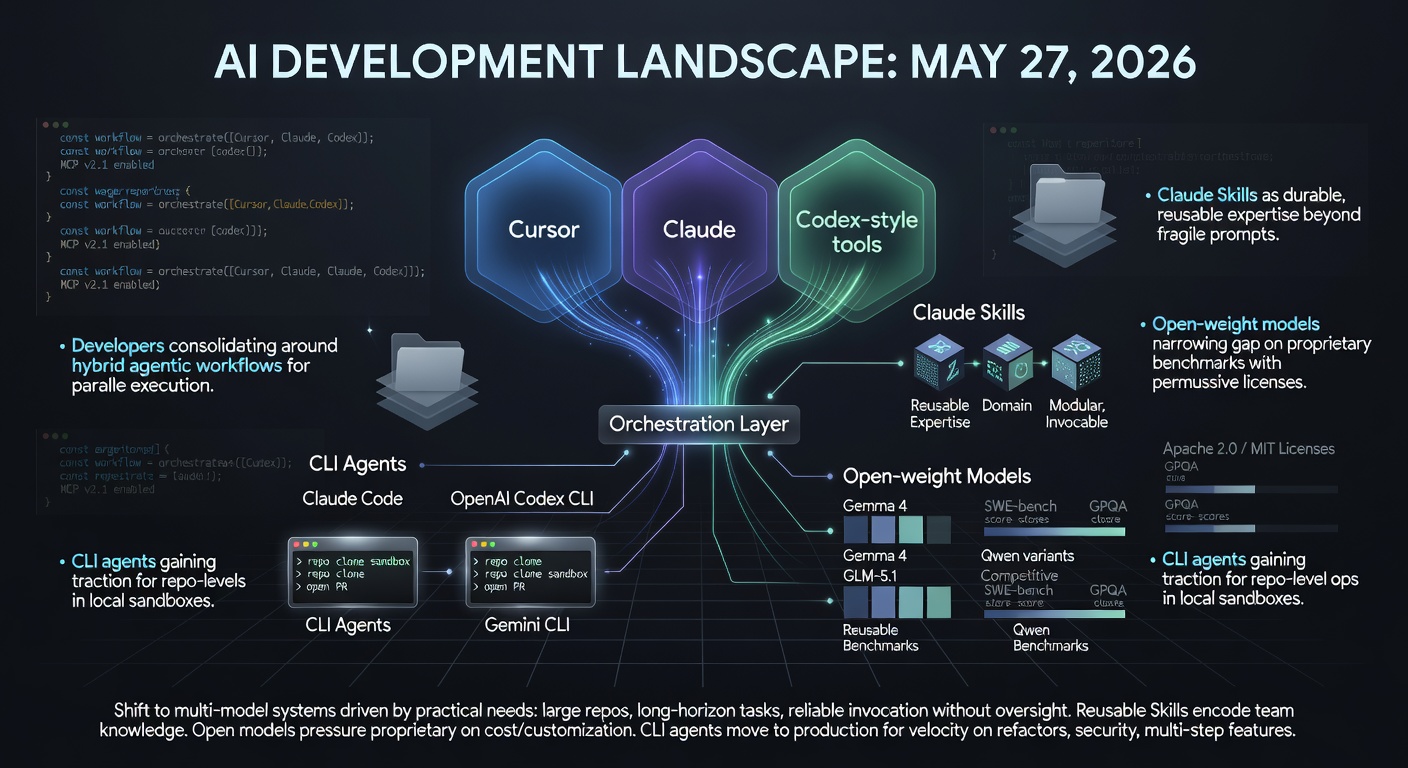
At a glance
## At a glance – Developers are consolidating around hybrid agentic workflows combining Cursor, Claude Code, and Codex-style tools for parallel task execution. – Claude Skills emerge as a durable way to package reusable domain expertise, moving beyond fragile prompts. – Open-weight models continue closing the gap on proprietary ones in coding benchmarks, with permissive licenses accelerating adoption. – CLI agents (Claude Code, OpenAI Codex CLI, Gemini CLI) gain traction for repo-level operations in local environments.
The AI development landscape on May 27, 2026, reflects a maturing agentic era where isolated chat interfaces give way to orchestrated, multi-model systems that handle real codebases. Recent coverage highlights how teams now treat tools like Cursor as orchestration layers, Claude as the reasoning core, and specialized models for code generation—enabled by consistent protocols such as MCP v2.1 support across clients. This shift is driven by practical needs: handling large repositories, long-horizon tasks, and reliable tool invocation without constant human oversight.
At the same time, reusable “Skills” collections are gaining mindshare as a way to encode team knowledge and domain patterns into modular, automatically invocable components. Open models from Google (Gemma 4 family), Chinese labs (GLM-5.1, Qwen variants), and others are delivering competitive SWE-bench and GPQA scores under Apache 2.0 or MIT licenses, pressuring proprietary providers on cost and customization. CLI-first agents that clone repos into sandboxes and open PRs are moving from experimental to production-adjacent for many engineering orgs. These developments matter because they directly impact velocity on complex refactors, security reviews, and multi-step feature work—areas where traditional autocomplete has plateaued. Builders who invest in workflow orchestration and Skills today will compound advantages as context windows and agent reliability improve further.
Top Stories
Hybrid agent orchestration stabilizes in production IDEs Cursor’s rebuilt interface for parallel agents, combined with OpenAI’s official plugin for Claude Code and MCP v2.1 support, lets developers run multiple specialized models in one session. Practical dev impact: Teams can now assign long-running tasks across models without context switching, reducing iteration time on multi-file refactors.
Claude Skills package reusable expertise Community and official collections turn recurring prompting patterns into modular, auto-invoked capabilities that tools apply when a request matches. Practical dev impact: Developers encode frontend conventions, security checks, or domain logic once and reuse them reliably across sessions and teammates.
CLI agents mature for local repo work Claude Code, OpenAI Codex CLI, and Gemini CLI now read files, run tests, and execute multi-step fixes directly in project directories, complementing cloud-based async agents. Practical dev impact: Engineers gain fast, auditable local automation for bug fixes and test generation without leaving the terminal or exposing full repos to cloud services.
Open models narrow performance gap on coding tasks Gemma 4, GLM-5.1, and Qwen variants deliver strong results on SWE-bench and agentic benchmarks under permissive licenses, with 1M-token context options emerging. Practical dev impact: Teams can self-host or fine-tune capable coding models at lower cost while maintaining competitive quality for internal tools and agents.
Practical Impact Analysis
The convergence of orchestration layers, reusable Skills, and capable CLI agents signals a shift from prompt engineering to system design. Builders are now composing reliable pipelines where a fast model handles routine edits, a reasoning-heavy model tackles architecture decisions, and Skills ensure consistency on style or security rules. This reduces the cognitive load of managing multiple chats and improves reproducibility—critical for team-scale adoption.
Open models’ progress under permissive licenses lowers barriers to customization and on-prem deployment, especially for organizations concerned with data egress or latency. When paired with MCP-compatible clients, these models integrate seamlessly into existing IDE and CLI workflows, allowing cost optimization without sacrificing capability on standard coding benchmarks.
The practical outcome is faster iteration on complex changes: asynchronous agents handle background PR work while local CLIs provide immediate feedback loops. However, success depends on thoughtful guardrails—auditing tool calls, versioning Skills, and monitoring agent reliability on long-horizon tasks. Teams that standardize on a small set of orchestration patterns and reusable components will see compounding productivity gains, while those relying on ad-hoc prompting will continue fighting context drift and inconsistency. The tooling maturity visible this week makes 2026 the year agentic coding moves from demo to default for professional engineering.
Recommended Tutorial Idea
Build a minimal local CLI agent that uses Skills-style instructions to perform repo-aware code reviews and suggest fixes.
Extend this by integrating a real LLM client (e.g., Anthropic or OpenAI SDK) and adding git operations for automated patch application.
Grok Deep Dive
Today’s landscape shows agentic coding maturing through hybrid orchestration (Cursor + Claude Code + Codex), reusable Skills for durable workflows, and stronger open models with CLI agents. How would you design a production-grade multi-agent system that combines local CLI execution with cloud reasoning models while enforcing Skills for security and style consistency across a team repo? What benchmarks or guardrails would you add to measure reliability on long-horizon refactors?
Grok Deep Dive
Explore each Top Story in Grok — links open in a new tab. On phones, the same link may open the Grok app if you have it installed (via your device's normal link handling).
Article: Hybrid Agentic Workflows with — AI Dev Pulse · May 27, 2026
- Hybrid agent orchestration stabilizes in production IDEs
- Practical dev impact:
- Claude Skills package reusable expertise
- Practical dev impact:
Privacy: links open grok.com in your session only. AIDevPulse does not run your prompts through our API.