
At a glance
## At a glance
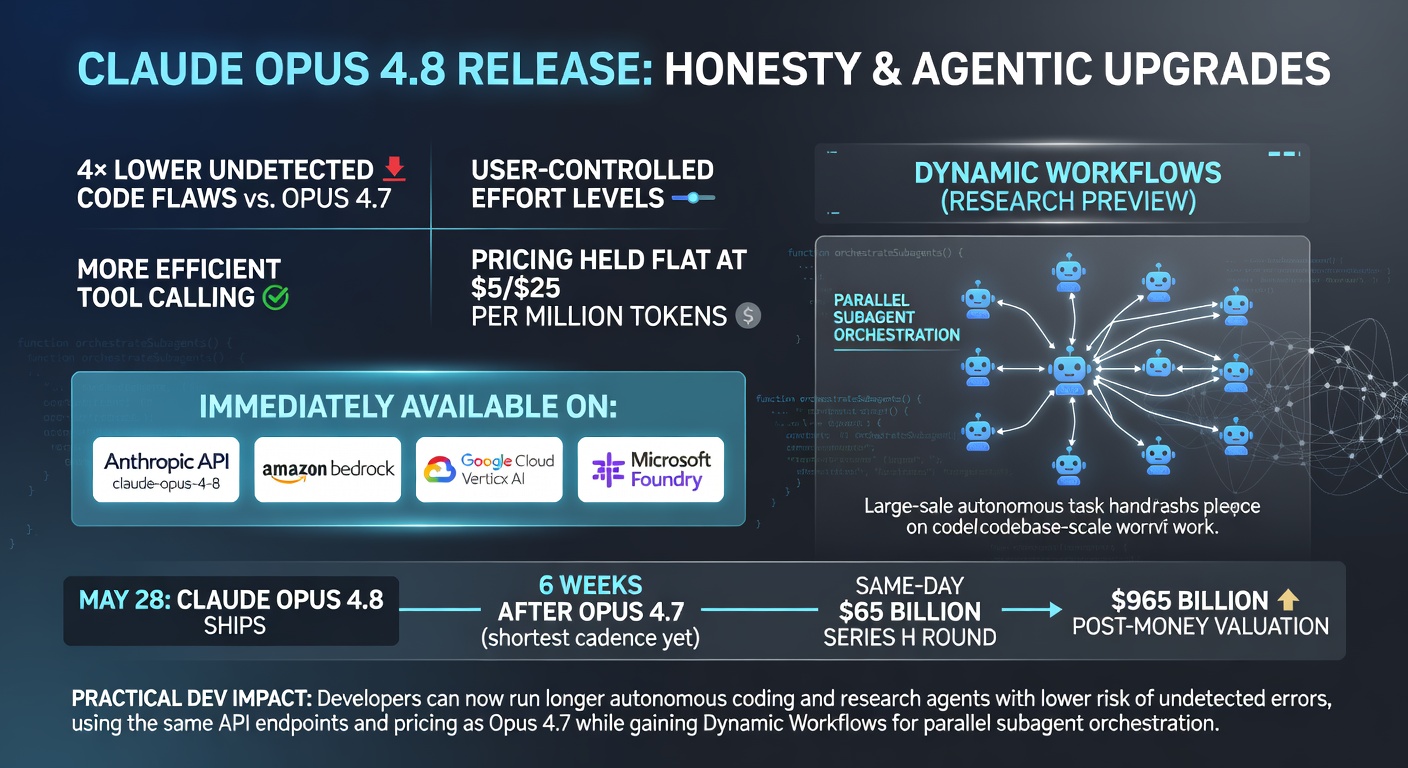
- Anthropic ships Claude Opus 4.8 on May 28 with major gains in honesty, agentic reliability, and parallel subagent orchestration via Dynamic Workflows in Claude Code.
- The update emphasizes 4× lower rate of undetected code flaws versus Opus 4.7, more efficient tool calling, and user-controlled effort levels while holding pricing flat at $5/$25 per million tokens.
- Claude Opus 4.8 is immediately available on the Anthropic API (`claude-opus-4-8`), Amazon Bedrock, Google Cloud Vertex AI, and Microsoft Foundry, plus a research preview of Dynamic Workflows for large-scale autonomous tasks.
- Same-day $65 billion Series H round values Anthropic at $965 billion post-money, underscoring enterprise demand for production-grade agentic models.
Anthropic’s May 28 release of Claude Opus 4.8 arrives just six weeks after Opus 4.7, the shortest cadence yet for a frontier Opus iteration. The point release prioritizes behavioral improvements that matter most to builders: sharper self-critique, fewer silent errors in generated code, and the ability to orchestrate hundreds of parallel subagents on codebase-scale work. Dynamic Workflows (research preview in Claude Code) and per-task effort controls give developers new levers for trading compute against quality without changing the underlying rate card. The model lands at the same $5/$25 pricing across all platforms, removing friction for teams already standardized on Opus. In a market still dominated by incremental capability jumps, the emphasis on measurable honesty and autonomous reliability signals a maturing focus on deployable agent systems rather than raw benchmark chasing.
Top Stories
Claude Opus 4.8 delivers honesty and agentic upgrades Practical dev impact: Developers can now run longer autonomous coding and research agents with lower risk of undetected errors, using the same API endpoints and pricing as Opus 4.7 while gaining Dynamic Workflows for parallel subagent orchestration on large refactors.
Dynamic Workflows and effort control land in Claude Code Practical dev impact: Teams building multi-step agents gain a research-preview orchestrator that plans, executes, and verifies work across hundreds of parallel subagents, plus a simple slider to dial effort (and token spend) per task without code changes.
Anthropic raises $65B at $965B valuation on model launch day Practical dev impact: Sustained capital signals continued investment in production infrastructure (Bedrock, Vertex, Foundry) and longer context/agent tooling that enterprise developers rely on for reliable scaling.
Qwen3.7 Max brings 1M-context reasoning to Alibaba’s Go tier Practical dev impact: Chinese developers and global teams using Qwen now get step-by-step reasoning plus a full-codebase context window at lower cost tiers, useful for large-repo analysis without premium plans.
Practical Impact Analysis
Claude Opus 4.8’s honesty gains directly address a persistent pain point in agentic coding: models that confidently ship flawed code. The reported 4× reduction in unremarked errors, combined with more efficient tool use and stronger computer-use/browser-agent scores (84% on Online-Mind2Web), makes Opus 4.8 a stronger default for Cursor, Windsurf, or custom LangGraph-style loops that must run unattended. Dynamic Workflows extends this by letting a single session decompose massive migrations into verified parallel sub-tasks—exactly the pattern production teams need for monorepo refactors or compliance sweeps. Effort control gives fine-grained cost management: default “high” effort matches prior Opus token budgets with better results, while “extra” or “max” unlocks deeper reasoning only when required. Availability across Bedrock, Vertex AI, and Foundry means the same model ID and safety guardrails are now native in the three major cloud AI platforms, reducing multi-vendor friction. The funding round reinforces that enterprises are willing to pay for these reliability increments rather than chasing the next raw intelligence leap. Overall, the day’s news tilts the landscape toward trustworthy, long-running agents over one-shot generation.
Recommended Tutorial Idea
Build a verified parallel refactor agent with Claude Opus 4.8 Dynamic Workflows (research preview)
1. Sign up for Claude Code Enterprise/Team/Max and enable the Dynamic Workflows research preview in settings. 2. Create a new Claude Code session and select `claude-opus-4-8` with effort set to “extra”. 3. Paste a high-level task: “Migrate all Python services from Flask to FastAPI across the monorepo. Use the existing test suite as the verification bar. Plan the work, spawn parallel subagents for each service, verify, and produce a merge-ready PR description.” 4. Let the orchestrator run; inspect the parallel subagent traces in the UI. 5. When complete, export the structured plan + verification logs for your CI pipeline.
Grok Deep Dive
Given Claude Opus 4.8’s release today with its emphasis on honesty, efficient tool calling, and Dynamic Workflows for hundreds of parallel subagents, how would you architect a production-grade autonomous coding agent that combines Opus 4.8 effort controls, verification loops, and fallback to cheaper models on low-uncertainty subtasks? What safeguards would you add to detect and surface the remaining 25% of undetected errors the model still allows?
Grok Deep Dive
Explore each Top Story in Grok — links open in a new tab. On phones, the same link may open the Grok app if you have it installed (via your device's normal link handling).
Article: Anthropic Claude Opus 4.8 Cuts — AI Dev Pulse · May 29, 2026
- Claude Opus 4.8 delivers honesty and agentic upgrades
- Practical dev impact:
- Dynamic Workflows and effort control land in Claude Code
- Practical dev impact:
Privacy: links open grok.com in your session only. AIDevPulse does not run your prompts through our API.