At a glance
## At a glance
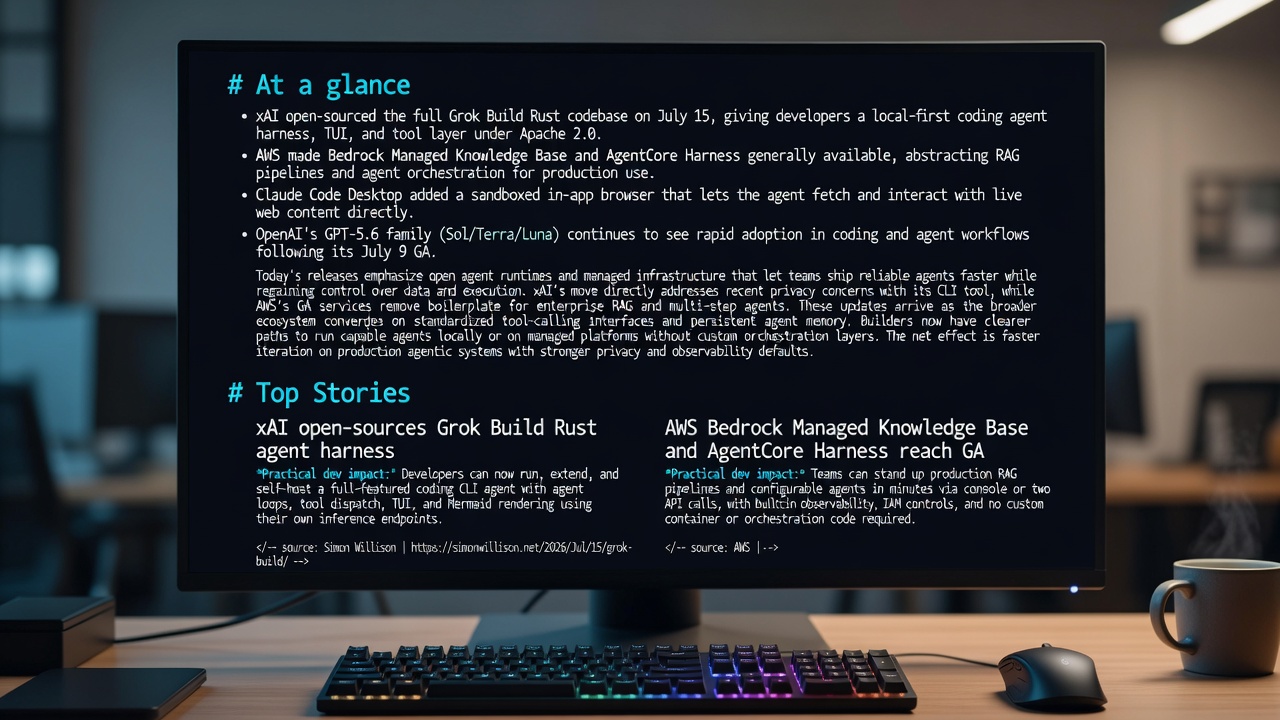
- xAI open-sourced the full Grok Build Rust codebase on July 15, giving developers a local-first coding agent harness, TUI, and tool layer under Apache 2.0.
- AWS made Bedrock Managed Knowledge Base and AgentCore Harness generally available, abstracting RAG pipelines and agent orchestration for production use.
- Claude Code Desktop added a sandboxed in-app browser that lets the agent fetch and interact with live web content directly.
- OpenAI’s GPT-5.6 family (Sol/Terra/Luna) continues to see rapid adoption in coding and agent workflows following its July 9 GA.
Today’s releases emphasize open agent runtimes and managed infrastructure that let teams ship reliable agents faster while regaining control over data and execution. xAI’s move directly addresses recent privacy concerns with its CLI tool, while AWS’s GA services remove boilerplate for enterprise RAG and multi-step agents. These updates arrive as the broader ecosystem converges on standardized tool-calling interfaces and persistent agent memory. Builders now have clearer paths to run capable agents locally or on managed platforms without custom orchestration layers. The net effect is faster iteration on production agentic systems with stronger privacy and observability defaults.
Top Stories
xAI open-sources Grok Build Rust agent harness Practical dev impact: Developers can now run, extend, and self-host a full-featured coding CLI agent with agent loops, tool dispatch, TUI, and Mermaid rendering using their own inference endpoints.
AWS Bedrock Managed Knowledge Base and AgentCore Harness reach GA Practical dev impact: Teams can stand up production RAG pipelines and configurable agents in minutes via console or two API calls, with built-in observability, IAM controls, and no custom container or orchestration code required.
Claude Code Desktop gains sandboxed in-app browser Practical dev impact: The coding agent can now open and interact with documentation, designs, or live sites inside the same session model it uses for local previews, reducing context switching during research-driven tasks.
Cursor reportedly exploring general-purpose agent capabilities Practical dev impact: If confirmed, the editor could expand beyond code into email, spreadsheets, and broader engineering workflows, letting developers stay inside one interface for mixed productivity and coding work.
Practical Impact Analysis
The open-sourcing of Grok Build signals a maturing pattern: frontier labs are releasing the agent runtime and tooling layers while keeping the underlying model closed. This gives developers full visibility into prompt templates, tool implementations, and execution flows—critical for auditing, customization, and local deployment. Combined with AWS’s GA services, teams gain two complementary deployment models: fully managed agent harnesses for enterprise scale and self-hosted runtimes for privacy-sensitive or air-gapped environments.
Claude Code’s in-app browser and the rumored Cursor expansion highlight the shift from narrow code-completion tools to persistent, multimodal agents that maintain context across local files, web resources, and external services. The common thread is standardized tool interfaces (MCP-style) and background sub-agents, which reduce the engineering overhead of building reliable multi-step workflows. For professional engineers, the immediate payoff is faster prototyping of agentic features and clearer paths to production with observability and policy controls already in place.
Recommended Tutorial Idea
Build a minimal local coding agent using the newly open-sourced Grok Build patterns and integrate a simple Mermaid diagram renderer.
Clone the xai-org/grok-build repo, explore the `xai-grok-markdown` and `xai-grok-tools` crates, then extend the renderer or add a custom tool implementation. Run the agent loop locally against any OpenAI-compatible endpoint.
Grok Deep Dive
How does open-sourcing the full Rust agent harness (including prompt templates, tool ports from Codex/Claude/Cursor, and the disabled GCS upload path) change the way teams evaluate and extend third-party coding agents? What practical steps would you take to swap in your own model, add custom skills, or run the TUI entirely offline while preserving the same agent loop and Mermaid rendering behavior?
Grok Deep Dive
Explore each Top Story in Grok — links open in a new tab. On phones, the same link may open the Grok app if you have it installed (via your device's normal link handling).
Article: xAI Open Sources Grok Build as — AI Dev Pulse · Jul 16, 2026
- xAI open-sources Grok Build Rust agent harness
- Practical dev impact:
- AWS Bedrock Managed Knowledge Base and AgentCore Harness reach GA
- Practical dev impact:
Privacy: links open grok.com in your session only. AIDevPulse does not run your prompts through our API.