
At a glance
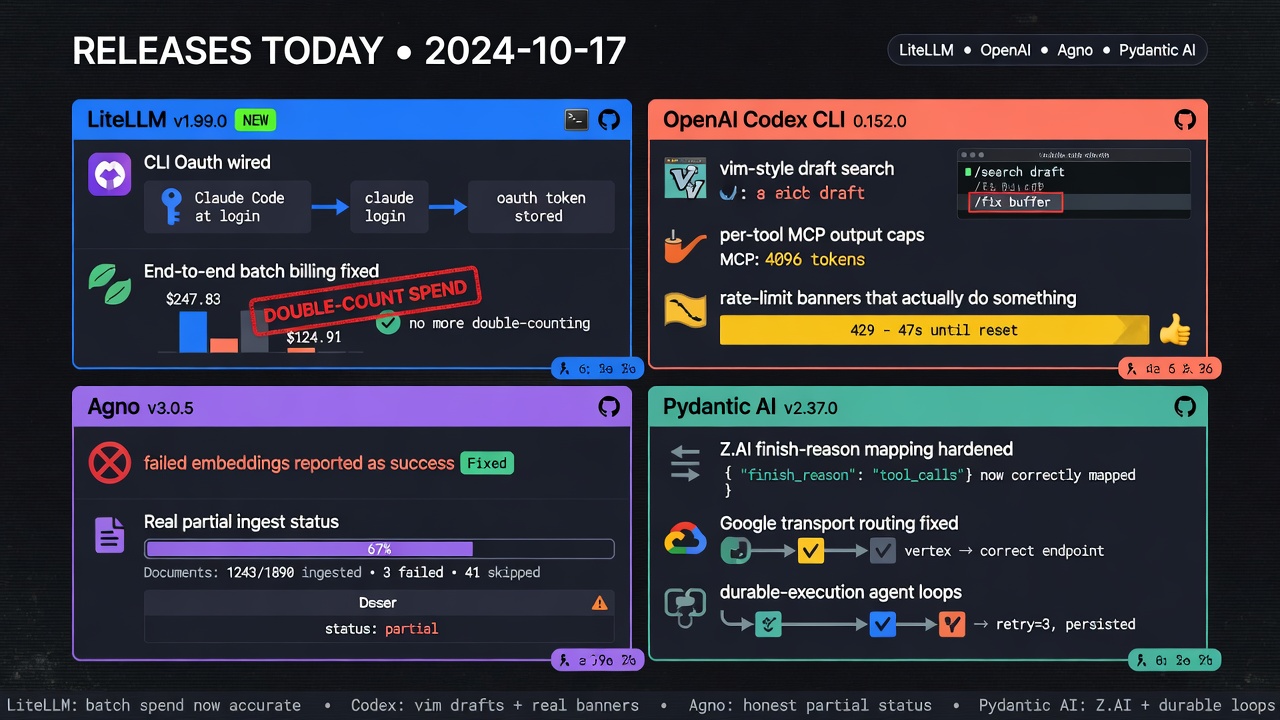
- LiteLLM v1.99.0 landed today with CLI OAuth that wires Claude Code at login, plus end-to-end batch billing that can no longer double-count spend.
- OpenAI Codex CLI 0.152.0 adds vim-style draft search, per-tool MCP output caps, and rate-limit banners that actually do something.
- Agno v3.0.5 stops reporting failed embeddings as successful and introduces a real `partial` ingest status.
- Pydantic AI v2.37.0 hardens Z.AI finish-reason mapping, Google transport routing, and durable-execution agent loops.
September 1 is not a frontier-model day. It is a control-plane day. The drops that shipped in the last 24 hours sit where production teams actually burn money and lose sleep: gateways, coding agents, knowledge ingestion, and typed agent runtimes. LiteLLM’s v1.99.0 stable is the loudest of those — Admin UI on React 19 with a real dark mode, OAuth login that stores refresh tokens in the OS keychain and can configure Claude Code in one pass, and batch accounting that finally treats cancelled or failed jobs as billable when they still produced output. Beside it, Codex CLI 0.152.0 tightens the terminal coding loop: search inside drafts, name MCP servers the way package registries already do, and stop letting a noisy tool dump unbounded tokens into the transcript.
The agent-framework layer moved in the same window. Agno 3.0.5 is a honesty patch for RAG: incomplete embeddings used to look “completed.” They no longer do. Pydantic AI 2.37.0 is quieter but equally practical — provider quirks and durable backends that used to blow up traces now fail in typed, catchable ways. None of this is a keynote. All of it is the difference between a demo that “worked once” and a stack you can leave running over a long weekend.
Top Stories
LiteLLM v1.99.0 ships dark mode, Claude Code OAuth login, and honest batch billing Practical dev impact: Platform teams can upgrade the gateway today, log Claude Code in through a real PKCE flow, and stop arguing about batch invoices that double-bill or ignore cancelled jobs that still wrote tokens. The Admin UI is off antd/Tremor and on React 19, with a light/dark/system toggle. CLI login is authorization-code plus PKCE, credentials in the OS keychain, and `lite login –config-claude` to wire Claude Code at login. Batch spend is end-to-end: enqueued-token rate limits that refund on completion, atomic cost claims so multi-pod polling cannot double-bill, and billing for cancelled and failed batches that still produced output. Provisioned throughput can be declared in `config.yaml`, and the complexity router is now operator-configurable — custom classifier plugins, tier sets, and per-model reasoning effort. Docker images are cosign-signed.Codex CLI 0.152.0 adds vim search, MCP output token limits, and actionable rate-limit banners Practical dev impact: If you live in the Codex TUI, this is the upgrade that stops MCP dumps from eating the context window and lets you jump the rate-limit wall without leaving the terminal. Version 0.152.0 (GitHub tag `rust-v0.152.0`, npm `@openai/codex@0.152.0`) adds `/` and `?` search in vim-mode drafts with `n`/`N` repeat, rate-limit banners that deep-link into usage, credits, resets, and plans, and credential-refresh progress including Amazon Bedrock reauth. MCP server names may contain `:`, `@`, `/`, and `.`. Individual MCP tools take an `output_token_limit`, truncated consistently across session resumes. App-server clients can set thread/shellCommand timeouts past one hour. Planning is off by default (`tools.update_plan.enabled = true` to restore it). Cloud task requests now reject untrusted backend URLs.
Agno v3.0.5 surfaces embedding failures and adds a partial knowledge status Practical dev impact: If your agents search a knowledge base that “ingested fine,” re-run ingest after this upgrade — some of those documents were always incomplete. v3.0.5 is a breaking honesty release: ingestion reports embedding failures instead of success; `ContentStatus` gains `partial` (`processing` / `completed` / `partial` / `failed`); embedders raise `EmbeddingError` instead of returning an empty vector; Bedrock embedding failures are `EmbeddingError`, not `ModelProviderError`; `GET /knowledge/content/{id}/status` returns 404 for missing or non-owned content; `skip_if_exists=True` no longer skips failed or partial rows. Optional retries are off by default: `Knowledge(max_embedding_retries=3, embedding_retry_backoff=1.0)`. Re-ingest now embeds before delete, so a failed rewrite cannot wipe searchable chunks. `MCPTools` accepts static `headers=` on the URL path for Streamable HTTP and SSE.
Pydantic AI v2.37.0 hardens Z.AI catalog support and durable agent backends Practical dev impact: Typed-agent shops on Google Vertex, Z.AI, Temporal, DBOS, or Prefect should bump now — several “it worked in the playground” failure modes are fixed in the runtime, not in your prompt. Tagged v2.37.0 (2026-08-31, published to PyPI around Sep 1), the release adds Z.AI catalog coverage, maps Z.AI’s non-standard `finish_reason` values, routes Vertex vs Gemini by client transport instead of provider name, emits AG-UI `TEXT_MESSAGE_START` for the assistant message that owns tool calls, skips inactive capability hooks in agent tracebacks, and context-manages models rebuilt inside durable operations. Per-run `capabilities=` is rejected on DBOS (matching Temporal). Prefect tool discovery is journaled in tasks. Unmanaged models are no longer rebuilt inside durable capability operations.
Practical Impact Analysis
Treat today as a maintenance window, not a model bake-off. LiteLLM v1.99.0 is the one that changes org-level cost and auth. If Claude Code already points at your proxy via `ANTHROPIC_BASE_URL`, the new CLI OAuth path plus keychain-stored refresh tokens is the difference between a shared virtual key in a wiki and a login flow you can audit. End-to-end batch accounting is the other half: teams running Bedrock or OpenAI batches through the gateway have been living with refunds, cancelled jobs, and multi-pod races that either under-billed or double-billed. Atomic cost claims and “bill output that existed even if the job failed” close that argument. Complexity-router knobs (tier sets, classifier plugins, per-model reasoning effort) belong to platform owners, not app teams — pin a version, shadow-eval, then cut traffic.Codex 0.152.0 is a local-loop upgrade. `output_token_limit` on MCP tools is the feature to turn on first if you attach GitHub, browsers, or log dumpers; unbounded tool output is still the fastest way to blow a coding-agent context. Package-style MCP names reduce the glue you write around scoped registries. Rate-limit banners with actions matter once you are on usage-based coding seats.
Agno’s ingest change will look like a regression in dashboards. It is not. Content that flipped from `completed` to `partial` or `failed` was never fully in the index. Catch `EmbeddingError` at the embedder boundary, enable retries only where the failure is transient (auth failures correctly ignore retry), and stop treating `skip_if_exists` as a correctness guarantee.
Pydantic AI 2.37.0 is the “durable agents don’t lie about their model object” patch. If you fork models inside Temporal/DBOS/Prefect, unmanaged rebuilds and capability flags were a class of heisenbug. Vertex-vs-Gemini routing by transport also kills a common mis-route when the provider string and the actual client disagree.
Tutorial
Upgrade LiteLLM to v1.99.0, verify the signed image, then log Claude Code through the new CLI OAuth path so coding-agent traffic hits your gateway instead of a raw vendor key.1. Pull the signed gateway image (or `pip install ‘litellm[proxy]==1.99.0’` if you run the Python process). 2. Verify the image with the pinned cosign key from the v1.99.0 release. 3. Run a minimal proxy with a virtual key and at least one Claude-compatible deployment. 4. From a developer laptop: `lite login –config-claude`, then confirm Claude Code is aimed at the proxy.
After login, issue one Claude Code turn and confirm the request appears in the LiteLLM spend logs under that virtual key. If you run batches through the same proxy, cancelled jobs that still wrote an output file should now show cost instead of a silent zero — that is the v1.99.0 billing contract, not a dashboard bug.
Grok Deep Dive
Walk me through a production cutover for today (2026-09-01): LiteLLM v1.99.0 as the org gateway (CLI OAuth + `lite login –config-claude`, atomic batch billing, complexity router), Codex CLI 0.152.0 with per-tool MCP `output_token_limit`, Agno v3.0.5 knowledge ingest that now raises `EmbeddingError` and can land in `partial` status, and Pydantic AI v2.37.0 durable-backend fixes. Design a two-week rollout: what to pin, what to shadow-eval, which dashboards will look “worse” because they were lying, and a rollback plan that does not leave Claude Code or Codex pointed at raw vendor keys.Sources
Grok Deep Dive
Explore each Top Story in Grok — links open in a new tab. On phones, the same link may open the Grok app if you have it installed (via your device's normal link handling).
Article: LiteLLM Codex Agno and Pydantic AI Harden Production Agent Control Planes
- LiteLLM v1.99.0 ships dark mode, Claude Code OAuth login, and honest batch billing
- Codex CLI 0.152.0 adds vim search, MCP output token limits, and actionable rate-limit banners
- Agno v3.0.5 surfaces embedding failures and adds a partial knowledge status
- Pydantic AI v2.37.0 hardens Z.AI catalog support and durable agent backends
Privacy: links open grok.com in your session only. AIDevPulse does not run your prompts through our API.