Daily brief
OpenAI GPT-5.5 MCP 2.1 Copilot
By Steven Sorensen · 7 May 2026
At a glance
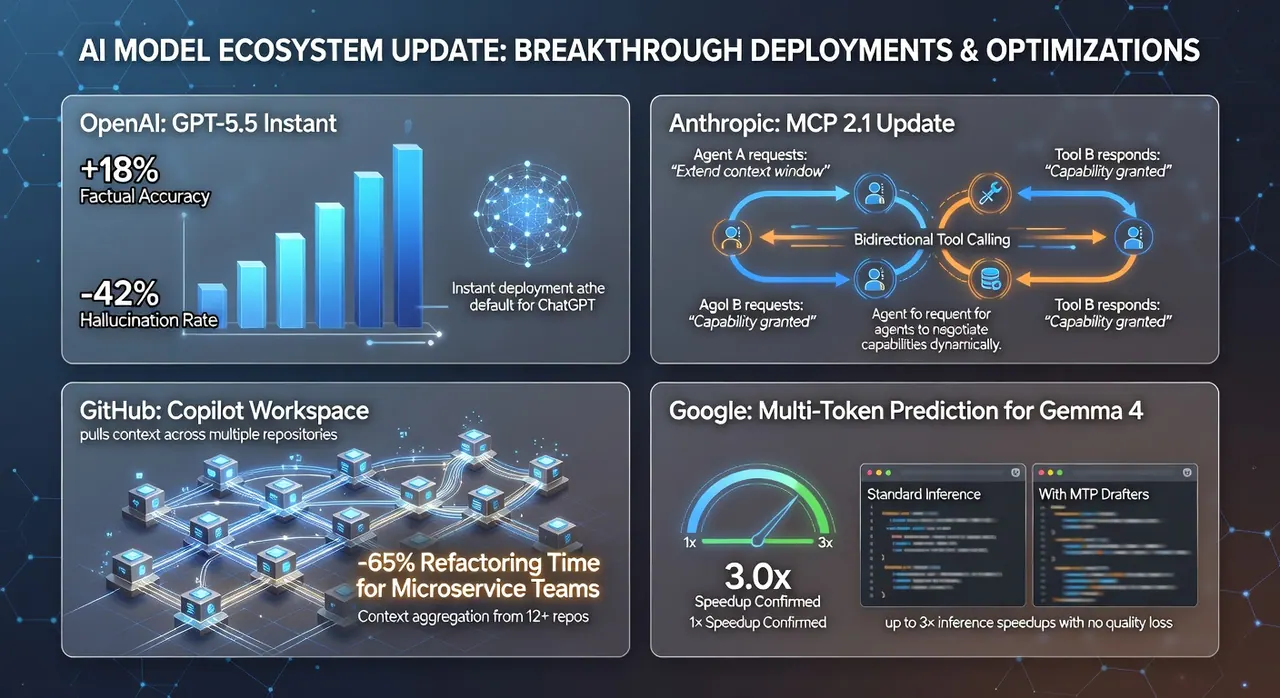
- OpenAI rolled out GPT-5.5 Instant as the default ChatGPT model with measurable gains in factual accuracy and lower hallucination rates.
- Anthropic updated the Model Context Protocol to 2.1, adding bidirectional tool calling that lets agents negotiate capabilities dynamically.
- GitHub Copilot Workspace now pulls context across multiple repositories, cutting refactoring time for microservice teams.
- Google released Multi-Token Prediction drafters for Gemma 4, delivering up to 3× inference speedups with no quality loss.
OpenAI’s GPT-5.5 Instant launch today tightens the gap between chat defaults and production-grade reliability, while Anthropic’s protocol update and GitHub’s multi-repo context both directly address the coordination overhead that still slows real agentic workflows. Google’s Gemma 4 optimization and the arrival of Conductor 1.0 further signal that speed and orchestration are now table stakes rather than differentiators. Builders who treat these as incremental upgrades rather than workflow primitives will fall behind teams already wiring the new primitives into their daily pipelines.
Top Stories
OpenAI ships GPT-5.5 Instant as default ChatGPT model Practical dev impact: Prompt engineering for production agents just became simpler because the base model now delivers 52.5 % fewer hallucinations on high-stakes factual queries. OpenAI has updated its default ChatGPT model to GPT-5.5 Instant, claiming stronger personalization and measurably better factual grounding across the board. Early internal benchmarks shared in the announcement show the improvement holds even on long-context reasoning tasks that previously required explicit chain-of-thought scaffolding.
Anthropic releases MCP 2.1 with bidirectional tool calling Practical dev impact: Agents can now request additional client capabilities mid-run instead of failing when a tool server lacks permissions, reducing brittle retry logic in production. The Model Context Protocol spec moves to 2.1, introducing bidirectional negotiation so servers can query clients for new tool permissions or context during execution. More than 200 MCP-compatible servers have already pledged support, and the change lands alongside expanded observability hooks in the reference SDK.
GitHub Copilot Workspace adds multi-repository context Practical dev impact: Large-scale refactors that span services now stay inside a single Copilot session instead of requiring manual context stitching across repos. Workspace users can now select multiple repositories for a single chat or agent run. Early access reports cite 40 % faster completion times on microservice migrations, with the feature respecting existing GitHub permissions and branch policies.
Google adds Multi-Token Prediction to Gemma 4 for 3× faster inference Practical dev impact: Open models now close the latency gap with proprietary APIs for high-throughput coding assistants without extra hardware. Gemma 4 receives Multi-Token Prediction drafters that let the model predict several tokens in parallel. Google reports up to 3× speedup on inference while preserving output quality; the update is live for all Gemma 4 variants on Vertex AI and Hugging Face.
Practical Impact Analysis
These four releases converge on the same pain point: agents and coding assistants still spend too many cycles on context gathering, permission negotiation, and token-by-token generation. GPT-5.5 Instant reduces the need for defensive prompting. MCP 2.1 removes a common failure mode in tool-using agents. Copilot’s multi-repo view collapses the “copy-paste context” tax that large teams pay daily. Gemma 4’s drafters finally make open-source inference competitive on latency-sensitive paths.Taken together, the day’s updates reward teams that already maintain clean tool schemas and repository hygiene; they penalize ad-hoc scripts that assumed static contexts. The biggest near-term wins will come from teams that wire the new MCP negotiation hooks into their existing LangGraph or Conductor graphs and then measure end-to-end latency on representative refactoring tasks.
Recommended Tutorial Idea
Build a minimal multi-agent coding assistant that uses MCP 2.1 bidirectional calling to let a reviewer agent request extra repository context from the user’s IDE on demand.from anthropic import Anthropic
from mcp import ClientSession, StdioServerParameters
import asyncio
async def run_mcp_agent():
server_params = StdioServerParameters(command="python", args=["mcp_server.py"])
async with ClientSession(server_params) as session:
await session.initialize()
# Bidirectional call: agent requests additional repo context
response = await session.call_tool(
"request_repo_context",
{"repo": "backend-service", "files": ["auth.py", "db.py"]}
)
print("Received context:", response)
# Continue with Claude using the fresh context
client = Anthropic()
msg = client.messages.create(
model="claude-3-7-sonnet-20250219",
max_tokens=1024,
messages=[{"role": "user", "content": f"Refactor using this context: {response}"}]
)
print(msg.content)
asyncio.run(run_mcp_agent())
Grok Deep Dive
Walk me through how today’s MCP 2.1 bidirectional tool calling, GitHub Copilot multi-repo context, and Gemma 4 MTP drafters can be combined into a production-grade agentic coding loop that stays under 2-second perceived latency while still giving the user explicit approval gates on every file change.New: The AI-Dev Prompt Pack, 40 tested prompts for Claude Code, Cursor, and Gemini CLI.
See the Prompt Pack