Daily brief
Production Teams Balance Gemini
By Steven Sorensen · 13 May 2026
At a glance
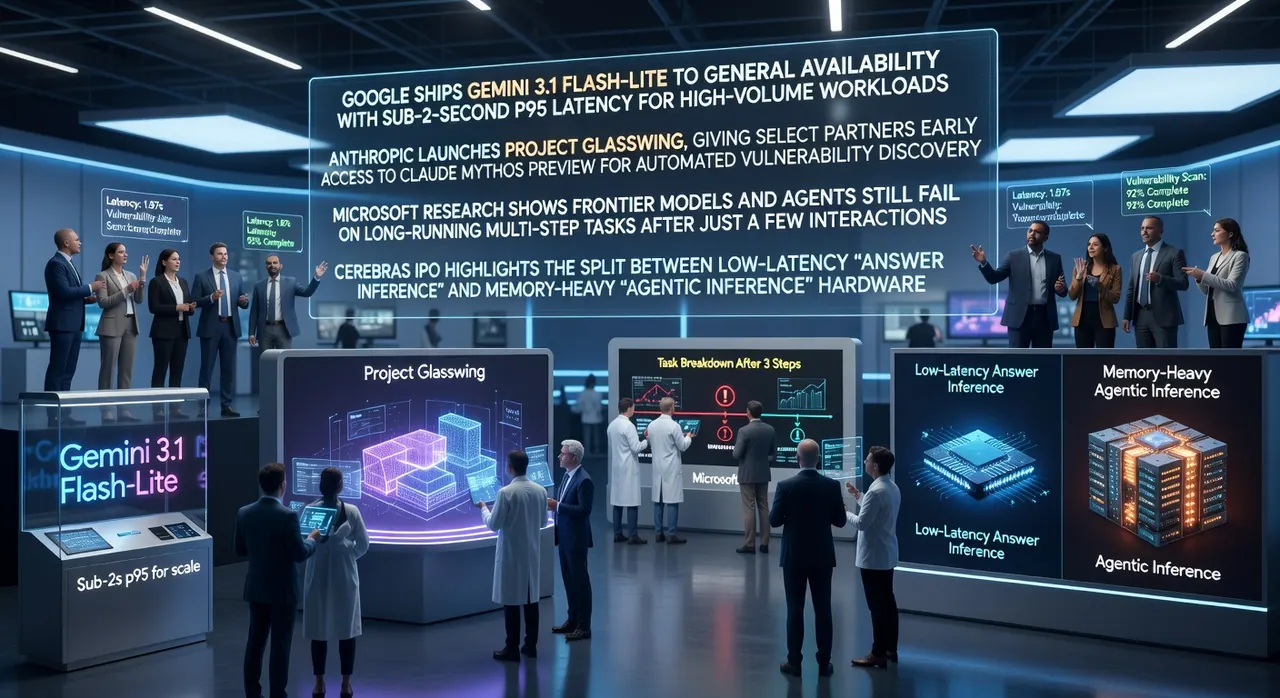
- Google ships Gemini 3.1 Flash-Lite to general availability with sub-2-second p95 latency for high-volume workloads.
- Anthropic launches Project Glasswing, giving select partners early access to Claude Mythos Preview for automated vulnerability discovery.
- Microsoft research shows frontier models and agents still fail on long-running multi-step tasks after just a few interactions.
- Cerebras IPO highlights the split between low-latency “answer inference” and memory-heavy “agentic inference” hardware.
Today’s developer landscape is defined by the tension between raw speed and reliable agency. Google’s new Flash-Lite model lands with concrete latency numbers that matter for real-time services, while Anthropic’s controlled security preview demonstrates how frontier models can surface zero-days that have lingered for decades. At the same time, Microsoft’s latest findings expose the practical ceiling on autonomous agent workflows, and Cerebras’ hardware push signals that inference architecture itself is now a first-class design choice. Builders shipping production systems must therefore choose models and runtimes with explicit trade-offs in latency, context retention, and error accumulation rather than chasing headline benchmarks. These developments arrive against a backdrop of enterprise adoption metrics—Chief AI Officer roles now exist in 76 % of surveyed organizations—making yesterday’s experimental tooling today’s compliance surface.
Top Stories
Google ships Gemini 3.1 Flash-Lite in general availability Google’s ultra-low-latency model targets high-volume, sub-second workloads with a reported p95 of 1.8 s. Practical dev impact: Developers can now route latency-sensitive paths—financial tick feeds, live coding assistants, or real-time validation—directly to a production-ready endpoint without custom distillation or fallback logic.
Anthropic opens Project Glasswing with Claude Mythos Preview Selected partners receive controlled access to a frontier model explicitly tuned for large-scale vulnerability discovery across operating systems and browsers. Practical dev impact: Security teams can integrate the preview into existing SAST pipelines to surface previously unknown logic flaws that traditional scanners miss, shortening the window between disclosure and remediation.
Microsoft researchers publish limits of long-running agent workflows Even top-tier models introduce compounding errors after only a handful of sequential interactions in extended tasks. Practical dev impact: Any production agent loop longer than a few turns now requires explicit human checkpoints, state rollback, or hierarchical decomposition to avoid silent failure modes.
Cerebras WSE-3 architecture targets the inference split The upcoming IPO underscores hardware optimized either for ultra-fast token generation or for agentic workloads that exceed on-chip SRAM. Practical dev impact: Teams running voice or wearable assistants can target low-latency silicon while agent frameworks handling large KV caches must plan for off-chip memory hierarchies from day one.
Practical Impact Analysis
Speed and reliability are no longer orthogonal concerns. Gemini 3.1 Flash-Lite’s general availability gives builders a concrete latency target they can bake into SLAs today, but the same model still inherits the long-context degradation Microsoft documented. Consequently, architects are already designing hybrid routing layers: Flash-Lite for the first hop, heavier models only after state has been explicitly validated. Anthropic’s Glasswing program adds a new class of tooling—model-assisted red teaming—that security engineers can slot into CI without waiting for public releases. At the infrastructure layer, Cerebras’ emphasis on on-chip bandwidth versus off-chip memory forces framework authors to expose explicit memory-hierarchy hints so that agent runtimes can decide at scheduling time whether a workload belongs on WSE-3 or on conventional GPU clusters. The net result is that yesterday’s “just call the API” pattern is being replaced by deliberate topology choices that balance latency, context lifetime, and failure recovery.Recommended Tutorial Idea
Build a latency-aware agent router that falls back from Gemini 3.1 Flash-Lite to a heavier model only after detecting state drift.from google.generativeai import GenerativeModel
import time
flash = GenerativeModel("gemini-3.1-flash-lite")
heavy = GenerativeModel("gemini-3.1-pro")
def run_with_fallback(prompt, max_turns=3):
history = []
for turn in range(max_turns):
start = time.time()
resp = flash.generate_content(prompt + str(history))
latency = time.time() - start
if latency > 1.5 or "I don't know" in resp.text:
resp = heavy.generate_content(prompt + str(history))
history.append(resp.text)
if "TASK_COMPLETE" in resp.text:
return resp.text
return "Escalation required"
print(run_with_fallback("Summarize the latest security advisory and flag any zero-days."))
Grok Deep Dive
Given today’s releases—Gemini 3.1 Flash-Lite GA, Anthropic’s Glasswing security preview, Microsoft’s long-running agent limits, and the Cerebras inference split—how should a production team redesign an existing multi-agent coding assistant to keep p95 latency under 2 s while still catching the zero-day class vulnerabilities that Mythos-style models surface? What concrete routing, checkpointing, and hardware-mapping rules would you implement first?New: The AI-Dev Prompt Pack, 40 tested prompts for Claude Code, Cursor, and Gemini CLI.
See the Prompt Pack