Daily brief
Brockman Consolidates OpenAI
By Steven Sorensen · 17 May 2026
At a glance
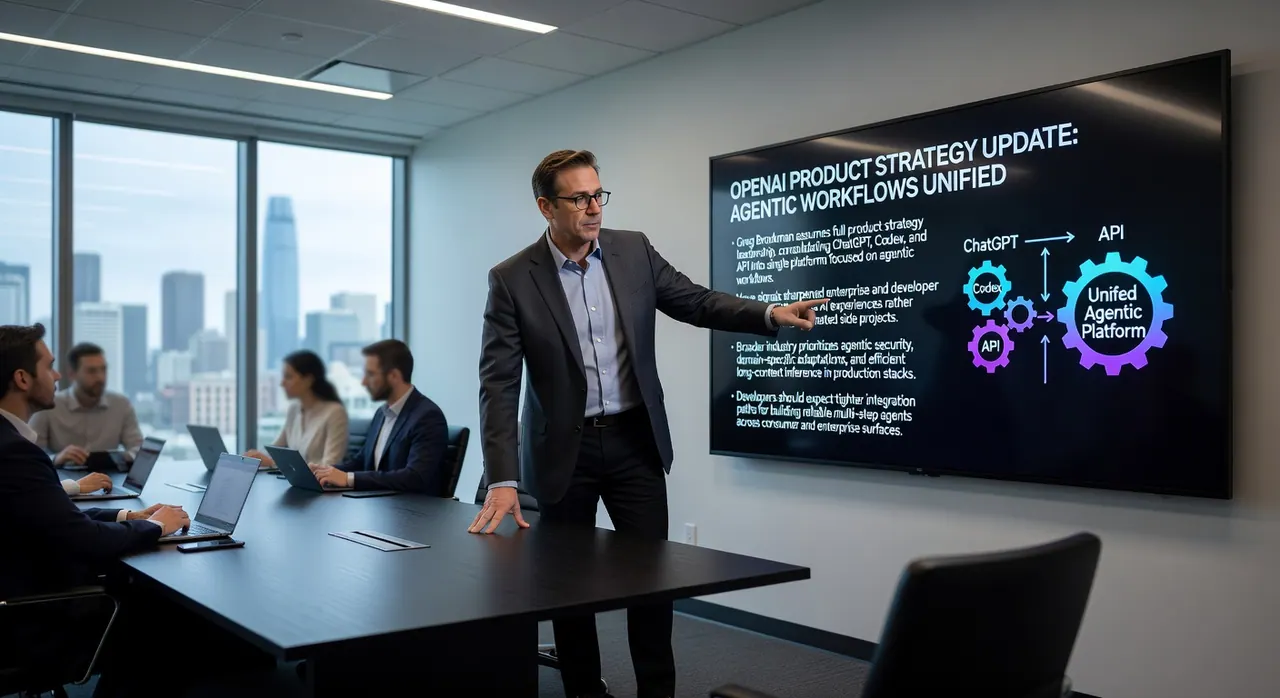
- OpenAI co-founder Greg Brockman officially assumes full product strategy leadership, consolidating ChatGPT, Codex, and the API into a single platform focused on agentic workflows.
- The move signals a sharpened enterprise and developer emphasis on unified AI experiences rather than fragmented side projects.
- Broader industry continues prioritizing agentic security, domain-specific adaptations, and efficient long-context inference in production stacks.
- Developers should expect tighter integration paths for building reliable multi-step agents across consumer and enterprise surfaces.
OpenAI’s latest reorganization lands at a moment when agentic systems are moving from experimental demos to production workloads. With Greg Brockman now permanently steering product direction, the company is explicitly merging its flagship consumer interface, coding product, and developer API under one team. The stated goal—maximum focus on the “agentic future”—directly affects how engineers will build, deploy, and maintain long-running autonomous workflows in the coming months. Meanwhile, the rest of the landscape shows incremental but meaningful progress in specialized models, runtime security tooling, and inference efficiency. These threads converge on a single practical question for builders: how to ship reliable, cost-effective agents without fragmenting across disconnected platforms and models.
Top Stories
Brockman takes permanent control of OpenAI product strategy Practical dev impact: Engineers can now target a single unified ChatGPT + Codex + API surface for agentic coding and enterprise workflows instead of juggling separate product teams and endpoints.
The reorganization folds the consumer ChatGPT experience, the Codex coding product, and the core API into one product organization. Brockman’s internal memo frames the change as consolidation “to execute with maximum focus toward the agentic future, to win across both consumer and enterprise.” Side efforts such as Sora and OpenAI for Science remain paused while resources shift to this core platform.
Agentic AI governance frameworks gain traction across industries Practical dev impact: Teams building autonomous agents must now incorporate cross-industry security and oversight patterns early in the design phase to meet emerging enterprise requirements.
Yale’s Chief Executive Leadership Institute released a governance framework prompted by real-world exposure of models like Anthropic’s Claude Mythos Preview. The document emphasizes human-in-the-loop controls, audit trails, and risk boundaries for agentic systems in high-stakes domains.
Open-source long-context models push agent throughput higher Practical dev impact: Developers can deploy efficient 1 M-token agent loops locally or on modest hardware using recently released hybrid architectures that deliver 2×+ throughput gains over dense baselines.
NVIDIA’s Nemotron 3 Super (120 B total / 12 B active) combines Mamba-Attention MoE with native speculative decoding, achieving up to 2.2× higher throughput than comparable models while supporting 1 M context. The open weights enable rapid experimentation with long-running agentic workflows without API latency or cost spikes.
Practical Impact Analysis
The Brockman-led consolidation removes friction that previously forced developers to maintain separate integration paths for ChatGPT consumer features, Codex-style coding assistance, and raw API calls. Expect faster iteration on unified agent loops that can fluidly switch between conversational context, code generation, and tool use within the same session.
Security and governance updates from Yale and allied agencies reinforce the need for explicit guardrails around autonomous execution. Builders should now treat runtime monitoring, permission scoping, and rollback mechanisms as first-class requirements rather than afterthoughts.
On the infrastructure side, open models like Nemotron 3 Super lower the barrier to running high-context agents on-prem or in private clouds. Teams can prototype long-horizon tasks today and later migrate production traffic to the consolidated OpenAI platform once the unified experience stabilizes. The net effect is a clearer migration path: start with open long-context models for cost-sensitive experimentation, then graduate to the unified OpenAI surface for scale and enterprise features.
Recommended Tutorial Idea
Build a minimal long-running agent that uses the consolidated OpenAI platform for tool orchestration while falling back to a local Nemotron-style model for high-context research steps.
from openai import OpenAI
import requests

client = OpenAI()

def run_agentic_loop(task: str, max_steps: int = 5):
    messages = [{"role": "user", "content": task}]
    for step in range(max_steps):
        response = client.chat.completions.create(
            model="gpt-5.5",  # unified Codex/ChatGPT surface
            messages=messages,
            tools=[{"type": "function", "function": {"name": "web_search"}}],
        )
        # ... handle tool calls, append results, continue loop
    return messages[-1]["content"]

print(run_agentic_loop("Research and summarize latest agentic security best practices"))
Grok Deep Dive
Given today’s OpenAI reorg under Brockman and the push toward unified agentic platforms, what concrete migration steps would you recommend for a team already running production agents on separate ChatGPT and Codex endpoints—especially around preserving session state, tool schemas, and cost controls when everything collapses into one product surface?
New: The AI-Dev Prompt Pack, 40 tested prompts for Claude Code, Cursor, and Gemini CLI.
See the Prompt Pack