At a glance
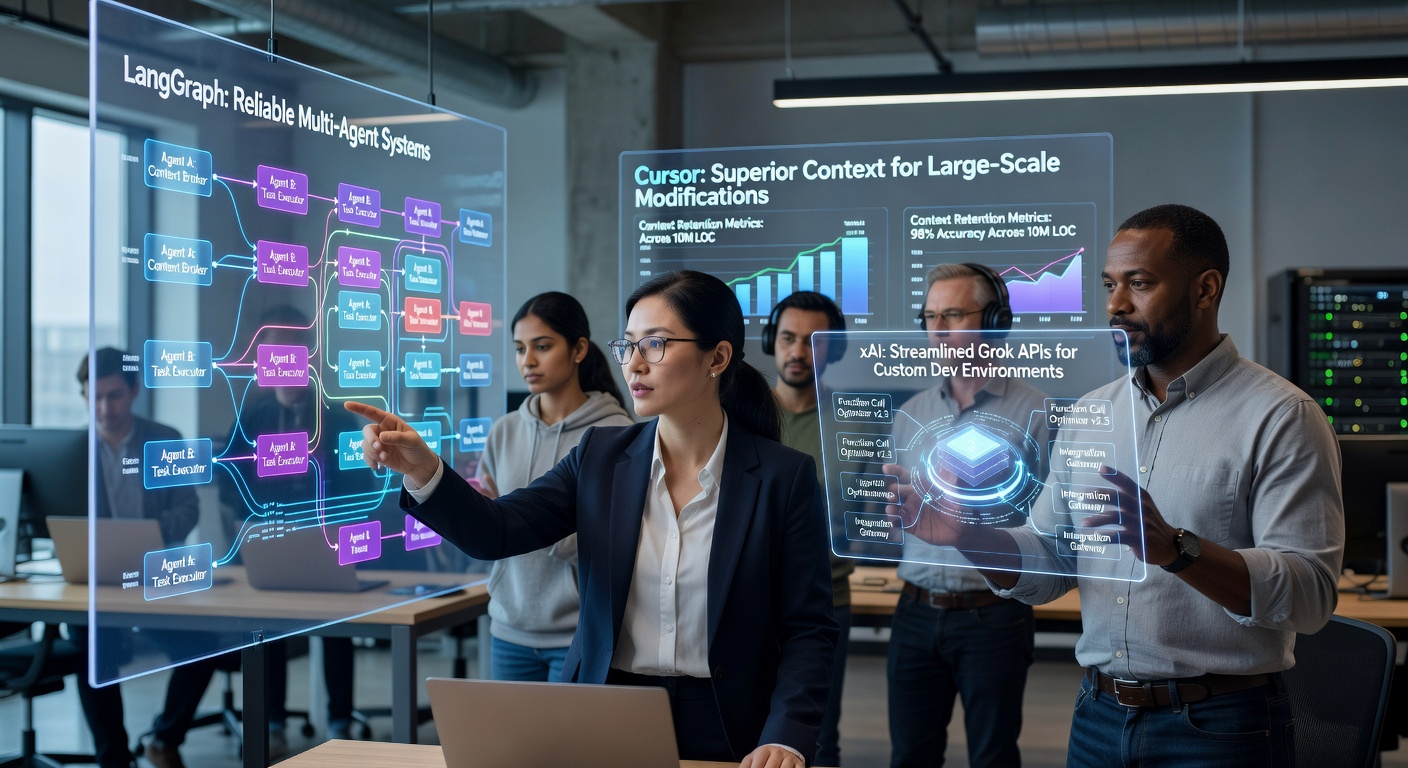
- Cursor's latest agent updates focus on superior context retention for large-scale code modifications.
- LangGraph's new orchestration tools simplify building reliable multi-agent applications.
- Grok's enhanced API features streamline integration into custom development environments.
- Combined use of these technologies enables developers to create sophisticated automated coding workflows.
The AI development ecosystem continues to mature rapidly as of April 2026, with leading platforms placing greater emphasis on practical agentic coding capabilities that integrate directly into daily developer workflows. Cursor has iterated on its core agent tools to better support sustained context across extensive codebases, addressing one of the most persistent friction points in autonomous refactoring and feature implementation. Simultaneously, the LangGraph team has strengthened primitives for coordinating multiple specialized agents, enabling more resilient systems that can recover from errors and dynamically adjust task routing without constant human supervision. xAI has refined Grok’s function-calling and structured-output behaviors specifically for software engineering contexts, making it easier to embed the model into IDE extensions, CI pipelines, and internal tooling.
These updates arrive at a time when organizations are moving beyond single-agent experiments toward orchestrated multi-agent teams that handle end-to-end development tasks. The improvements focus less on raw model intelligence and more on reliability, observability, and seamless handoff between human developers and AI collaborators. For teams already invested in the Cursor IDE or LangChain ecosystem, the changes lower the barrier to productionizing agentic workflows while highlighting the growing importance of thoughtful prompt design, state persistence strategies, and evaluation frameworks. Developers who master these evolving patterns stand to achieve significant gains in velocity, though success still depends on careful system design rather than simply adopting the latest features. This edition examines the most relevant updates, analyzes their practical implications for engineering organizations, and provides a concrete tutorial for building a basic multi-agent code review system.
Top Stories
Cursor Advances Context Retention in Agent Mode Per the April 2026 changelog on cursor.com, recent enhancements improve how agents maintain awareness of project conventions and prior decisions across multi-file edits. This reduces repetitive clarification requests and supports longer, more complex autonomous tasks. The practical impact for developers is faster iteration on large refactors and feature additions, allowing teams to delegate higher-level objectives while retaining control through natural language checkpoints.LangGraph Strengthens Multi-Agent Orchestration Patterns Updates documented in the LangGraph repository introduce more robust supervisor and routing capabilities for teams of specialized agents. These changes emphasize error recovery loops and dynamic task delegation, making it simpler to construct systems where agents can hand off work intelligently. Development teams building internal tools or automated pipelines benefit from reduced boilerplate and more predictable behavior when scaling beyond single-agent implementations.
xAI Refines Grok Function Calling for Engineering Use Cases xAI’s latest API documentation highlights improved reliability in structured outputs and tool selection when Grok is used for code-related tasks. The refinements align model behavior more closely with common developer patterns such as test generation, documentation, and API integration. This enables smoother incorporation of Grok into custom IDE plugins and CI/CD agents without extensive post-processing or validation layers.
Practical Impact Analysis
The updates from Cursor, LangGraph, and xAI collectively signal a shift toward production-grade agentic development rather than isolated experiments. Cursor’s context retention improvements directly address a core limitation that has historically forced developers to break large tasks into smaller, manually orchestrated pieces. By sustaining awareness of architectural decisions and coding standards, the IDE now supports scenarios where an agent can realistically own an entire ticket from analysis through implementation and basic testing. This has immediate implications for mid-sized engineering teams: senior developers can spend less time on mechanical reviews and more on system design, while junior engineers receive higher-quality starting implementations that respect project norms.LangGraph’s enhanced orchestration patterns complement these IDE-level gains by providing a reliable framework for scenarios that exceed single-agent capacity. The supervisor improvements allow teams to define clear hierarchies—perhaps a planner agent that decomposes requirements, specialist agents that implement frontend or backend components, and a critic agent that validates consistency. Because these patterns now include better native support for persistence and recovery, organizations can deploy such systems in CI environments where failures must not derail entire pipelines. The combination of Cursor’s interactive editing strengths with LangGraph’s programmatic coordination creates a spectrum of options: interactive agents inside the IDE for exploratory work and autonomous graph-based agents for repeatable, auditable processes.
Grok’s refined function calling further lowers integration costs. Teams already using the xAI platform can now embed more capable coding assistants into proprietary tools with less custom glue code. This is particularly relevant for organizations concerned about data privacy or those seeking alternatives to models trained heavily on public repositories. The net effect across these developments is a measurable expansion of what constitutes a realistic autonomous development workload in 2026. However, new challenges emerge around observability, cost management of long-running agent sessions, and the skills required to debug agent graphs when they produce unexpected outcomes.
Engineering leaders should prioritize building evaluation harnesses that measure not just code correctness but also adherence to team standards and architectural coherence. Early adopters are combining Cursor for rapid prototyping, LangGraph for production orchestration, and selective use of Grok where its reasoning strengths provide differentiation. The most successful implementations treat these tools as collaborative participants rather than replacements, maintaining human oversight at key decision gates. As these platforms continue to converge on common patterns, the competitive advantage will increasingly belong to teams that excel at prompt engineering, state modeling, and systematic evaluation of agent outputs.
Recommended Tutorial Idea
Build a basic multi-agent code review system using LangGraph that assigns specialized roles for bug detection, security scanning, and style compliance before synthesizing final recommendations. The following runnable example demonstrates a simple supervisor graph. Replace placeholder API keys and model names with your actual credentials.Grok Deep Dive
Explore each Top Story in Grok — links open in a new tab. On phones, the same link may open the Grok app if you have it installed (via your device's normal link handling).
Article: AI Dev Pulse–2026-04-27
- Cursor Advances Context Retention in Agent Mode
- LangGraph Strengthens Multi-Agent Orchestration Patterns
- xAI Refines Grok Function Calling for Engineering Use Cases
Privacy: links open grok.com in your session only. AIDevPulse does not run your prompts through our API.