
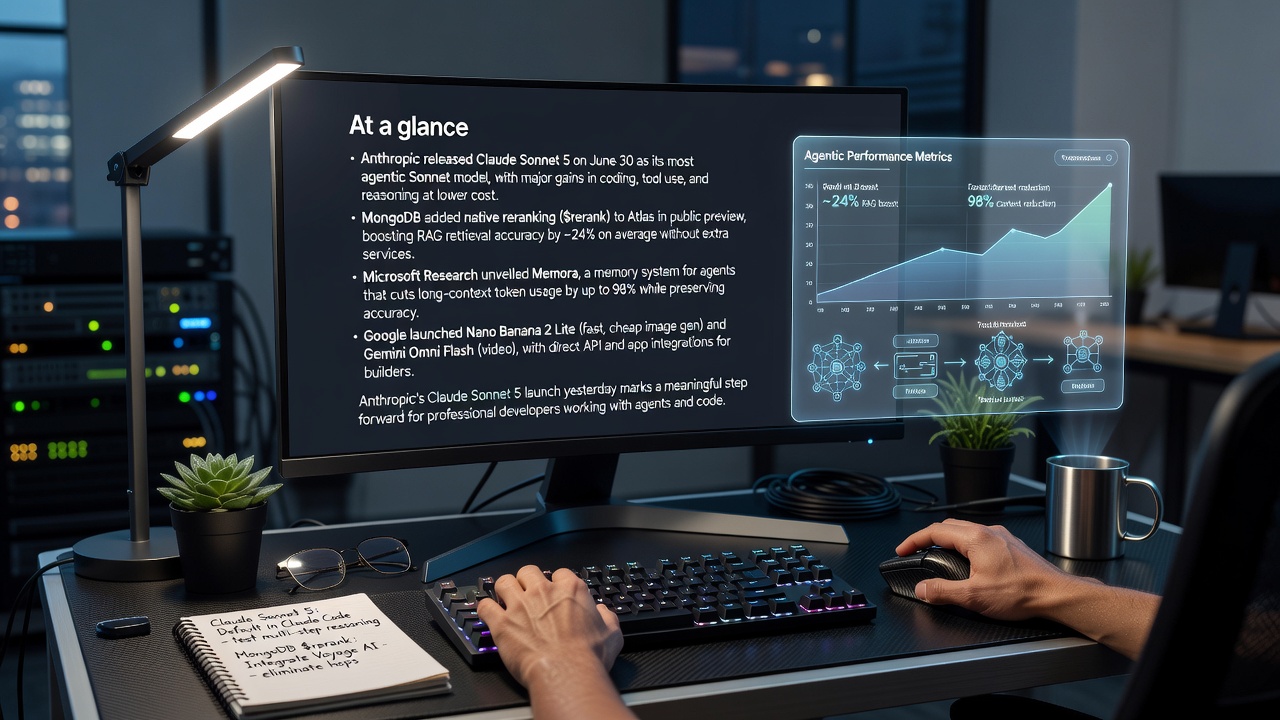
At a glance
## At a glance – Anthropic released Claude Sonnet 5 on June 30 as its most agentic Sonnet model, with major gains in coding, tool use, and reasoning at lower cost. – MongoDB added native reranking ($rerank) to Atlas in public preview, boosting RAG retrieval accuracy by ~24% on average without extra services. – Microsoft Research unveiled Memora, a memory system for agents that cuts long-context token usage by up to 98% while preserving accuracy. – Google launched Nano Banana 2 Lite (fast, cheap image gen) and Gemini Omni Flash (video), with direct API and app integrations for builders.
Anthropic’s Claude Sonnet 5 launch yesterday marks a meaningful step forward for professional developers working with agents and code. The new model delivers performance close to higher-tier Opus variants while lowering API costs and becoming the default across Free and Pro tiers. It ships with explicit improvements in tool calling, multi-step reasoning, and knowledge work, and it is already the recommended model inside Claude Code.
Parallel infrastructure updates make production AI systems easier to operate. MongoDB’s native reranking stage folds Voyage AI models directly into the aggregation pipeline, eliminating separate API hops and credential management for RAG and agent retrieval. Microsoft’s Memora research project tackles the persistent memory bottleneck in long-running agents by using abstraction and cue-based lookup rather than raw history, promising dramatically smaller context windows.
Google’s media model releases add efficient image and video generation options that integrate cleanly into existing Gemini workflows and agent platforms. Together these changes signal a shift toward more composable, cost-efficient building blocks that reduce friction between frontier models, retrieval layers, and persistent agent state.
Top Stories
Claude Sonnet 5 becomes default model with agentic upgrades Practical dev impact: Developers can now route coding and agent workloads to a single model that approaches Opus-level tool use and reasoning at Sonnet pricing, with immediate availability in Claude Code and the Anthropic API.
MongoDB Atlas adds native $rerank stage Practical dev impact: RAG and agent retrieval pipelines can now include Voyage reranking inside the same aggregation query, cutting external calls and improving result quality by double-digit percentages with no additional infrastructure.
Microsoft Research releases Memora memory framework Practical dev impact: Agent builders gain a drop-in approach to long-horizon memory that slashes token consumption by up to 98% while matching full-context performance, easing scaling of persistent assistants.
Google ships Nano Banana 2 Lite and Gemini Omni Flash Practical dev impact: Teams can add low-latency image generation and conversational video editing to agents or apps via the Gemini API at competitive per-image and per-second pricing.
Practical Impact Analysis
These releases lower the activation energy for production-grade agent systems. Claude Sonnet 5’s improved tool use and lower price point make it practical to run more autonomous loops inside existing codebases without immediately jumping to the most expensive frontier tier. When paired with Claude Code’s new goal-based and proactive loop guidance, teams can prototype reliable multi-step agents faster.
MongoDB’s in-database reranking removes a common operational tax on RAG pipelines. Developers no longer need to orchestrate separate embedding, vector search, and reranker services; the single $rerank stage delivers measurable accuracy lifts while keeping billing and monitoring inside Atlas. This simplification matters most for enterprises scaling retrieval-augmented agents across multiple domains.
Memora addresses the context-window explosion that currently limits agent longevity. By separating stored knowledge from retrieval cues, it lets agents maintain coherent state over hours or days of interaction without exhausting token budgets. Early adopters building on Microsoft’s agent platforms will be the first to test the approach in production.
Google’s media models fill the remaining gap in multimodal agent output. Low-cost image generation and controllable video editing can now be invoked natively inside Gemini-powered workflows, enabling agents that not only reason but also produce visual artifacts without additional vendor hops.
Recommended Tutorial Idea
Build a goal-based agent loop with Claude Sonnet 5, native MongoDB reranking, and Memora-style memory abstraction.
Grok Deep Dive
Claude Sonnet 5 just dropped with strong coding and agentic tool-use gains, MongoDB folded reranking into Atlas, Microsoft published Memora for efficient long-term agent memory, and Google released cheap image/video models. How would you combine Sonnet 5’s tool calling with MongoDB’s native $rerank and a Memora-style abstraction layer to build a persistent research or coding agent that runs for hours without exploding context? What benchmarks or failure modes would you test first?
Grok Deep Dive
Explore each Top Story in Grok — links open in a new tab. On phones, the same link may open the Grok app if you have it installed (via your device's normal link handling).
Article: Claude Sonnet 5 Memora MongoDB — AI Dev Pulse · Jul 01, 2026
- Claude Sonnet 5 becomes default model with agentic upgrades
- Practical dev impact:
- MongoDB Atlas adds native $rerank stage
- Practical dev impact:
Privacy: links open grok.com in your session only. AIDevPulse does not run your prompts through our API.