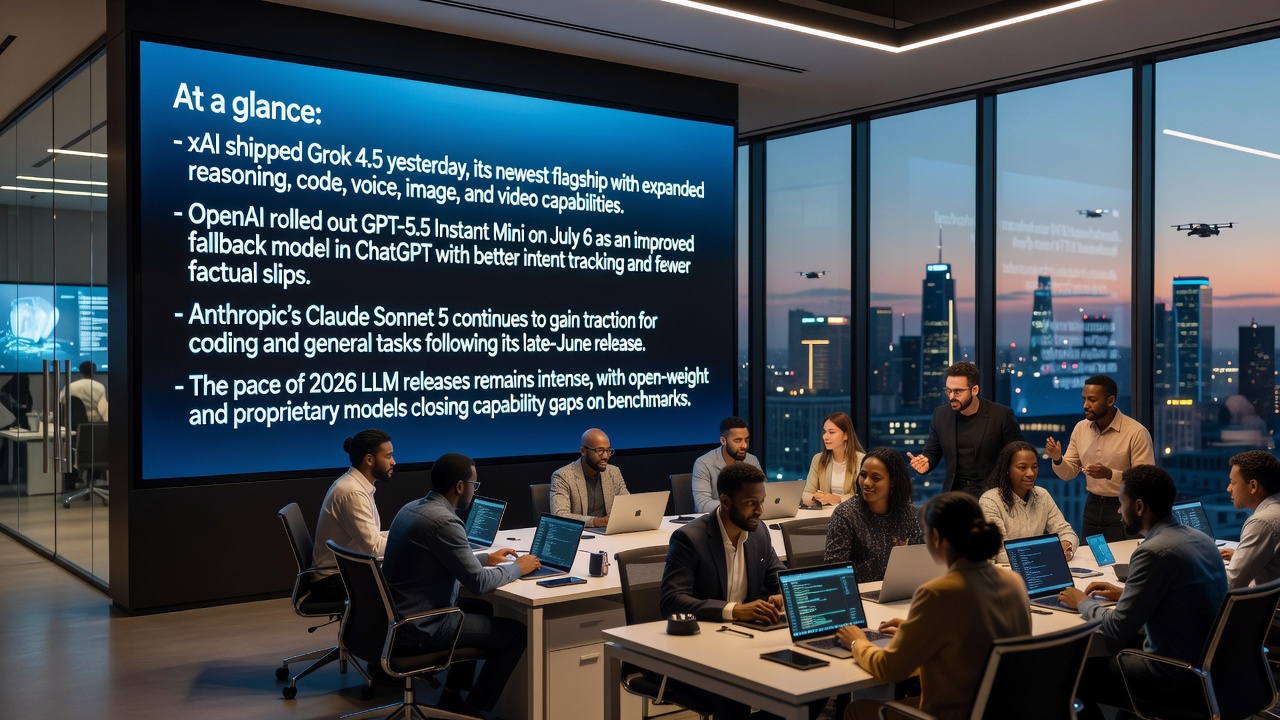
At a glance
- xAI shipped Grok 4.5 yesterday, its newest flagship with expanded reasoning, code, voice, image, and video capabilities.
- OpenAI rolled out GPT-5.5 Instant Mini on July 6 as an improved fallback model in ChatGPT with better intent tracking and fewer factual slips.
- Anthropic’s Claude Sonnet 5 continues to gain traction for coding and general tasks following its late-June release.
- The pace of 2026 LLM releases remains intense, with open-weight and proprietary models closing capability gaps on benchmarks.
Today’s developer landscape is defined by rapid iteration at the frontier. xAI’s Grok 4.5 launch on July 8 marks the latest high-signal release, building on the company’s expanding supercluster infrastructure and real-time X data access. OpenAI’s incremental GPT-5.5 Instant Mini update refines fallback behavior without touching the API surface, while Anthropic’s Sonnet 5 strengthens its position in coding workflows. These moves underscore a broader trend: models are maturing faster than tooling ecosystems can fully absorb them, forcing engineers to evaluate integration, cost, and agentic patterns on compressed timelines. Builders who track primary release notes and benchmark deltas will extract the most immediate value.
Top Stories
xAI releases Grok 4.5 flagship model Practical dev impact: Developers gain a new API-accessible model strong in reasoning, code generation, and multimodal tasks trained on the largest current supercluster.OpenAI deploys GPT-5.5 Instant Mini in ChatGPT Practical dev impact: Chat users hitting rate limits now encounter a fallback with improved user-intent tracking, tone calibration, and reduced repetition or factual errors.
Anthropic advances Claude Sonnet 5 adoption Practical dev impact: Engineering teams report stronger performance on coding and creative tasks compared with prior Sonnet iterations, accelerating evaluation cycles for agentic workflows.
Model release velocity shows no signs of slowing Practical dev impact: Teams must maintain lightweight evaluation harnesses and cost-modeling scripts as new open-weight and proprietary options appear weekly.
Practical Impact Analysis
The Grok 4.5 release immediately expands options for teams needing strong native multimodal and real-time data grounding without heavy custom retrieval layers. Its timing, one day before this brief, highlights how frontier labs are compressing release cadences, pushing developers to treat model selection as an ongoing optimization rather than a quarterly decision. OpenAI’s GPT-5.5 Instant Mini change is narrower but still relevant for product teams relying on ChatGPT as a user-facing surface; the fallback improvements reduce visible quality drops during peak usage. Claude Sonnet 5’s continued momentum reinforces Anthropic’s edge in structured coding assistance, which many agent frameworks now route through preferentially.Collectively these updates pressure engineering organizations to maintain flexible provider abstractions and token-budget monitoring. The broader 2026 pattern—hundreds of releases already tracked—means benchmark chasing alone is insufficient; production systems need reproducible evaluation suites that can incorporate new models within days. Teams ignoring cost-per-token shifts or context-window differences risk sudden budget or latency surprises when routing traffic to the newest flagships.
Recommended Tutorial Idea
Build a minimal multi-model router that falls back from Grok 4.5 to GPT-5.5 Instant Mini based on simple latency and error heuristics. This pattern lets teams experiment with the newest release while maintaining reliability.Grok Deep Dive
With Grok 4.5 now live alongside recent OpenAI and Anthropic drops, how should teams structure a lightweight A/B evaluation harness that measures coding accuracy, latency, and cost across these three providers on the same SWE-bench subset while keeping total daily spend under a fixed budget?Grok Deep Dive
Explore each Top Story in Grok — links open in a new tab. On phones, the same link may open the Grok app if you have it installed (via your device's normal link handling).
Article: 2026 LLM Release Velocity — AI Dev Pulse · Jul 09, 2026
- xAI releases Grok 4.5 flagship model
- Practical dev impact:
- OpenAI deploys GPT-5.5 Instant Mini in ChatGPT
- Practical dev impact:
Privacy: links open grok.com in your session only. AIDevPulse does not run your prompts through our API.