At a glance
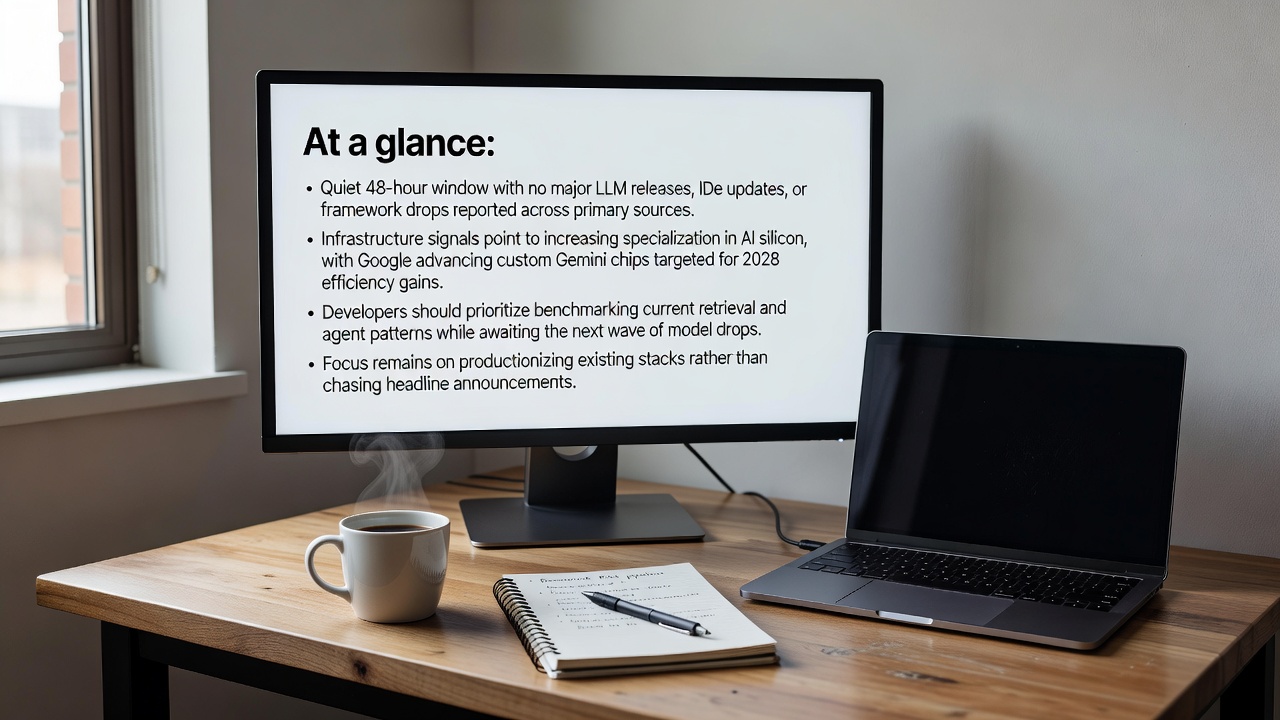
- Quiet 48-hour window with no major LLM releases, IDE updates, or framework drops reported across primary sources.
- Infrastructure signals point to increasing specialization in AI silicon, with Google advancing custom Gemini chips targeted for 2028 efficiency gains.
- Developers should prioritize benchmarking current retrieval and agent patterns while awaiting the next wave of model drops.
- Focus remains on productionizing existing stacks rather than chasing headline announcements.
The past two days have been unusually sparse for high-impact AI developer news. No new model weights, API tiers, or coding-assistant features surfaced from the usual suspects—OpenAI, Anthropic, Google, Meta, or xAI—nor from the tooling layer around LangGraph, Cursor, or Copilot. This lull is not uncommon in mid-summer cycles and gives teams breathing room to harden what they already have in production.
One modest infrastructure signal did appear on X: Google is iterating on a Gemini-specific chip family (“Frozen V2”) aimed at 6–10× efficiency improvements, with server deployment slated for 2028. While not an immediate code change, it underscores the industry-wide shift from general-purpose GPUs toward workload-optimized silicon—an evolution that will eventually affect cost curves for inference-heavy applications.
Top Stories
Google advances custom silicon roadmap for Gemini workloads Practical dev impact: Expect future inference cost reductions and new deployment targets once specialized chips reach production, but no code changes are required today.
Practical Impact Analysis
With no fresh releases to integrate, engineering teams gain time to audit latency, token usage, and retrieval quality in existing RAG and agent pipelines. The Google chip signal reinforces that hardware specialization is accelerating; developers running large-scale inference should begin modeling cost scenarios around future TPU-like accelerators rather than assuming continued reliance on off-the-shelf GPUs. In the interim, the absence of noise is an opportunity to ship incremental reliability improvements—better observability around agent traces, tighter evaluation harnesses, and migration planning for any pending context-window expansions announced earlier this month. Teams that treat quiet periods as optimization sprints will be better positioned when the next model wave arrives.Recommended Tutorial Idea
Build a lightweight inference-cost simulator that factors in projected efficiency gains from specialized silicon.Grok Deep Dive
Given the current quiet period and the emerging custom-silicon trend, what practical steps would you recommend for a mid-size team to benchmark their inference workloads against projected 2028 efficiency gains while keeping today’s stack unchanged?Sources
Grok Deep Dive
Explore each Top Story in Grok — links open in a new tab. On phones, the same link may open the Grok app if you have it installed (via your device's normal link handling).
Article: Google Targets 2028 Gemini Chip — AI Dev Pulse · Jul 22, 2026
Privacy: links open grok.com in your session only. AIDevPulse does not run your prompts through our API.