Daily brief
Pentagon AI Deals Push
By Steven Sorensen · 3 May 2026
At a glance
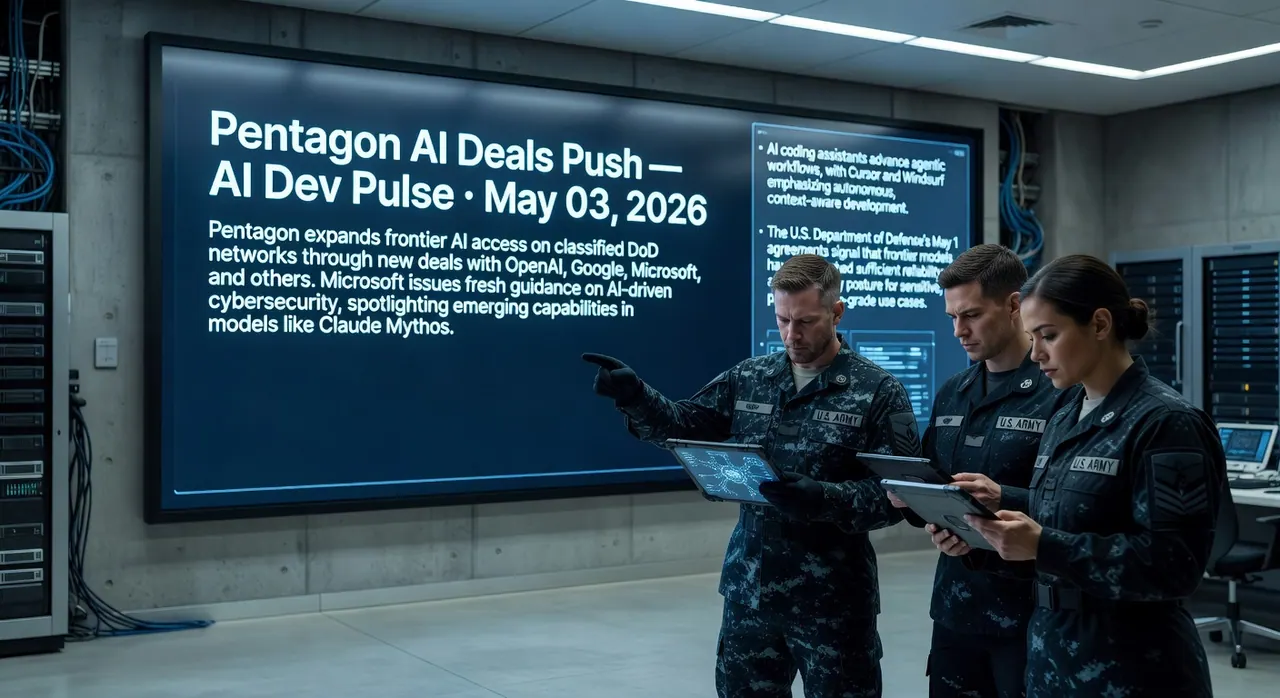
- Pentagon expands frontier AI access on classified DoD networks through new deals with OpenAI, Google, Microsoft, and others.
- Microsoft issues fresh guidance on AI-driven cybersecurity, spotlighting emerging capabilities in models like Claude Mythos.
- AI news covers ongoing model and infrastructure developments, shifting emphasis to tooling and governance.
- AI coding assistants advance agentic workflows, with Cursor and Windsurf emphasizing autonomous, context-aware development.
In a relatively quiet news cycle for raw model drops, today’s developments underscore the AI ecosystem’s maturation for professional developers. The U.S. Department of Defense’s May 1 agreements signal that frontier models have reached sufficient reliability and security posture for sensitive, production-grade use cases. This move broadens access beyond previous restrictions while highlighting ongoing vendor dynamics around safeguards.
Microsoft’s concurrent security briefing reinforces that builders must treat AI not just as a productivity layer but as a core component of zero-trust architectures, especially as agentic systems proliferate. With Google I/O’s developer keynote just weeks away, expect deeper integrations for multimodal and long-context workflows that will land in everyday IDEs and frameworks. For engineers, the takeaway is clear: optimize for compliance, observability, and agent orchestration rather than chasing incremental benchmark gains. Existing tools like Cursor’s sub-agents and background processing are already positioned to absorb these shifts without major retooling.
Top Stories
Pentagon Expands Access to Frontier AI Models on Classified Networks Practical dev impact: Defense and enterprise developers working on secure systems now gain direct production access to models from OpenAI, Google, NVIDIA, and others via classified environments.
Microsoft Outlines Next-Generation AI Security Practices Practical dev impact: Developers must integrate AI-accelerated vulnerability detection and agentic control-plane hardening into workflows to meet emerging enterprise and government standards.
Google Schedules I/O 2026 Developer Keynote for May 19 Practical dev impact: Builders can prepare for hands-on sessions and new AI tooling that will accelerate productivity in coding, debugging, and multimodal application development.
LLM Tracking Sites Report Zero New Releases in Past 24 Hours Practical dev impact: Teams should double down on optimizing existing models through better retrieval, agent orchestration, and IDE integrations rather than waiting for the next base model.
Practical Impact Analysis
These updates collectively mark a transition from model-centric hype to infrastructure and governance maturity. The Pentagon’s classified-network agreements demonstrate that providers have hardened enough for high-stakes environments, reducing friction for contractors and government-adjacent teams who previously navigated fragmented access. This stability should translate into more predictable pricing and SLAs for cloud AI services like Azure AI and AWS Bedrock.Microsoft’s emphasis on AI-augmented cybersecurity forces a reevaluation of agent frameworks: LangGraph, CrewAI, and similar stacks now require explicit observability layers and non-human identity controls to prevent cascading failures in production. Developers building long-running agents should prioritize audit logs, sandboxed execution, and integration with existing zero-trust pipelines.
The absence of fresh LLM drops keeps the spotlight on tooling. Cursor’s sub-agents and Windsurf’s autonomous flows support multi-file refactoring and background task handling. Teams can prepare for new AI tooling from Google I/O that will accelerate productivity in coding and multimodal development. Overall, the signal for builders is to invest in secure, observable agent architectures and custom rulesets that future-proof workflows against the next wave of compliance requirements.
Recommended Tutorial Idea
Securely Configuring Cursor for Agentic Coding with Custom Project RulesThis tutorial shows how to leverage Cursor’s `.cursorrules` system to enforce security-first behaviors in autonomous coding sessions, directly addressing the enterprise and government security themes from today’s news.
1. Update to the latest Cursor release and open your project root. 2. Create a `.cursorrules` file at the project root (plain text or Markdown). 3. Define rules that prioritize secure patterns, input sanitization, and observability. 4. In Cursor chat or Composer, reference the rules implicitly by starting prompts with project context. 5. Test with a multi-file task and review the AI’s adherence in the diff view. 6. Commit the rules file to git for team-wide consistency.
# .cursorrules
You are a senior security-focused software engineer.
- Always validate and sanitize all inputs and outputs.
- Prefer least-privilege patterns and avoid hard-coded secrets.
- Include logging and observability hooks for every new function or agent step.
- Use environment variables for configuration; never commit keys.
- When suggesting code, provide a brief security review comment block.
- For agentic tasks, break them into small, auditable steps with clear failure modes.
After setup, your next Composer prompt might read: “Refactor the auth module using the project rules.”
Grok Deep Dive
With the Pentagon broadening classified access to models like GPT and Gemini alongside Microsoft’s push for AI-native cybersecurity, how should developers redesign agentic workflows for compliance and resilience? Consider practical implementations in Cursor or Windsurf that incorporate custom rules, observability, and zero-trust principles—then explore extensions for multi-agent systems that could support government or enterprise deployments.New: The AI-Dev Prompt Pack, 40 tested prompts for Claude Code, Cursor, and Gemini CLI.
See the Prompt Pack