Daily brief
Agent Layer Matures Into
By Steven Sorensen · 4 May 2026
At a glance
## At a glance
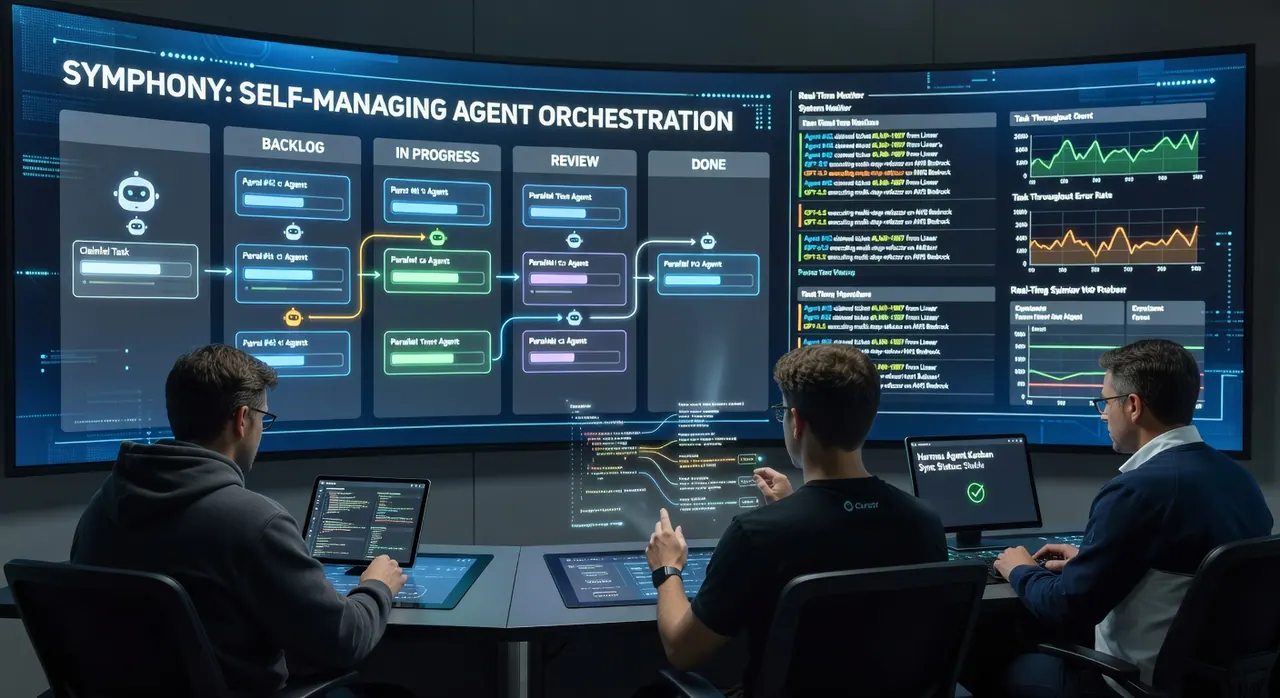
- OpenAI released Symphony today, enabling agents to autonomously pull tasks from Linear and execute without constant human oversight.
- Hermes Agent introduced a durable Kanban board for multi-agent collaboration, with parallel task claiming and handoffs.
- GPT-5.5 continues its rollout, now live on AWS Bedrock alongside managed agents.
- Cursor’s Background Agents and Subagents, paired with emerging IDEs, are reshaping how developers orchestrate autonomous coding workflows.
Developers spent the last 48 hours watching the agent layer mature from promising prototypes into production-ready orchestration systems. OpenAI’s Symphony announcement directly targets the “human babysitting” bottleneck that has limited real-world agent deployment in coding pipelines. At the same time, open tools like Hermes Agent delivered a concrete Kanban primitive that lets teams of specialized agents coordinate without fragile in-memory swarms. Frontier models such as GPT-5.5 and Claude Opus 4.7 are shipping the raw reasoning horsepower needed to make those orchestrations reliable, while IDE vendors are embedding the same patterns directly into the editor. The net result is a shift: instead of writing prompts for single agents, teams are now designing durable workflows, task boards, and self-managing loops. This matters today because the tooling has finally caught up to the architectural ideas that were only theoretical six months ago.
Top Stories
OpenAI Introduces Symphony for Self-Managing Coding Agents Practical dev impact: Agents can now pull tickets from Linear, run multi-step tasks to completion, and hand off results without a developer monitoring every loop.
OpenAI’s new Symphony specification flips the traditional AI coding workflow. Instead of developers spawning and supervising multiple Codex sessions, agents independently claim work items and execute until the job is done. The system is designed explicitly for long-running agentic tasks where human attention was the previous limiter. Early reports indicate it integrates with existing issue trackers and supports the same model stack (GPT-5.5 and friends) already rolling out to ChatGPT and Codex users. This is the clearest signal yet that the industry is moving past single-shot prompting toward autonomous execution loops.
Hermes Agent v0.12.0 Ships Kanban Board for Multi-Agent Teams Practical dev impact: Developers can now assign tasks to specialized agent profiles that claim work from a shared, crash-resistant board and hand off when blocked.
The latest release from Nous Research adds a durable Kanban layer on top of Hermes’ existing self-improving agent core. Named agents with distinct skills and tools pull tasks in parallel, update progress via comments, and survive restarts because the board is SQLite-backed. The feature ships with CLI and dashboard commands (`hermes kanban create`, `hermes dashboard`) and is positioned as a direct competitor to single-agent tools like Claude Code or Cursor Composer when the workload requires coordination.
GPT-5.5 Delivers Strong Agentic Coding Gains on AWS Bedrock Practical dev impact: Teams gain a 1M-token frontier model with 88.7% SWE-bench performance and managed agent infrastructure without managing GPU fleets.
OpenAI’s April 23 release of GPT-5.5 is now fully available on Amazon Bedrock (April 28), bringing the model’s 60% hallucination reduction and superior computer-use capabilities to enterprise accounts. The base model emphasizes agentic coding and multi-step workflows. Combined with Bedrock’s managed agent primitives, this gives developers a turnkey path to production-grade autonomous coding agents without custom orchestration boilerplate.
Cursor and Competing IDEs Accelerate Multi-Agent Coding Interfaces Practical dev impact: Background agents now run asynchronously across worktrees and integrate with Linear, Slack, and GitHub, freeing developers from real-time supervision.
Cursor’s Subagents and Composer Mode allow multiple autonomous tasks to execute in parallel while the developer reviews diffs or switches contexts. Subagents split complex refactors across files. Windsurf and GitHub Copilot’s Agent Mode are responding with similar Cascade and Workspace features, pushing the entire IDE market toward agent-first interfaces.
Practical Impact Analysis
The convergence of self-managing agents (Symphony), durable task boards (Hermes Kanban), and frontier model access on managed platforms is forcing a fundamental change in how engineering teams structure work. Single-prompt interactions are giving way to workflow design: developers now spend more time defining task schemas, agent roles, and handoff rules than writing the actual code. This raises productivity but also introduces new failure modes—runaway agents, skill drift in self-improving loops, and the need for robust observability that most current stacks still lack.
Organizations adopting these tools early are seeing the biggest gains in areas that were previously bottlenecked by context switching: large refactors, dependency updates, and exploratory research tasks. The open-source side (Hermes, emerging Nyx-style canvas tools) is lowering the barrier for teams that want to avoid vendor lock-in while still getting production-grade coordination. Meanwhile, the IDE layer is absorbing the same patterns, so the boundary between “agent framework” and “editor” is blurring. The net effect is that the 2026 developer’s daily workflow increasingly looks like directing a small autonomous team rather than typing every line. Teams that invest in clear task decomposition and review gates today will pull ahead of those still treating agents as glorified autocomplete.
Recommended Tutorial Idea
Build a simple Kanban-style multi-agent orchestrator that mirrors the Hermes pattern but runs on top of LangGraph for easy debugging and persistence.
Step-by-step 1. Install the required packages. 2. Define agent profiles with distinct roles and tools. 3. Create a shared state schema that represents the Kanban board. 4. Implement task claiming and handoff logic as graph nodes. 5. Add a supervisor node that routes work and logs progress. 6. Run the graph with checkpointing so it survives restarts.
from langgraph.graph import StateGraph, END
from typing import TypedDict, List, Literal
from langchain_core.messages import BaseMessage

class KanbanState(TypedDict):
    board: dict  # task_id -> {"status": str, "assignee": str, "result": str}
    messages: List[BaseMessage]

def researcher_node(state: KanbanState):
    # Simulate claiming a "research" task
    for task_id, task in state["board"].items():
        if task["status"] == "todo" and task["assignee"] == "researcher":
            task["status"] = "in_progress"
            task["result"] = "Research complete: key findings..."
            task["status"] = "done"
            return {"board": state["board"]}
    return {"board": state["board"]}

def writer_node(state: KanbanState):
    # Hand off to writer when research done
    for task_id, task in state["board"].items():
        if task["status"] == "done" and task.get("assignee") == "researcher":
            # create new task for writer
            new_task = {"status": "todo", "assignee": "writer", "result": ""}
            state["board"][f"write_{task_id}"] = new_task
    return {"board": state["board"]}

# Build graph
workflow = StateGraph(KanbanState)
workflow.add_node("researcher", researcher_node)
workflow.add_node("writer", writer_node)
workflow.set_entry_point("researcher")
workflow.add_edge("researcher", "writer")
workflow.add_edge("writer", END)

# Compile with checkpointing
app = workflow.compile(checkpointer=...)

# Example invocation
initial_state = {
    "board": {"task1": {"status": "todo", "assignee": "researcher", "result": ""}},
    "messages": []
}
config = {"configurable": {"thread_id": "project-42"}}
result = app.invoke(initial_state, config)
print(result["board"])
This pattern scales directly to the Hermes Kanban model and can be extended with real tool calling, human-in-the-loop interrupts, or integration with Linear via webhooks.
Grok Deep Dive
How do OpenAI’s Symphony self-managing agents and Hermes Agent’s durable Kanban board change the economics and reliability of production agent systems in 2026 compared to single-agent or purely in-memory multi-agent approaches? Walk through the practical migration path for a mid-size engineering team currently using Cursor Composer or basic LangChain agents—what new primitives (task schemas, observability, skill curation) become essential, what failure modes emerge when agents run unsupervised for hours, and which benchmarks or internal metrics should teams track to decide whether to adopt these orchestration layers now or wait for the next wave of IDE-native improvements.
New: The AI-Dev Prompt Pack, 40 tested prompts for Claude Code, Cursor, and Gemini CLI.
See the Prompt Pack