
At a glance
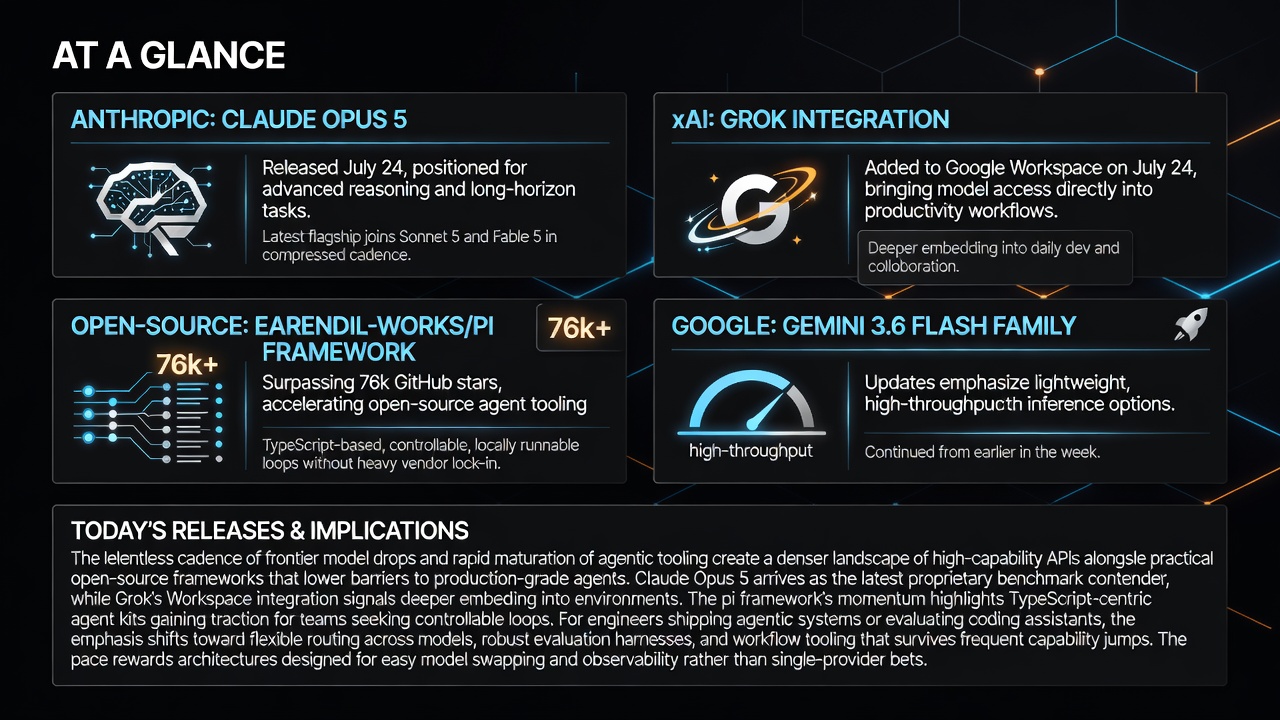
## At a glance – Anthropic released Claude Opus 5 on July 24, its newest flagship model positioned for advanced reasoning and long-horizon tasks. – xAI added Grok integration to Google Workspace on July 24, bringing model access directly into productivity workflows. – Open-source agent tooling accelerated, with the TypeScript-based earendil-works/pi framework surpassing 76k GitHub stars. – Google’s Gemini 3.6 Flash family updates from earlier in the week continue to emphasize lightweight, high-throughput inference options.
Today’s releases underscore the relentless cadence of frontier model drops and the rapid maturation of agentic tooling. Builders now face a denser landscape of high-capability APIs alongside practical open-source frameworks that lower the barrier to production-grade agents. Claude Opus 5 arrives as the latest proprietary benchmark contender, while Grok’s Workspace integration signals deeper embedding of models into daily dev and collaboration environments. The pi framework’s momentum highlights how TypeScript-centric agent kits are gaining traction for teams seeking controllable, locally runnable loops without heavy vendor lock-in. For engineers shipping agentic systems or evaluating coding assistants, the emphasis shifts toward flexible routing across models, robust evaluation harnesses, and workflow tooling that survives frequent capability jumps. The pace rewards architectures designed for easy model swapping and observability rather than single-provider bets.
Top Stories
Anthropic ships Claude Opus 5 Anthropic released its latest flagship, Claude Opus 5, on July 24. The model joins the recent Sonnet 5 and Fable 5 releases in a compressed cadence of frontier updates. Practical dev impact: Teams using Claude for coding agents or long-context reasoning can immediately test the new Opus tier via API for higher performance on complex SWE-Bench-style tasks.
xAI brings Grok to Google Workspace xAI enabled Grok access inside Google Workspace on July 24, extending the model family into collaborative documents and email flows. Practical dev impact: Developers can now invoke Grok directly from Workspace contexts for code review, doc generation, or quick prototyping without leaving productivity tools.
Open-source agent framework pi surges past 76k stars The TypeScript-based earendil-works/pi agent toolkit saw rapid adoption, crossing 76k GitHub stars with additions for constrained sampling and local model support, as noted in the July 24 LLM Daily. Practical dev impact: Teams can adopt a unified LLM API plus TUI/CLI agent loop for quick iteration on constrained or self-hosted agent workflows.
Gemini 3.6 Flash family expands lightweight options Google added Gemini 3.6 Flash, 3.5 Flash Cyber, and 3.5 Flash-Lite variants around July 21, targeting high-throughput scenarios. Practical dev impact: Cost-sensitive retrieval or batch inference pipelines gain new price-performance tiers without sacrificing context length.
Practical Impact Analysis
The July 24 double-header of Claude Opus 5 and Grok Workspace integration tightens the loop between frontier capability and everyday tooling. Developers running agent loops or IDE agents now have fresher options for routing high-reasoning work to Opus 5 while keeping lighter tasks on Flash variants or Grok. The pi framework’s growth shows demand for open, TypeScript-native control planes that support local models and constrained generation—useful for teams that need auditability or offline execution.Practically, this favors architectures with explicit model routers, standardized evaluation suites (SWE-Bench, Terminal-Bench), and observability layers that log which model handled which sub-task. Cost management becomes sharper: new lightweight Gemini tiers and existing Grok pricing allow aggressive experimentation without proportional spend increases. Builders should prioritize prompt and tool schemas that remain stable across model versions, then layer in A/B testing harnesses to quantify uplift from Opus 5 versus prior Opus releases. The net effect is faster iteration cycles for agentic features, provided teams avoid over-indexing on any single lab’s release cadence.
Recommended Tutorial Idea
Build a minimal multi-model agent router in TypeScript using the pi framework patterns, swapping between Claude Opus 5 and a local fallback.Grok Deep Dive
With Claude Opus 5 now live alongside Grok’s Workspace integration and the pi agent framework’s rapid growth, how should engineering teams decide between proprietary frontier models and open TypeScript agent kits for production coding agents—specifically around evaluation, cost routing, and long-horizon task reliability?Grok Deep Dive
Explore each Top Story in Grok — links open in a new tab. On phones, the same link may open the Grok app if you have it installed (via your device's normal link handling).
Article: Claude Opus 5 Grok Workspace — AI Dev Pulse · Jul 25, 2026
- Anthropic ships Claude Opus 5
- Practical dev impact:
- xAI brings Grok to Google Workspace
- Practical dev impact:
Privacy: links open grok.com in your session only. AIDevPulse does not run your prompts through our API.