
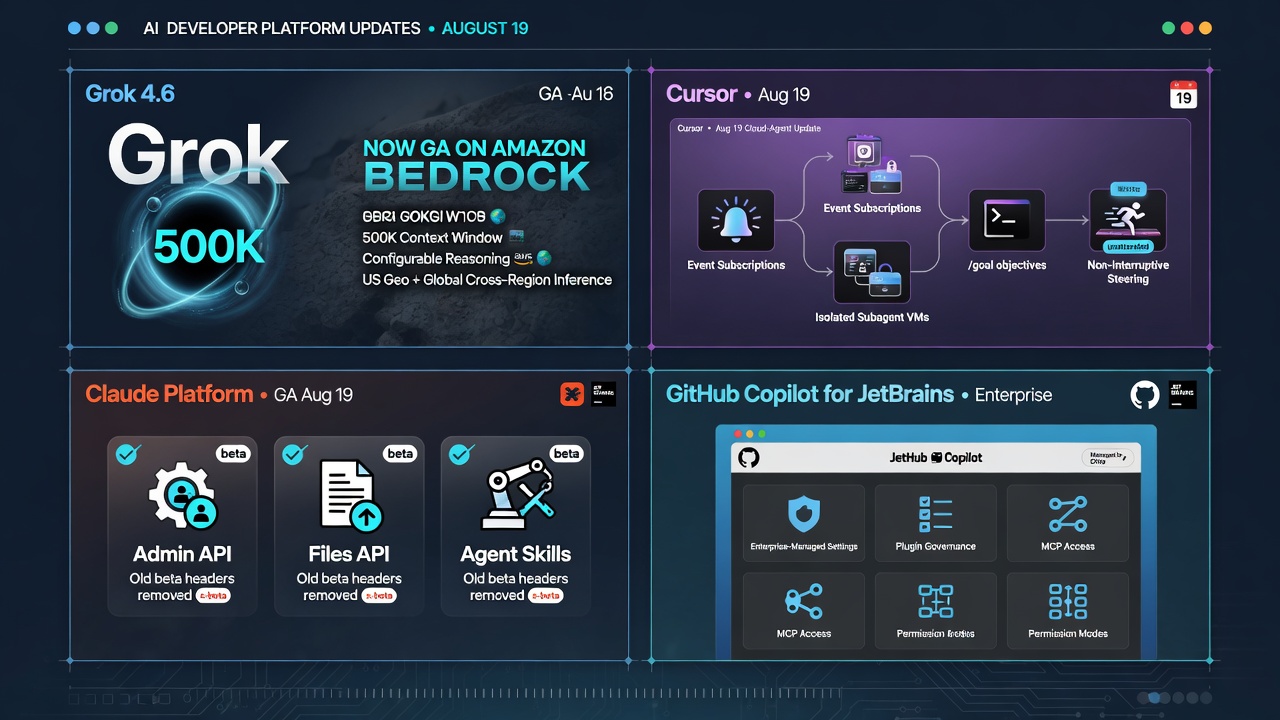
At a glance
- Grok 4.6 is now generally available on Amazon Bedrock with a 500K context window, configurable reasoning, and US Geo plus Global cross-region inference.
- Cursor’s Aug 19 cloud-agent update adds event subscriptions, isolated subagent VMs, /goal objectives, and non-interruptive steering so agents can run unattended.
- Anthropic’s Claude Platform made the Admin API, Files API, and Agent Skills generally available on August 19, dropping the old beta headers.
- GitHub Copilot for JetBrains now supports enterprise-managed settings for plugin governance, MCP access, and permission modes.
Builders spent yesterday wiring long-horizon agents into the same clouds and IDEs they already operate. SpaceXAI’s Grok 4.6 reached Bedrock one week after launch, giving AWS shops a 500K-token coding and agentic model they can invoke with existing IAM, logging, and Cost Explorer controls instead of a separate API key. Cursor simultaneously turned its cloud agents into event-driven systems that subscribe to PRs and Slack, spawn isolated subagents, and hold a /goal until CI is green. Anthropic closed the beta chapter on three core platform primitives so production Claude apps no longer need header gymnastics. Copilot’s JetBrains side added the governance layer enterprises actually require. The common thread is operational maturity: models and agents that already exist are now reachable, observable, and policy-compliant inside the stacks developers already pay for. Quiet days are over; the last 48 hours were about removing the last friction between a frontier model and a production merge.
Top Stories
Grok 4.6 generally available on Amazon Bedrock with cross-region inference Practical dev impact: You can now route Grok 4.6 through us.xai.grok-4.6 or global.xai.grok-4.6 inference profiles, keep US data residency, and bill it like any other Bedrock model. Amazon Bedrock added SpaceXAI’s Grok 4.6 on August 19 with support for the Responses, Chat Completions, and Converse APIs plus the same invocation logging, CloudWatch metrics, and Cost Explorer itemization already used for Claude and Nova. The model ships a 500K context window and four reasoning-effort levels (low, medium, high, xhigh). Input is $2 and output $6 per million tokens. Cross-region routing is automatic, so throughput scales without capacity planning. Model launch date on the Bedrock card is listed as August 18.Cursor cloud agents gain subscriptions, isolated subagents, and /goal Practical dev impact: Cloud agents can now wake on PR comments or Slack messages, spawn subagents on fresh VMs, and persist a long-lived objective without you babysitting every loop. The August 19 Cursor changelog ships four harness upgrades. Subscriptions let a cloud agent watch a PR it created or a Slack thread and resume when new events arrive. Custom modes pin a skill so it stays “always on.” Subagents now launch on their own virtual machines with isolated copies of the repo. The new /goal command (e.g. `/goal fix all flaky tests and make CI green`) keeps the agent working until the objective is met; follow-up messages queue instead of interrupting a tool call. Origin code hosting, which began rolling out two days earlier, sits underneath so agents, PRs, and hosted repos live in one surface.
Claude Platform Admin API, Files API, and Agent Skills reach general availability Practical dev impact: Drop the beta headers; Files API now has 1 TB org storage, 500 RPM, expiration, and pagination, while Agent Skills and user-management endpoints are production-ready. On August 19 Anthropic moved three previously beta surfaces to GA. The Admin API user-management endpoints (members, invites, groups, custom roles) no longer require the `ce-user-management-2026-07-13` header. The Files API (`/v1/files`) dropped its beta header, added `expires_in_seconds`, pagination, and an `ids[]` filter; storage is 1 TB per organization. Agent Skills and the Skills API (`/v1/skills`) are likewise GA, including Messages API `container` loads. Additional Managed Agents controls now let you restrict `web_search`/`web_fetch` domains, attach memory stores to self-hosted sandboxes, and inspect sessions via a redesigned Console timeline.
GitHub Copilot for JetBrains adds enterprise-managed settings Practical dev impact: Admins can now centrally govern plugins, MCP servers, OpenTelemetry, and permission modes for every JetBrains user on a Copilot Business or Enterprise plan. The August 18 changelog entry gives enterprise administrators a single policy surface for Copilot inside IntelliJ, PyCharm, and the rest of the JetBrains family. Plugin allow/deny lists, MCP server access, telemetry export, and permission modes can be pushed from the GitHub org settings instead of per-developer configuration. The change aligns JetBrains Copilot with the governance already available in VS Code and Visual Studio, closing a common enterprise blocker.
Practical Impact Analysis
The four updates collapse the remaining “it works in the playground” gaps. Grok 4.6 on Bedrock means a team already running Claude or Llama on AWS can A/B a 500K-context coding model without a new vendor contract or key-management story; cross-region profiles also give a cheap way to absorb traffic spikes. Cursor’s subscriptions and /goal turn the IDE into an event-driven control plane: an agent that opened a PR can now own the CI comments and Slack follow-ups until the branch is green, which is the difference between a demo and a teammate. Anthropic’s GA drop removes the last “remember the beta header” tax on Files and Skills, so RAG pipelines and custom agent toolsets can be promoted from prototype to production without a code freeze. Copilot’s JetBrains governance finally lets security teams treat the IDE plugin the same way they treat VS Code Copilot—plugin allow-lists, MCP lockdown, telemetry off-switch—so regulated shops no longer have to choose between JetBrains and compliance. Taken together, the day is less about new intelligence and more about making last month’s intelligence operable at the scale, policy, and observability bar that shipping software actually requires. If your backlog still has “wait for the model to land in our cloud / IDE / policy engine,” yesterday was the day those tickets closed.Recommended Tutorial Idea
Wire Grok 4.6 on Bedrock into a small Python agent that uses the Converse API, respects the US Geo profile, and logs invocations to CloudWatch—exactly the pattern an AWS shop would use after yesterday’s announcement.1. Enable the model in the Bedrock console and note the inference profile IDs (`us.xai.grok-4-6` or `global.xai.grok-4-6`). 2. Create an IAM role with `bedrock:InvokeModel` and attach it to your Lambda or ECS task. 3. Use boto3 1.35+ (or the Bedrock Runtime client) with the Converse API so you stay compatible with other Bedrock models. 4. Set `additionalModelRequestFields` for reasoning effort if you need xhigh on a long-horizon task. 5. Enable model invocation logging to S3/CloudWatch so every token is auditable.
Swap the modelId to the Global profile when you want cheaper burst capacity. Pair this with Cursor’s new /goal so a cloud agent can keep iterating on the same test until it passes.
Grok Deep Dive
Yesterday Grok 4.6 became a first-class Bedrock citizen with 500K context and cross-region routing, Cursor’s cloud agents learned to subscribe to PRs and hold /goal until CI is green, Anthropic GA’d Files + Skills + Admin APIs, and Copilot JetBrains finally got enterprise policy knobs. Walk me through a concrete architecture that uses Grok-on-Bedrock as the reasoning engine inside a Cursor cloud agent that also calls Claude’s new Files API for persistent artifacts, then tell me the exact IAM, logging, and /goal prompt I should ship this week so the whole loop is observable and unattended.Grok Deep Dive
Explore each Top Story in Grok — links open in a new tab. On phones, the same link may open the Grok app if you have it installed (via your device's normal link handling).
Article: Grok 4.6, Cursor, Claude, and Copilot close last gaps to production agents
- Grok 4.6 generally available on Amazon Bedrock with cross-region inference
- Practical dev impact:
- Cursor cloud agents gain subscriptions, isolated subagents, and /goal
- Practical dev impact:
Privacy: links open grok.com in your session only. AIDevPulse does not run your prompts through our API.