At a glance
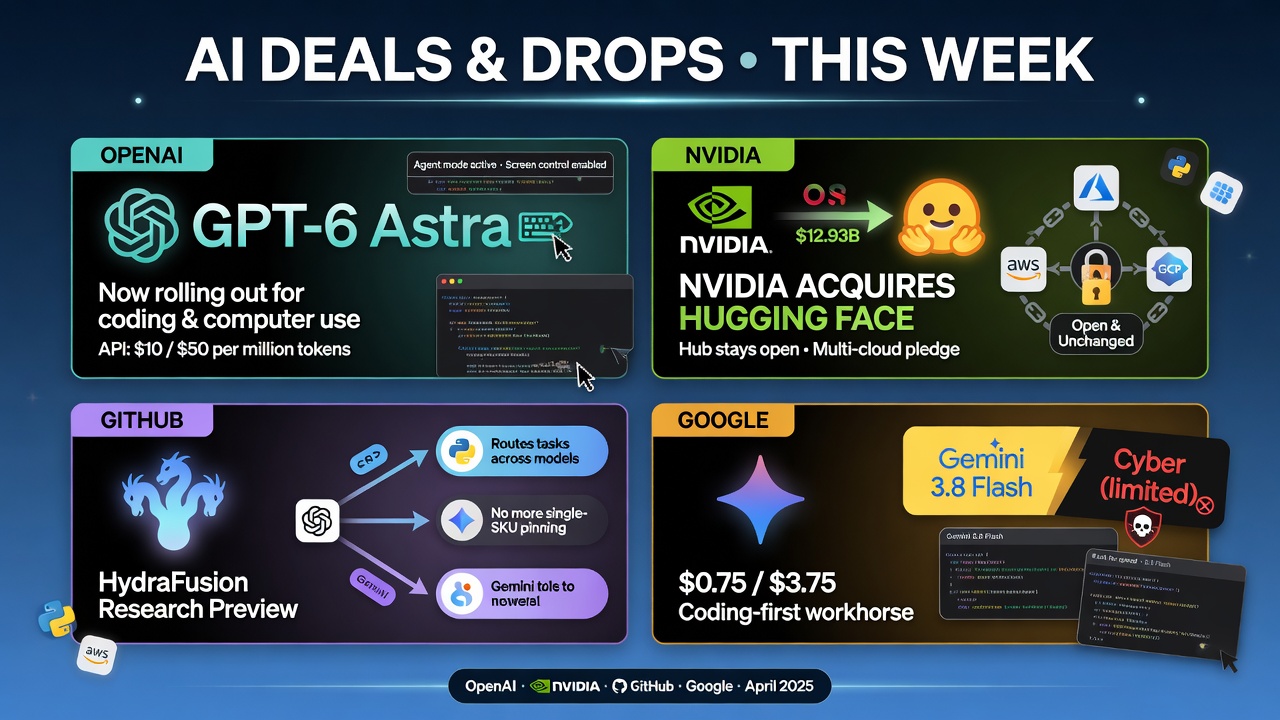
- OpenAI is rolling out GPT-6 Astra for coding and computer use, with API pricing at $10/$50 per million tokens.
- NVIDIA agreed to acquire Hugging Face for $12.93 billion and pledged the hub stays open and multi-cloud.
- GitHub Copilot's HydraFusion research preview routes coding tasks across models instead of pinning every job to one SKU.
- Google's Gemini 3.8 Flash lands at $0.75/$3.75 as a coding-first workhorse, with a restricted Cyber sibling.
The last forty-eight hours compressed a year of stack decisions into one developer week. OpenAI began a phased rollout of GPT-6 Astra, a flagship it positions for software engineering, computer use, and cybersecurity, with API pricing of $10 per million input tokens and $50 per million output. NVIDIA agreed to acquire Hugging Face for $12.93 billion and pledged that the hub remains open, multi-cloud, and free of a CUDA mandate. GitHub put HydraFusion into Copilot CLI as a research preview, arguing that frontier quality can come from routing, critique, and cascade instead of a single model. Google, a day earlier, posted Gemini 3.8 Flash at Flash pricing for agentic coding, plus a locked-down Cyber variant for trusted defenders.
Treat today as a cascade-routing morning. Redesign how work is dispatched: cheap models take first pass, expensive models finish multi-step jobs, and vendor-neutral Hub hosting stays in the plan even after NVIDIA's deal.
Top Stories
OpenAI starts phased GPT-6 Astra rollout for coding and computer use
Practical dev impact: Point new agent workloads at gpt-6-astra on the Responses API, but keep it off autocomplete paths. It is a $10/$50 frontier SKU with no custom temperature and no none reasoning effort. OpenAI describes Astra as its most capable broadly deployed model for computer use, browsing, software engineering, and professional artifacts, with a 1.05M-token context window and 128K max output. Vendor-reported scores include 99.9% on ARC-AGI-3, 98% on FrontierMath Tier 4, 72.6% on OSWorld 2.0, and 64.6% on Terminal-Bench Science 0.1. Access is rolling out through ChatGPT Plus/Pro/Business/Enterprise, the OpenAI API, Azure, and AWS Bedrock; Codex's updated harness is claimed to finish computer-use tasks 1.9x faster versus GPT-5.6 Sol on Mind2Web. Safety materials say Astra is the first OpenAI model to hit the Critical cybersecurity threshold under the Preparedness Framework, so expect tighter monitoring on agent trajectories.
NVIDIA agrees to acquire Hugging Face for $12.93 billion
Practical dev impact: Do not rip Hub pipelines out today, but inventory every production dependency on huggingface.co weights, datasets, and Spaces before the deal is expected to close in H1 2027. Jensen Huang's post prices the deal at $12,930,300,000 and states Hugging Face will remain an open platform: developers keep their choice of models, frameworks, clouds, inference providers, and accelerators, and "NVIDIA compute will not be required." The hub currently hosts more than 3 million models, 500,000 datasets, and 1 million applications for 18 million builders and 200,000 companies. NVIDIA's SEC 8-K frames an ~$11.9B stockholder purchase plus up to ~$1.0B in employee retention equity, plus a commitment to keep uploads and other-silicon support intact. Treat that as a contractual pledge, not an already-shipped change to Hub TOS.
GitHub Copilot HydraFusion research preview routes coding tasks across models
Practical dev impact: In Copilot CLI, run /update, /experimental on, then /model and select HydraFusion if you want GitHub to pick Single, Cascade, or Critique per task instead of hard-coding Opus or Astra. GitHub's September 4 post says the runtime builds an execution plan across providers: one model solves directly, an efficient model drafts then escalates, or a cross-family critic reviews a draft in an isolated, tool-less context. Offline, GitHub reports TerminalBench 2.1 quality +4.9 points versus Claude Opus 5 at 67% lower estimated cost; DeepSWE and CheckpointBench came in 1.5 and 0.1 points below Opus 5 at 36% and 65% lower cost. Usage is billed at each underlying model's token rate. GitHub itself calls this a research preview whose names, workflows, and quality may change.
Google launches Gemini 3.8 Flash as a coding-first workhorse
Practical dev impact: Use Gemini 3.8 Flash as the default draft model in agent loops. Same $0.75/$3.75 pricing as 3.7 Flash, 1M input tokens, 64K output, and GA for software engineering and long-horizon tool use. Google says 3.8 Flash is based on 3.7 Flash rather than a new pretrain, and that it "works harder" on tough tasks via extra reasoning steps and iterative tool calls. DeepMind positions it for DeepSWE-style end-to-end engineering and reports 54.9% on HLE-Verified. A sibling, Gemini 3.8 Flash Cyber, is not a public SKU: it ships through the Fairwind Program for trusted defenders doing vulnerability discovery and automated patching. Keep the public Flash on product agents; do not assume Cyber-level exploit help in the general API.
Practical Impact Analysis
Astra is a job-finisher, not a tab-complete upgrade. Official docs put it on the Responses API, drop custom temperature/top_p, and price it like Anthropic's frontier tier. Wire it into computer-use, long-context refactors, and Codex-style loops; keep it off high-QPS autocomplete. GitHub's HydraFusion is the same idea productized: Copilot CLI users can try cascade and critique without owning a router. The vendor table is mixed (a TerminalBench win, slight DeepSWE/CheckpointBench misses versus Opus 5), so treat the 36-67% cost cuts as a thesis to measure on your repo, not a SLA.
Gemini 3.8 Flash is the obvious first-pass model in that pattern. Flash pricing plus a 1M window means you can afford to draft, lint, and only escalate the failures. That is how you absorb Astra's $50 output tokens without lighting the monthly bill on fire. HydraFusion's isolated critic is the piece most teams skip: run review without tools so the second model cannot "fix" the repo while judging it.
NVIDIA's Hugging Face deal is the governance risk. Huang's open-platform language is explicit, and the 8-K repeats multi-accelerator support, but closing is months away. Snapshot critical weights, pin revisions, and decide which eval/dataset jobs must run on a second host. The through-line across Astra's safety writeup and this week's Hub headlines is agent isolation: if you launch fleets of coding agents, scoped credentials, egress controls, and trajectory logs are now part of the build, not a later compliance ticket.
Tutorial
Build a two-stage coding cascade that mirrors HydraFusion: Gemini 3.8 Flash drafts, a tool-less gate accepts or rejects, and GPT-6 Astra rewrites only the failures. Use Vercel AI Gateway so model ids stay portable.
- Export
AI_GATEWAY_API_KEYand confirm the gateway base URL ishttps://ai-gateway.vercel.sh/v1(notapi.vercel.ai). - Draft with
google/gemini-3.8-flash. Keep the prompt tight: public signature, file path, and "minimal patch." - Gate with the same cheap model, no tools,
PASSorESCALATEonly. - Escalate to
openai/gpt-6-astra. Do not settemperature. Astra's native contract does not take custom sampling. - Log draft tokens, gate decision, and escalate tokens. That log is how you prove the cascade is cheaper than sending every task to Astra.
import os
from openai import OpenAI

client = OpenAI(
    api_key=os.environ["AI_GATEWAY_API_KEY"],
    base_url="https://ai-gateway.vercel.sh/v1",
)

DRAFT_MODEL = "google/gemini-3.8-flash"
ESCALATE_MODEL = "openai/gpt-6-astra"
GATE = (
    "Reply with PASS or ESCALATE only. "
    "ESCALATE if the draft is incomplete, incorrect, or lacks tests."
)


def cascade_fix(task: str) -> str:
    draft = client.chat.completions.create(
        model=DRAFT_MODEL,
        messages=[
            {
                "role": "system",
                "content": "Return a complete, minimal patch. No extra prose.",
            },
            {"role": "user", "content": task},
        ],
    )
    draft_text = draft.choices[0].message.content or ""

    gate = client.chat.completions.create(
        model=DRAFT_MODEL,
        messages=[
            {"role": "system", "content": GATE},
            {"role": "user", "content": f"Task:\n{task}\n\nDraft:\n{draft_text}"},
        ],
    )
    decision = (gate.choices[0].message.content or "").strip().upper()
    if decision.startswith("PASS"):
        return draft_text

    final = client.chat.completions.create(
        model=ESCALATE_MODEL,
        messages=[
            {
                "role": "system",
                "content": "You are a frontier coding agent. Produce a complete, tested fix.",
            },
            {
                "role": "user",
                "content": (
                    f"Task:\n{task}\n\nRejected draft:\n{draft_text}\n\n"
                    "Rewrite with a smaller, correct change."
                ),
            },
        ],
    )
    return final.choices[0].message.content or ""


if __name__ == "__main__":
    print(
        cascade_fix(
            "Add exponential backoff to fetch_user() in src/api.py "
            "without changing the public signature."
        )
    )
Swap the draft model independently of the escalate model. That is the whole point of this week's releases: Flash for volume, Astra for the jobs that fail the gate, Copilot HydraFusion if you would rather not own the router.
Recommended AI prompt
Copy this paragraph into ChatGPT, Claude, Gemini, Grok, or whatever you use.
It is 5 September 2026. OpenAI is rolling out GPT-6 Astra (gpt-6-astra, $10/$50 per million tokens, 1.05M context, Responses API, no custom temperature) for coding and computer use. NVIDIA agreed to buy Hugging Face for $12.93 billion (close targeted H1 2027) while pledging the hub stays open. GitHub Copilot shipped HydraFusion in CLI as a research preview (Single / Cascade / Critique). Google GA'd Gemini 3.8 Flash at $0.75/$3.75 for agentic coding, with Cyber gated to Fairwind. Design a production coding-agent stack for a 200-dev org: routing policy (when Flash drafts vs when Astra or HydraFusion runs), isolation and credential rules, and a 90-day Hugging Face dependency plan that does not assume Hub behavior changes before close.