At a glance
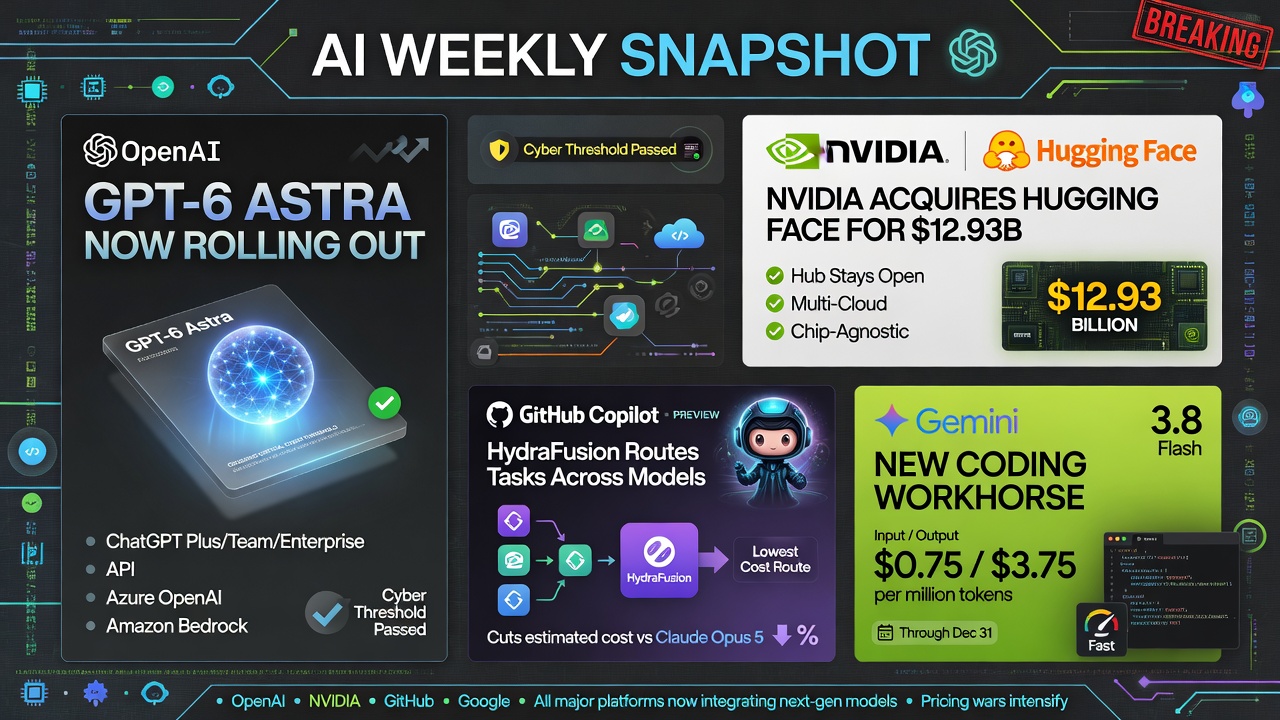
- OpenAI is rolling GPT-6 Astra into ChatGPT paid tiers, the API, Azure, and Bedrock after crossing its Critical cyber threshold.
- NVIDIA agreed to buy Hugging Face for $12.93 billion and pledged the hub stays open, multi-cloud, and chip-agnostic.
- GitHub Copilot's HydraFusion preview routes coding tasks across models and cuts estimated cost versus Claude Opus 5.
- Gemini 3.8 Flash is Google's new coding workhorse at $0.75/$3.75 per million tokens through December 31.
The last 72 hours dumped a generation of models on every builder’s desk, and Saturday’s coverage is already calling it model fatigue. OpenAI is rolling GPT-6 Astra (its first model to hit the Critical cybersecurity rung on the Preparedness Framework) into ChatGPT paid seats, the API, Azure, and Bedrock. NVIDIA answered the open-weight question by agreeing to buy Hugging Face for $12.93 billion while promising the hub stays multi-cloud and chip-agnostic. GitHub put the same cost pressure into Copilot with HydraFusion, a research preview that drafts, critiques, and escalates across providers instead of pinning every task to one flagship. Google, meanwhile, is selling Gemini 3.8 Flash as the workhorse: Flash speed, frontier-adjacent coding, and introductory pricing that undercuts Astra by more than an order of magnitude.
Treat today as a routing morning. Default cheap, escalate on hard agent loops, treat Copilot’s orchestrator as an option instead of a religion, and assume the model hub is infrastructure you no longer fully control.
Top Stories
OpenAI rolls GPT-6 Astra across ChatGPT paid plans, API, Azure, and Bedrock
Practical dev impact: Point Astra at long-horizon computer use, Codex loops, and finished artifacts, not at everyday autocomplete. OpenAI calls GPT-6 Astra its most intelligent and aligned model, with vendor-reported highs on computer use, software engineering, and science (64.6% on Terminal-Bench Science 0.1 versus 52.6% for Claude Fable 5.1 in OpenAI’s comparison). API pricing is $10 / $50 per million input/output tokens ($1 cached input); prompts over 272K input tokens pay a surcharge. New primitives include async tool calling, mid-turn steering, and reasoning changes that keep the cache. It is also the first OpenAI model designated Critical for cybersecurity: advanced cyber access is gated, conversations may pause under misalignment monitoring, none reasoning effort is gone, and tool calling wants the Responses API. Cognition is wiring it into Devin on launch day; treat it as an escalation tier until your evals say otherwise.
NVIDIA agrees to acquire Hugging Face for $12.93 billion
Practical dev impact: Keep shipping against Hugging Face APIs this week, but pin revisions and mirror weights you cannot afford to lose. Jensen Huang’s post puts the price at exactly $12,930,300,000 and pledges that Hugging Face remains an open platform: developers still choose models, frameworks, clouds, inference providers, and chips, and “NVIDIA compute will not be required.” The hub hosts more than 18 million users, 3 million models, 500,000 datasets, and 1 million apps, with 200,000 companies on it. NVIDIA already claims to be the largest contributor of open models and data there (500+ models, 250+ datasets). The deal still has to clear regulators; until then, the practical move is operational hygiene, not a platform rewrite.
GitHub Copilot HydraFusion routes coding work across models in a research preview
Practical dev impact: If you already live in Copilot CLI, turn on experimental mode before you write another router. Project HydraFusion, now a Copilot research preview, builds an execution plan and picks Single, Cascade, or Critique workflows across providers (draft, independent review from another model family, or escalate). GitHub’s offline evals versus Claude Opus 5 show 67% lower estimated cost and +4.9 points on TerminalBench 2.1, 36% lower cost and -1.5 points on DeepSWE, and 65% lower cost with a near-tie on CheckpointBench. It is on all Copilot plans via /experimental in Copilot CLI; you pay each model’s standard token rate with no orchestration surcharge. GitHub is still tuning multi-turn loops, so keep it on well-specified single-shot coding tasks until your own traces look clean.
Gemini 3.8 Flash undercuts frontier coding at Flash prices
Practical dev impact: Make 3.8 Flash the default for high-volume coding and agent loops; reserve Astra-class models for the tasks Flash fails. Google’s third Flash drop in six weeks keeps 3.7’s speed and introductory price ($0.75 / $3.75 per million tokens through December 31, 2026, then $1.50 / $7.50). Model id gemini-3.8-flash, 1,048,576-token context, 64K output, tunable thinking (low / medium / high). Google reports 54.9% on HLE-Verified and says DeepSWE v1.1 results approach much larger frontier models at a fraction of the cost. 3.7 Flash stays supported for efficiency-first traffic. A gated Gemini 3.8 Flash Cyber sibling is limited to Fairwind Program defenders; most product teams should ignore it and bake the January price step into forecasts now.
Practical Impact Analysis
The stack just forked. GPT-6 Astra is the model you aim at long-horizon computer use, Codex sessions, and artifacts that have to match a template, but it is a $10/$50 model with extra misalignment monitoring, no none reasoning effort, and tool calling that wants the Responses API. Treat it as the escalation tier, not the default tab-complete. Prompt it to bias toward action or it will stop and ask; audit AGENTS.md and skills, because instruction-following is sharper and more literal than GPT-5.6 Sol.
HydraFusion is GitHub’s productized version of that instinct. If Copilot CLI is already in the inner loop, /experimental plus Single/Cascade/Critique eats a lot of routing work you would otherwise own. The published benches are mixed on quality versus Opus 5; the cost story is not. Measure dollars per merged PR, not dollars per million tokens, and keep HydraFusion off fuzzy multi-turn refactors until GitHub says those loops are ready.
Gemini 3.8 Flash is the new volume default. Introductory $0.75/$3.75 holds through December 31, 2026, then doubles. Freeze evals and fallbacks this month so a January price step does not land as an incident. Keep 3.7 Flash on the latency path; Google still supports it.
NVIDIA’s Hugging Face deal does not break from_pretrained this weekend. It does change who owns the zoo. Huang pledged NVIDIA silicon will not be required and the hub stays multi-cloud. Until regulators weigh in, pin model revisions, mirror critical weights, and assume evaluation, inference, and ranking surfaces get more NVIDIA-shaped. Open weights remain the hedge; routing remains the daily job.
Tutorial
Implement the pattern the rest of this week is converging on: default Gemini 3.8 Flash, escalate GPT-6 Astra when the task is long-horizon. Vercel AI Gateway keeps both behind one OpenAI-compatible client.
- Export
AI_GATEWAY_API_KEYand never hard-code it. - Classify the request with a cheap heuristic (keywords beat a second model call for v1).
- Send volume work to
google/gemini-3.8-flash; send agentic, multi-file, or computer-use work toopenai/gpt-6-astra. - Log the chosen model on every call so finance can see the mix before January’s Flash price step.
Swap the gateway for OpenAI’s native gpt-6-astra Responses client when you need async tools, mid-turn steering, or computer use. Keep Flash as the default until an eval says the extra tokens are worth it.
Recommended AI prompt
Copy this paragraph into ChatGPT, Claude, Gemini, Grok, or whatever you use.
I just read this week’s builder stack: OpenAI is rolling GPT-6 Astra ($10/$50, Critical cyber designation, async tools, Responses API) as an escalation model; Google’s Gemini 3.8 Flash is the volume coding workhorse at $0.75/$3.75 through 2026-12-31; GitHub Copilot HydraFusion (Copilot CLI /experimental) routes Single/Cascade/Critique across providers and reports large cost cuts versus Claude Opus 5 with mixed quality; NVIDIA agreed to buy Hugging Face for $12.93B while pledging the hub stays open and chip-agnostic. Act as a staff engineer for a 40-person product org on Copilot plus a Python agent service. Design a 30-day routing policy: which tasks stay on Flash, which escalate to Astra, when HydraFusion is allowed to pick, what to pin and mirror on Hugging Face, how to measure dollars per merged PR, and what breaks on 2027-01-01 when Flash intro pricing ends. Give a concrete default/escalate matrix, eval harness, and the failure modes you would watch in traces.