At a glance
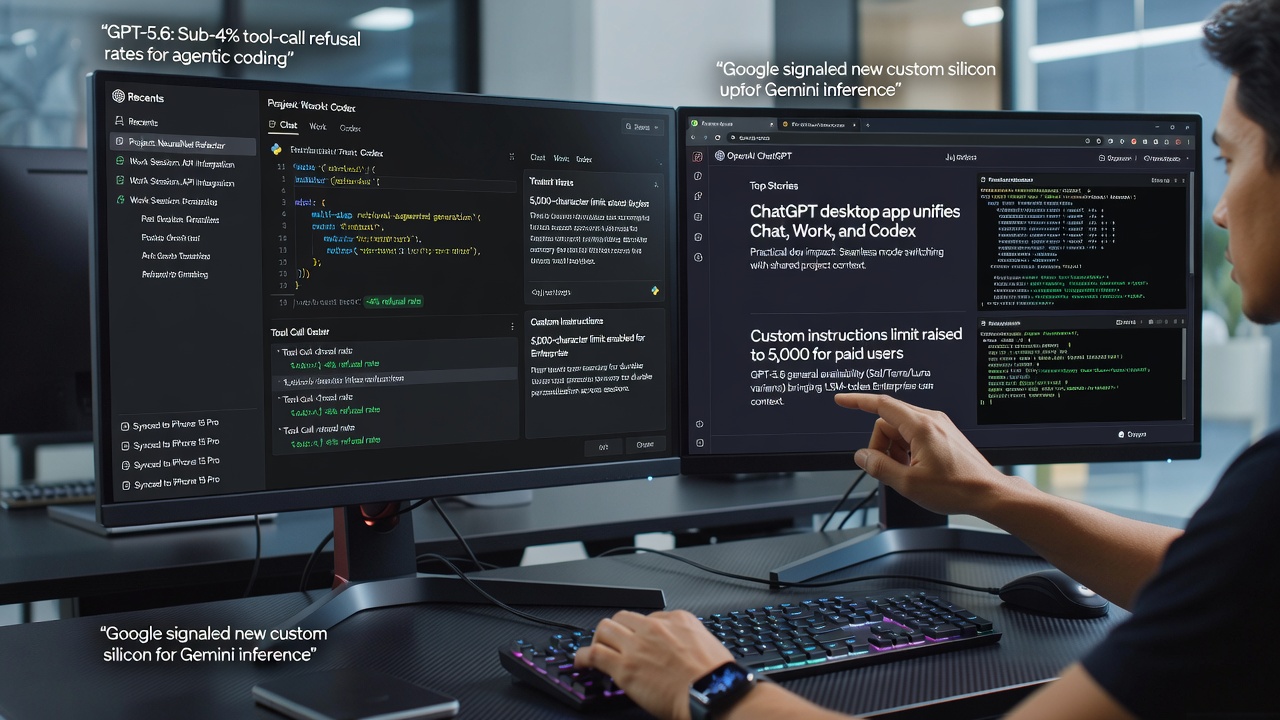
## At a glance – OpenAI rolled out a major ChatGPT desktop app redesign on July 16, merging Chat, Work, and Codex workflows with unified recents and cross-device sync. – Custom instructions character limit increased to 5,000 for paid users on July 15, enabling richer persistent personalization. – GPT-5.6 general availability (with Sol/Terra/Luna variants) brings 1.5M-token Enterprise context and sub-4% tool-call refusal rates for agentic coding. – Google signaled new custom silicon for more efficient Gemini model inference in a July 20 report.
OpenAI’s July desktop refresh and GPT-5.6 rollout arrive at a moment when developers increasingly rely on persistent, agentic environments rather than one-off chat sessions. The Work mode integration and larger context windows directly address pain points in multi-step coding, project management, and retrieval-augmented workflows that have grown more complex as context windows expand. Meanwhile, the custom instructions expansion and Perplexity’s earlier memory upgrades signal a broader industry shift toward durable, user-specific agent memory that survives across sessions and surfaces. These changes matter because they lower the friction of keeping AI copilots aligned with real engineering contexts while raising the bar for how reliably those copilots can execute tool calls and maintain state. Builders should treat the next week as an opportunity to re-evaluate desktop workflows and test whether the new context and refusal improvements meaningfully accelerate agent scaffolding.
Top Stories
ChatGPT desktop app unifies Chat, Work, and Codex Practical dev impact: Developers can now switch seamlessly between quick chat, long-running agentic Work tasks, and dedicated Codex coding sessions inside a single macOS/Windows app with shared recents and project context.
Custom instructions limit raised to 5,000 characters Practical dev impact: Paid users gain significantly more room to encode style guides, codebase conventions, and team-specific constraints that persist across all conversations.
GPT-5.6 reaches general availability with improved agent reliability Practical dev impact: Lower tool-call refusal rates and 1.5M-token Enterprise context enable more robust multi-agent coding pipelines and larger codebase retrieval without truncation.
Google plans custom chip to run Gemini models more efficiently Practical dev impact: Future inference cost reductions and higher throughput on Vertex AI could benefit teams running large-scale Gemini-based RAG or agent workloads.
Practical Impact Analysis
The desktop unification and Work mode rollout accelerate the trend of treating LLMs as always-on teammates rather than occasional query tools. Teams that previously maintained separate Codex and ChatGPT instances can consolidate, but early user reports note navigation friction during the transition—worth monitoring as the rollout stabilizes. The expanded custom instructions and GPT-5.6’s reliability gains compound each other: richer persistent prompts paired with fewer failed tool invocations should reduce the boilerplate scaffolding previously required for reliable agents. Google’s silicon move, while not immediate, hints at continued price/performance pressure across cloud providers, which will matter once 1M+ token contexts become routine in production RAG systems. Overall, the week’s changes reward developers who invest in durable agent memory and workflow orchestration rather than prompt hacks.
Recommended Tutorial Idea
Build a persistent coding agent with the new ChatGPT Work mode and expanded custom instructions
1. Update the ChatGPT desktop app to the July 16 release. 2. Create or open a Project and switch to Work mode. 3. Set a 5,000-character custom instruction that encodes your repo conventions, testing standards, and preferred libraries. 4. Connect relevant files/folders and start a Work thread that plans, implements, and tests a feature end-to-end. 5. Use the unified recents view to resume the thread across devices.
Grok Deep Dive
How do the new ChatGPT Work mode and GPT-5.6 context improvements change the way you would architect a production-grade coding agent compared with last month’s models, and what guardrails or evaluation harness would you add first?
Grok Deep Dive
Explore each Top Story in Grok — links open in a new tab. On phones, the same link may open the Grok app if you have it installed (via your device's normal link handling).
Article: OpenAI ChatGPT Desktop and — AI Dev Pulse · Jul 21, 2026
- ChatGPT desktop app unifies Chat, Work, and Codex
- Practical dev impact:
- Custom instructions limit raised to 5,000 characters
- Practical dev impact:
Privacy: links open grok.com in your session only. AIDevPulse does not run your prompts through our API.