At a glance
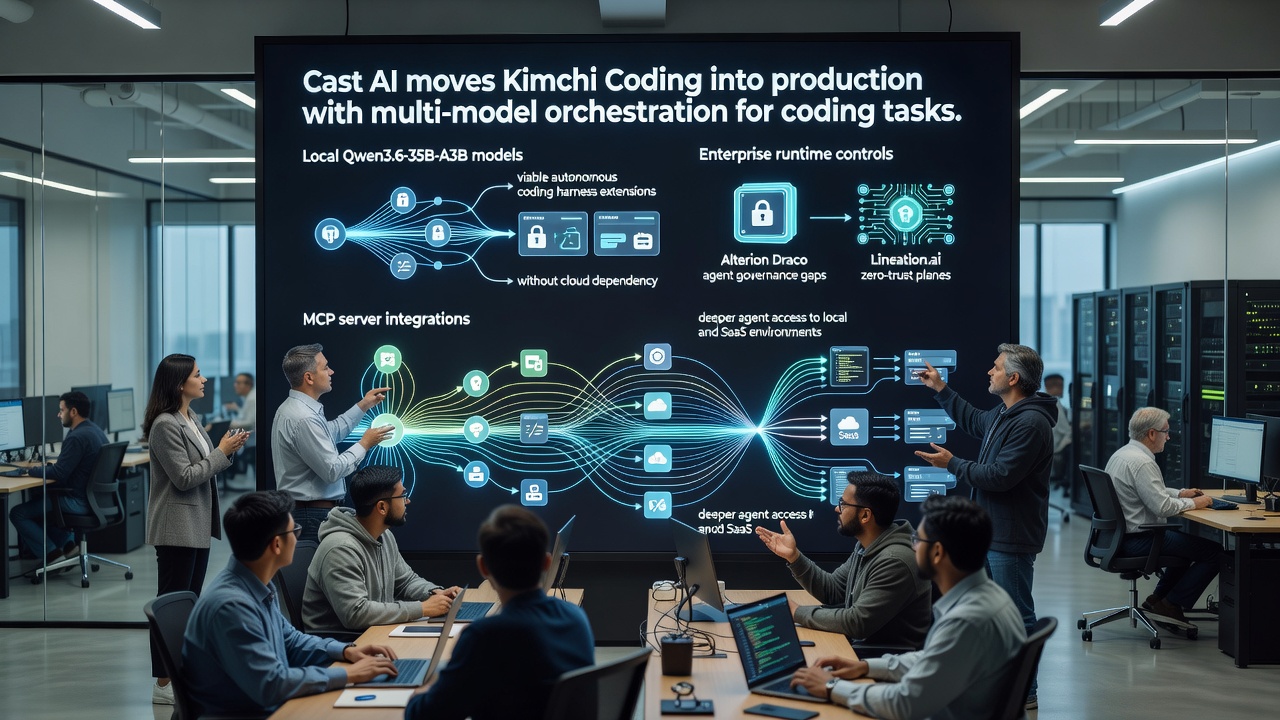
- Cast AI moves Kimchi Coding into production with multi-model orchestration for coding tasks.
- Local Qwen3.6-35B-A3B models demonstrate viable autonomous coding harness extensions without cloud dependency.
- Enterprise runtime controls like Alterion Draco and Lineation.ai zero-trust planes address agent governance gaps.
- MCP server integrations proliferate across tools, enabling deeper agent access to local and SaaS environments.
Today’s landscape shows agentic AI crossing from prototypes into governed, multi-model production systems. Developers gain concrete options for local inference, runtime oversight, and standardized tool calling via MCP, reducing reliance on single-vendor stacks while raising the bar for security and observability. These shifts matter because they directly affect how teams build reliable, auditable workflows that scale beyond demos—especially in coding, data access, and enterprise automation. Fresh launches this week underscore a maturing ecosystem where orchestration, security, and hybrid local/cloud setups converge on practical engineering concerns rather than hype.
Top Stories
Cast AI ships Kimchi Coding to production Practical dev impact: Teams can now route coding tasks across multiple models in a single production-grade harness, lowering vendor lock-in and cost risk for autonomous development workflows.Local Qwen3.6-35B-A3B extends coding harnesses Practical dev impact: Developers can prototype fully local autonomous coding agents that rival cloud tools like Claude Code on targeted tasks, cutting subscription costs and improving data privacy.
Alterion and Lineation launch agent runtime controls Practical dev impact: Security and compliance teams gain zero-trust and cross-cloud governance layers that wrap existing agents without code changes, enabling safer production deployments.
MCP servers expand tool reach for agents Practical dev impact: New MCP integrations for VPNs, creative tools, and domains let agents execute real device- and service-level actions natively, streamlining end-to-end automation.
Practical Impact Analysis
The week’s releases highlight a clear pivot toward production hardening. Multi-model routing in tools like Kimchi Coding and expanding MCP support reduce single-point failures while giving developers finer control over cost, latency, and model selection. Local model experiments with Qwen show that on-device or self-hosted inference can now handle meaningful coding workloads, opening hybrid architectures that keep sensitive code off external APIs.Governance additions from Alterion and Lineation directly tackle the biggest blocker for enterprise adoption: runtime visibility and policy enforcement. These layers sit atop existing frameworks without forcing rewrites, which means teams using LangGraph, CrewAI, or provider SDKs can layer compliance on top rather than rebuild. Overall, the signal is that agentic systems are becoming infrastructure—reliable enough for real workflows but requiring explicit attention to observability, security boundaries, and model orchestration.
Recommended Tutorial Idea
Build a lightweight multi-model coding agent that routes tasks through a local Qwen model with fallback to a cloud endpoint, using MCP for file-system access and a simple policy check.Grok Deep Dive
Given the July 17–19 launches of production multi-model coding tools, local Qwen harness experiments, zero-trust runtime controls from Alterion and Lineation, and expanding MCP integrations, what architectural patterns should teams adopt to combine local inference, cloud fallbacks, and governance layers into maintainable agent workflows without introducing new vendor lock-in?Grok Deep Dive
Explore each Top Story in Grok — links open in a new tab. On phones, the same link may open the Grok app if you have it installed (via your device's normal link handling).
Article: Agentic AI Production Hardening — AI Dev Pulse · Jul 20, 2026
- Cast AI ships Kimchi Coding to production
- Practical dev impact:
- Local Qwen3.6-35B-A3B extends coding harnesses
- Practical dev impact:
Privacy: links open grok.com in your session only. AIDevPulse does not run your prompts through our API.