At a glance
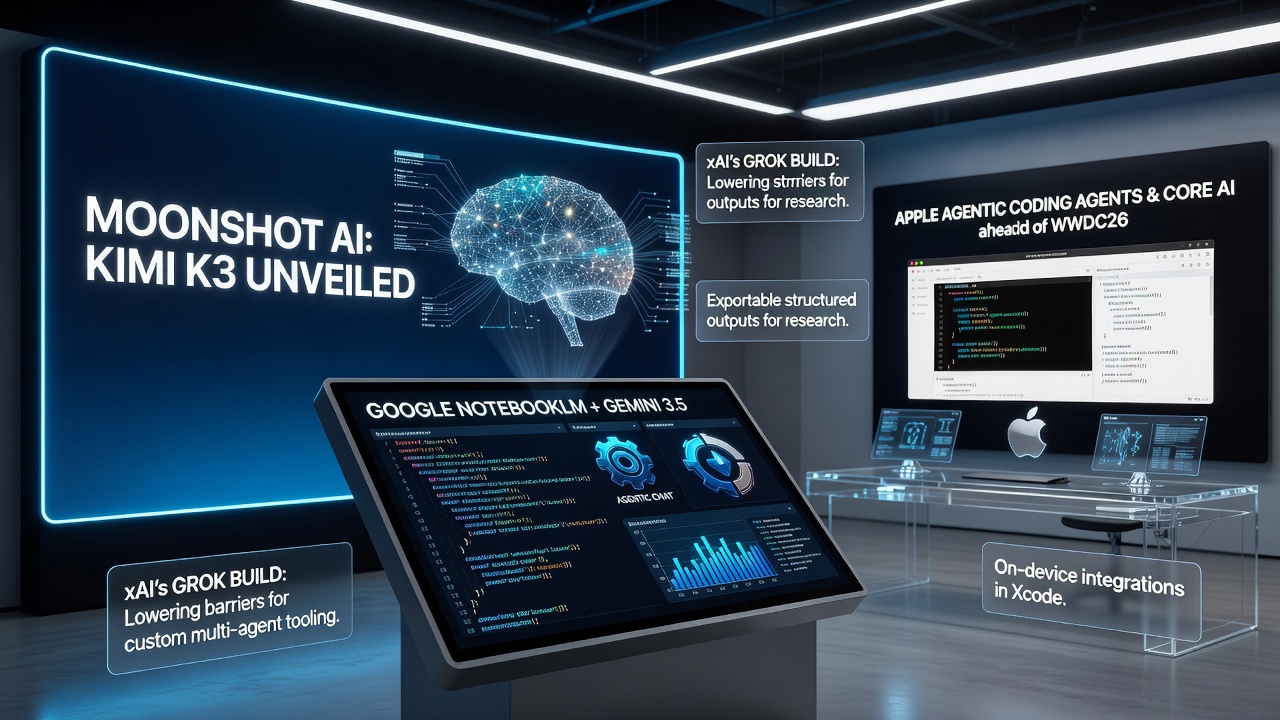
- Moonshot AI unveiled Kimi K3, a powerful new model.
- Google upgraded NotebookLM with Gemini 3.5 agentic chat, code execution, and exportable structured outputs for research workflows.
- Apple previewed agentic coding agents and on-device Core AI integrations ahead of WWDC26 in Xcode.
- Recent open releases like xAI’s Grok Build coding agent continue to lower barriers for custom multi-agent tooling.
Today’s releases underscore a clear shift: frontier-scale models are becoming accessible for local customization and agentic coding at developer-friendly costs. Moonshot’s Kimi K3 stands out as the largest open-weight system yet, directly targeting long-running coding agents and multi-step reasoning tasks that have historically required closed APIs. Paired with NotebookLM’s expanded execution capabilities and Apple’s on-device push, builders gain new options for hybrid cloud-edge pipelines without sacrificing context length or tool-use reliability. These moves compress iteration cycles for teams experimenting with autonomous agents while raising the bar for evaluation harnesses and cost monitoring.
Top Stories
Moonshot AI unveils Kimi K3 model Practical dev impact: Developers can soon run and fine-tune the new Kimi K3 model locally or on-prem for extended coding sessions and multi-agent orchestration.Google enhances NotebookLM with Gemini 3.5 agentic features Practical dev impact: Research and documentation workflows gain secure cloud execution, web-sourced citations, and direct exports to code-backed reports, spreadsheets, and slides without leaving the notebook environment.
Apple previews agentic coding and Core AI in Xcode Practical dev impact: macOS developers gain native support for on-device agents that can search docs, run tests, and iterate on projects using MLX-accelerated local models ahead of WWDC26.
xAI open-sources Grok Build coding agent and terminal UI Practical dev impact: Teams can fork a production-grade agentic terminal that integrates live search and multi-model routing, accelerating custom CLI-based development environments.
Practical Impact Analysis
The convergence of massive open-weight releases and improved agent tooling lowers the friction for running long-running, tool-calling agents without constant API spend. Kimi K3’s reported strengths in sustained coding sessions and high tool-call success rates directly address pain points seen in earlier agent frameworks, while its open-weight status enables fine-tuning on proprietary codebases. NotebookLM’s upgrades and Apple’s on-device focus further tilt the landscape toward hybrid setups where sensitive work stays local and heavy reasoning routes to capable cloud models. Builders should prioritize evaluation harnesses that measure multi-hour agent reliability and token efficiency rather than single-turn benchmarks. Cost models will shift quickly as teams mix open frontier models with managed services, making governance around data leakage and output verification non-negotiable.Recommended Tutorial Idea
Build a minimal multi-model coding agent harness that routes long-horizon tasks to Kimi K3 (or a local equivalent) while falling back to lighter models for verification.Grok Deep Dive
With Kimi K3 now available for local experimentation and full open-source landing in eight days, how should teams update their agent evaluation harnesses and routing logic to safely incorporate the new 2.8T open-weight model alongside existing closed frontier systems?Grok Deep Dive
Explore each Top Story in Grok — links open in a new tab. On phones, the same link may open the Grok app if you have it installed (via your device's normal link handling).
Article: Open Kimi K3 NotebookLM and — AI Dev Pulse · Jul 19, 2026
- Moonshot AI unveils Kimi K3 model
- Practical dev impact:
- Google enhances NotebookLM with Gemini 3.5 agentic features
- Practical dev impact:
Privacy: links open grok.com in your session only. AIDevPulse does not run your prompts through our API.