At a glance
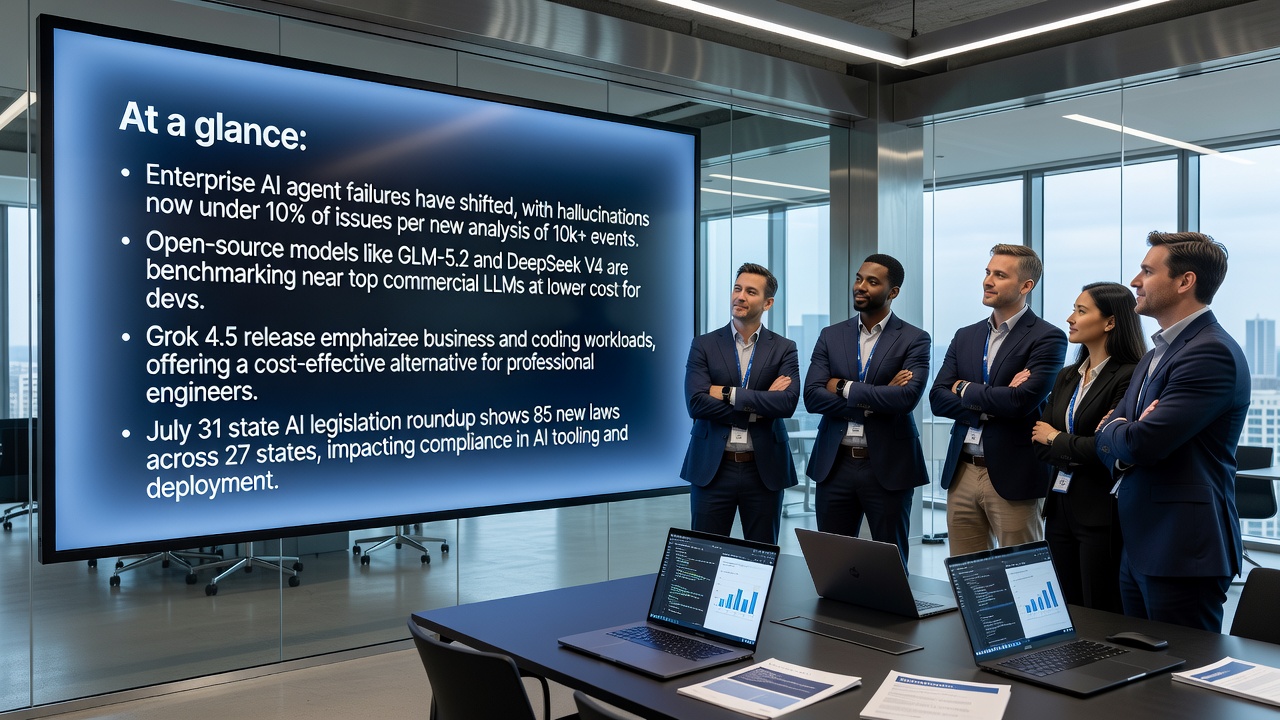
- Enterprise AI agent failures have shifted, with hallucinations now under 10% of issues per new analysis of 10k+ events.
- Open-source models like GLM-5.2 and DeepSeek V4 are benchmarking near top commercial LLMs at lower cost for devs.
- Grok 4.5 release emphasizes business and coding workloads, offering a cost-effective alternative for professional engineers.
- July 31 state AI legislation roundup shows 85 new laws across 27 states, impacting compliance in AI tooling and deployment.
Developers are navigating a maturing AI landscape where agent reliability and open-source accessibility are reshaping daily workflows more than raw capability jumps. Recent analysis highlights that enterprise AI failures now stem less from hallucinations and more from deployment gaps—80% of organizations embed agents but only 31% ship them successfully—putting pressure on engineering teams to focus on integration, monitoring, and human oversight. At the same time, Chinese-led open-source releases are closing performance gaps with frontier models, enabling local or private deployments that sidestep export controls and licensing fees that affected recent Claude and GPT updates. Grok 4.5’s positioning for coding and business use adds another practical option in a market where cost and control matter as much as benchmarks. Meanwhile, proliferating state-level AI regulations require devs to build auditability and transparency into RAG pipelines, multi-agent systems, and IDE extensions from day one. These trends converge on a single message: the next competitive edge lies in robust, compliant, and cost-efficient implementations rather than chasing the newest API.
Top Stories
AI agent failures pivot from hallucinations to deployment gaps Practical dev impact: Teams shipping agents must prioritize robust orchestration, logging, and rollback mechanisms over prompt tuning alone to close the 80%-to-31% embed-to-ship gap.Open-source LLMs close benchmark gap with commercial frontier models Practical dev impact: Engineers can now run near-SOTA models like GLM-5.2 or DeepSeek V4 locally or on cheap inference for RAG and coding tasks without vendor lock-in or export restrictions.
Grok 4.5 targets coding and enterprise workloads at lower cost Practical dev impact: Devs gain a new option for in-house agent frameworks or IDE augmentation that emphasizes practical coding assistance over general chat.
State AI laws hit 85 new enactments across 27 states by July 31 Practical dev impact: Compliance features such as audit logs and model disclosure must now be baked into any production AI tooling or agent system.
Practical Impact Analysis
The shift in failure modes means multi-agent frameworks (LangGraph, CrewAI, AutoGen) need stronger observability layers—think structured tracing and human-in-the-loop checkpoints—rather than ever-more-complex prompting. Open-source momentum lowers the barrier for private RAG deployments and fine-tuning on domain codebases, but introduces new maintenance overhead around security patches and Chinese-origin compliance checks. Grok 4.5’s coding focus suggests xAI is competing directly in the developer tooling space alongside Cursor and Claude Code workflows, potentially pressuring pricing on existing assistants. Regulatory fragmentation adds friction: any system that touches production data or generates code now risks state-level disclosure requirements, favoring frameworks with built-in governance hooks. Overall, builders should treat July’s releases as a signal to invest in evaluation harnesses, cost modeling, and audit infrastructure instead of chasing marginal capability gains.Recommended Tutorial Idea
Build a lightweight agent observability layer that logs decisions, tool calls, and failure modes for any LangGraph or CrewAI workflow, then surface compliance metadata.Grok Deep Dive
Given the July 31 legislative snapshot, the pivot in enterprise agent failure modes, and open-source models reaching near-parity on benchmarks, how should professional engineering teams redesign their RAG and multi-agent pipelines for both reliability and regulatory compliance while leveraging cost-effective options like Grok 4.5 or local GLM-5.2 deployments?Grok Deep Dive
Explore each Top Story in Grok — links open in a new tab. On phones, the same link may open the Grok app if you have it installed (via your device's normal link handling).
Article: AI Agents Pivot from — AI Dev Pulse · Aug 01, 2026
- AI agent failures pivot from hallucinations to deployment gaps
- Practical dev impact:
- Open-source LLMs close benchmark gap with commercial frontier models
- Practical dev impact:
Privacy: links open grok.com in your session only. AIDevPulse does not run your prompts through our API.