At a glance
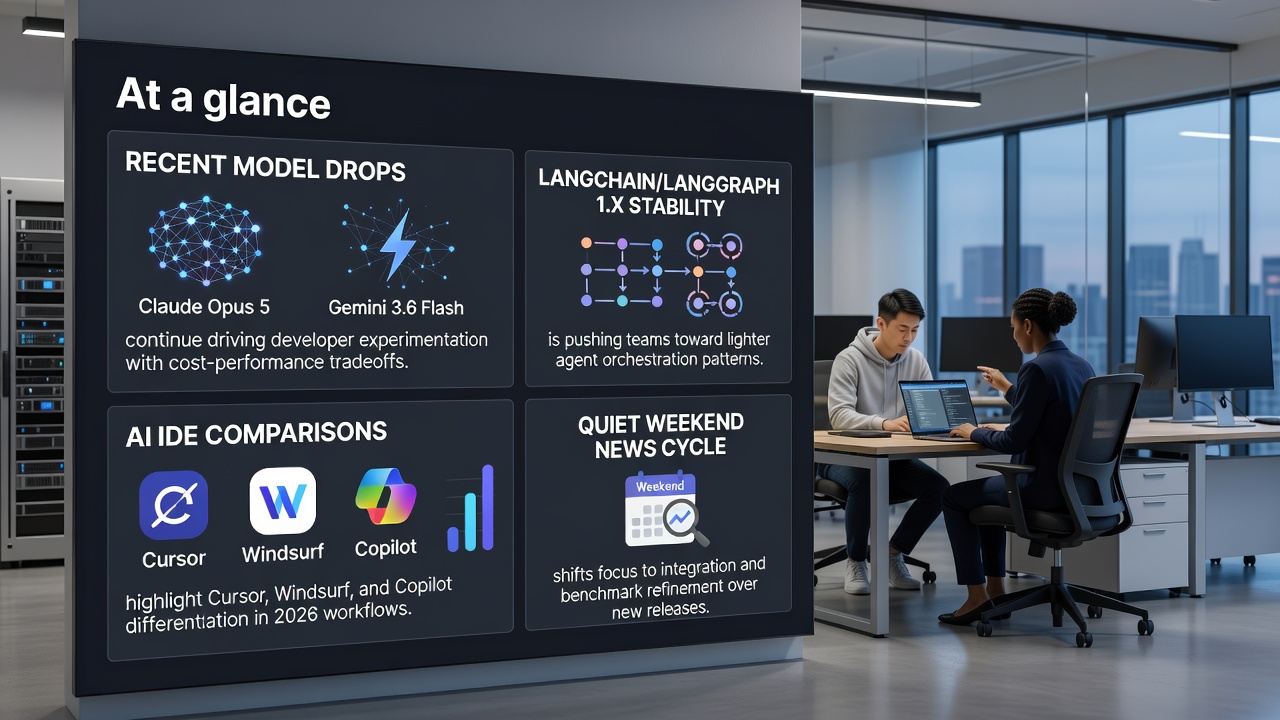
- Recent July model drops like Claude Opus 5 and Gemini 3.6 Flash continue driving developer experimentation with cost-performance tradeoffs.
- LangChain/LangGraph 1.x stability is pushing teams toward lighter agent orchestration patterns.
- AI IDE comparisons highlight Cursor, Windsurf, and Copilot differentiation in 2026 workflows.
- Quiet weekend news cycle shifts focus to integration and benchmark refinement over new releases.
The AI development landscape on August 2 shows no major flagship launches in the immediate 48-hour window, but the ripple effects from late-July releases are shaping practical choices for engineers. Claude Opus 5’s positioning as a near-frontier model at reduced cost, alongside Google’s iterative Flash upgrades, underscores a maturing market where speed, price, and context handling matter more than raw parameter counts. Meanwhile, post-1.0 agent frameworks emphasize reliability over novelty, and IDE tooling debates remain centered on ecosystem fit rather than headline features. Builders are prioritizing measurable workflow gains—such as faster iteration in multi-model setups or stateful agent loops—while tracking upcoming expectations around xAI and others. This steady-state period rewards deep integration work and benchmark-driven evaluation over chasing every new checkpoint.
Top Stories
Claude Opus 5 and Gemini Flash variants sustain momentum from late July releases Practical dev impact: Developers gain immediate options for balancing intelligence and latency in production agents without proportional cost increases.LangGraph 1.x stability encourages lighter orchestration in multi-agent systems Practical dev impact: Teams can now build reliable stateful workflows with fewer breaking changes, favoring middleware patterns over heavy custom loops.
2026 AI IDE landscape solidifies around Cursor, Windsurf, and Copilot differentiation Practical dev impact: Engineers can select tools based on specific needs like parallel execution, GitHub-native automation, or arena-style model comparison rather than chasing feature parity.
Practical Impact Analysis
The absence of fresh releases this weekend highlights how the ecosystem has shifted toward refinement and adoption. Recent models from Anthropic and Google are proving durable in real workloads, letting teams optimize for specific constraints like token pricing or context windows instead of waiting for the next leap. On the agent side, the 1.0 milestone in LangChain and LangGraph has reduced churn, allowing focus on evaluation, persistence, and recovery mechanisms that actually ship. IDE competition has similarly matured: rather than one tool dominating, developers mix based on team size and stack—Copilot for enterprise GitHub flows, Cursor for heavy refactoring, and Windsurf for comparative testing. Overall, signal favors deliberate upgrades to existing pipelines over reactive swaps, with benchmarks and cost tracking becoming core to daily decision-making.Recommended Tutorial Idea
Build a lightweight multi-model router that falls back between recent Gemini Flash and Claude Opus variants using simple cost and latency checks.Grok Deep Dive
Given the quiet cycle and emphasis on integration, explore how to productionize a cost-aware router across the latest Flash and Opus releases while benchmarking against your existing agent stack—what patterns have you found most effective for handling fallback logic and observability in multi-provider setups?Grok Deep Dive
Explore each Top Story in Grok — links open in a new tab. On phones, the same link may open the Grok app if you have it installed (via your device's normal link handling).
Article: Developers Navigate Cost — AI Dev Pulse · Aug 02, 2026
- Claude Opus 5 and Gemini Flash variants sustain momentum from late July releases
- Practical dev impact:
- LangGraph 1.x stability encourages lighter orchestration in multi-agent systems
- Practical dev impact:
Privacy: links open grok.com in your session only. AIDevPulse does not run your prompts through our API.