
At a glance
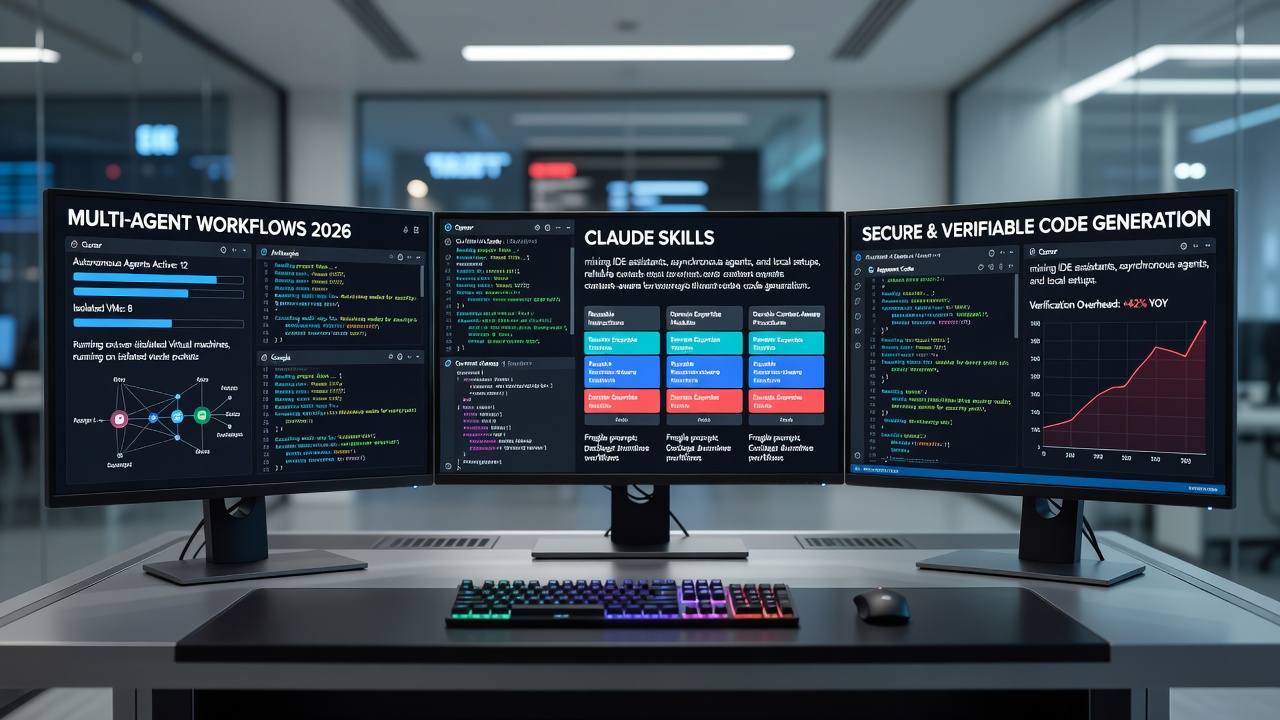
- Multi-agent coding workflows matured rapidly in 2026, with background agents now running autonomously on isolated VMs across tools like Cursor and Augment Code.
- CLI-first AI agents from Anthropic, OpenAI, and Google enable direct project-directory interaction for reading files, running tests, and multi-step fixes.
- Claude Skills packages reusable instructions and domain expertise into durable modules, shifting workflows from fragile prompts to reliable, context-aware procedures.
- Developers increasingly mix IDE assistants, asynchronous agents, and local setups for secure, verifiable code generation amid rising verification overhead.
The agentic era in AI tooling has settled into production patterns by early August 2026. What began as autocomplete experiments has evolved into orchestrated systems where specialized agents plan, execute, verify, and document changes across repositories. Recent discussions highlight how tools like Cursor’s parallel background agents, Augment Code’s Intent coordinator with living specs, and CLI interfaces from major providers now handle asynchronous tasks that previously required hours of manual oversight. This shift places new demands on developers: rigorous review processes, context management across long-running agents, and hybrid setups that blend cloud agents with local models for sensitive work. At the same time, reusable components such as Anthropic’s Skills framework reduce prompt fragility by encoding team knowledge into modular capabilities that tools can invoke automatically. The net effect is faster iteration on complex tasks, but only when paired with strong verification pipelines and selective use of isolated environments. Builders who treat AI output as junior-level drafts—always linted, tested, and secured—gain the clearest productivity edge while minimizing risk in enterprise contexts.
Top Stories
Multi-agent interfaces expand autonomous background execution in leading coding tools Practical dev impact: Developers can now delegate multi-file refactors or test generation to parallel agents that run on isolated VMs, record video/logs, and surface PRs without blocking local workflows.CLI agents from Anthropic, OpenAI, and Google enable direct repository interaction Practical dev impact: Engineers gain command-line access to models that read project files, execute tests, and perform multi-step fixes inside the working directory, streamlining terminal-centric debugging.
Claude Skills introduce modular, reusable expertise packaging Practical dev impact: Teams can convert recurring procedures into durable Skills that tools invoke automatically, replacing brittle repeated prompting with consistent, context-aware results for frontend or domain tasks.
Practical Impact Analysis
The convergence of background agents and CLI tooling accelerates end-to-end task completion while surfacing new friction points around verification and context hygiene. Cursor and Augment Code’s isolated-VM agents reduce context-switching for developers but require robust logging and review layers to catch hallucinations or incomplete implementations. CLI agents complement this by keeping work inside familiar terminal flows, yet they inherit the same need for explicit test gates before changes land. Skills-style modularization offers a promising middle path: once a procedure is encoded, agents apply it reliably across sessions, cutting down on prompt engineering overhead. Overall, the 2026 toolkit rewards hybrid strategies—using cloud agents for heavy lifting while maintaining local Ollama or isolated instances for proprietary logic. Teams that invest early in living specs, automated PR review add-ons, and skill libraries will likely see compounding gains in velocity, provided they enforce the “treat as junior draft” discipline across all outputs. The quiet period in brand-new releases underscores that integration depth and workflow orchestration now matter more than raw model drops.Recommended Tutorial Idea
Build a simple multi-agent coordinator in Python that delegates a refactoring task to a background-style agent simulation, then verifies results with tests.Grok Deep Dive
Given the maturation of multi-agent background execution, CLI repository agents, and reusable Skills packaging, what concrete workflow upgrades would you recommend for a mid-size team balancing velocity with verification—specifically around integrating isolated-VM agents with local test gates and modular Skills libraries?Sources
Grok Deep Dive
Explore each Top Story in Grok — links open in a new tab. On phones, the same link may open the Grok app if you have it installed (via your device's normal link handling).
Article: Multi-Agent Coding Workflows — AI Dev Pulse · Aug 03, 2026
- Multi-agent interfaces expand autonomous background execution in leading coding tools
- Practical dev impact:
- CLI agents from Anthropic, OpenAI, and Google enable direct repository interaction
- Practical dev impact:
Privacy: links open grok.com in your session only. AIDevPulse does not run your prompts through our API.