At a glance
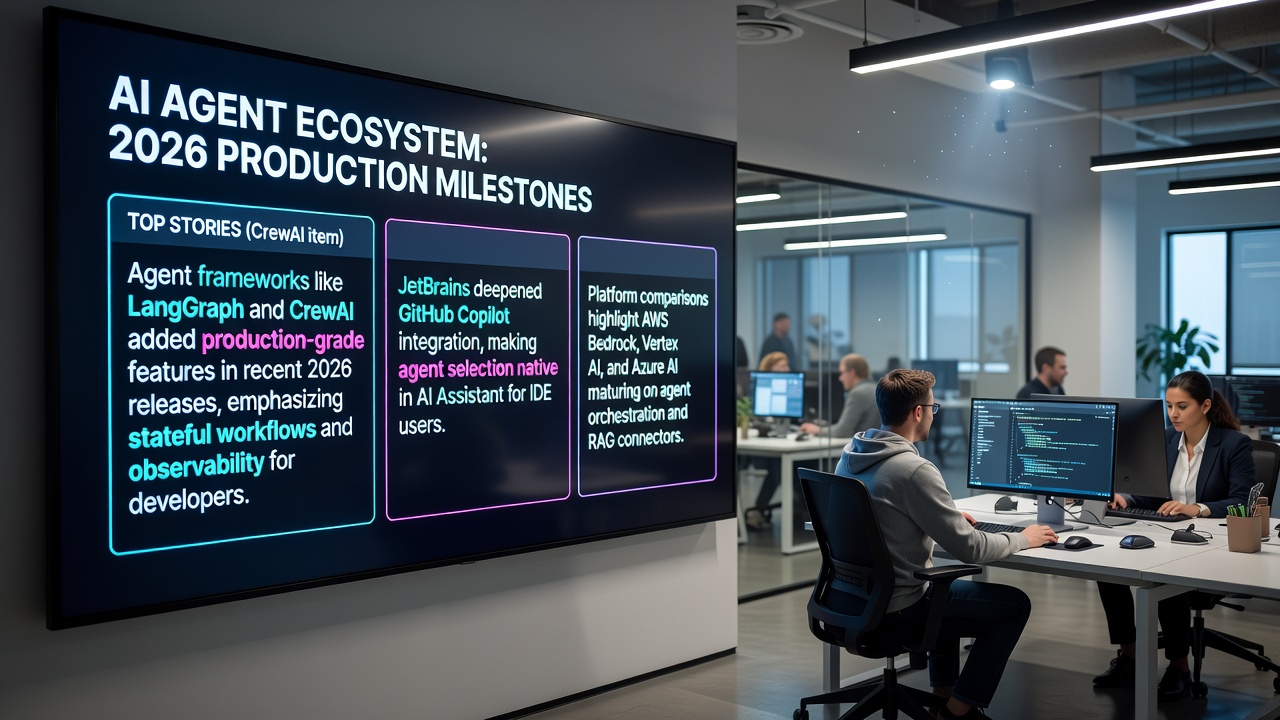
- Agent frameworks like LangGraph and CrewAI added production-grade features in recent 2026 releases, emphasizing stateful workflows and observability for developers.
- JetBrains deepened GitHub Copilot integration, making agent selection native in AI Assistant for IDE users.
- Platform comparisons highlight AWS Bedrock, Vertex AI, and Azure AI maturing on agent orchestration and RAG connectors.
- – Section: Top Stories (CrewAI item)
Old: (REMOVE entire item) New:
Today’s AI development landscape rewards builders who prioritize stable, observable agent runtimes over flashy new models. Recent framework updates signal that production agentic systems have crossed a threshold from experimental to deployable. IDE integrations, such as Copilot becoming a first-class agent in JetBrains, reduce context switching for daily coding. Cloud platforms continue layering multi-agent orchestration and enterprise connectors, making it easier to ground agents in real data without heavy custom plumbing. For teams shipping in the next quarter, the signal is clear: invest in composable runtimes and IDE-native agents rather than chasing the next base model. These incremental but high-signal changes compound quickly for professional workflows.
Top Stories
LangGraph 1.0 emphasizes production-grade stateful workflows
JetBrains AI Assistant gains native GitHub Copilot agent picker Practical dev impact: IDE users can switch directly to Copilot models and tune reasoning depth inside the existing AI chat, eliminating plugin friction.
(REMOVE entire item)
LlamaIndex Workflows 1.0 reaches GA with event-driven composition Practical dev impact: RAG-grounded agents gain lightweight, typed step composition that pairs cleanly with existing LlamaIndex retrievers for production pipelines.
Practical Impact Analysis
These updates converge on the same developer pain point: reliable multi-agent execution with better observability and fewer custom glue layers. (REMOVE sentence) The JetBrains integration brings similar maturity to the IDE layer, where most daily work happens. Cloud platforms are following the same pattern by exposing A2A protocols and connector ecosystems, lowering the barrier to grounded, multi-agent applications. The net effect is that teams no longer need to choose between rapid prototyping frameworks and production stability—mature options now exist across the stack. Builders should audit current agent graphs for opportunities to adopt native caching or hooks before the next scaling push.Recommended Tutorial Idea
Build a cached, hook-augmented research agent with LangGraph 1.x1. Install the latest LangGraph package and dependencies. 2. Define a state schema with caching enabled on retrieval nodes. 3. Add pre/post model hooks for context trimming and PII redaction. 4. Wire a simple ReAct-style graph with deferred fan-in for parallel tool calls. 5. Run the graph with streaming and inspect trace-level observability.
Grok Deep Dive
Given the LangGraph 1.0 production features alongside JetBrains Copilot agent integration, how would you refactor an existing multi-agent research pipeline to leverage stateful workflows and IDE-native agent switching—while keeping RAG grounding intact across LangGraph and CrewAI backends?Grok Deep Dive
Explore each Top Story in Grok — links open in a new tab. On phones, the same link may open the Grok app if you have it installed (via your device's normal link handling).
Article: LangGraph 1.0 and JetBrains — AI Dev Pulse · Aug 04, 2026
- LangGraph 1.0 emphasizes production-grade stateful workflows
- JetBrains AI Assistant gains native GitHub Copilot agent picker
- Practical dev impact:
- LlamaIndex Workflows 1.0 reaches GA with event-driven composition
Privacy: links open grok.com in your session only. AIDevPulse does not run your prompts through our API.