At a glance
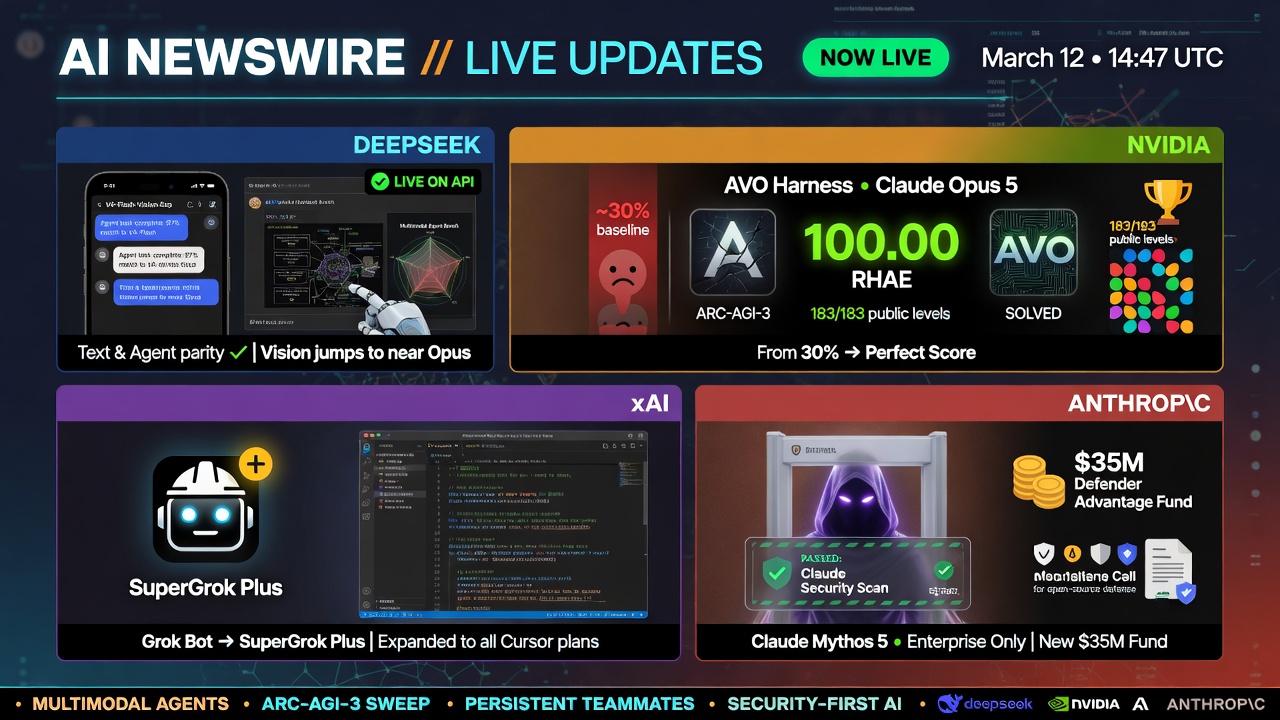
- DeepSeek’s V4-Flash-Vision-Exp goes live on the API, matching V4-Flash text and agent skills while jumping on multimodal agent benches near Opus 4.8.
- NVIDIA’s AVO harness takes Claude Opus 5 from a ~30% model baseline to a perfect 100.00 RHAE on ARC-AGI-3’s 183 public levels.
- xAI expands Grok Bot into SuperGrok Plus, Cursor Pro+, and all Cursor Teams plans as persistent cloud teammates.
- Anthropic puts Claude Mythos 5 behind Claude Security scans for Enterprise and launches a $35M Defender Advantage Fund for open-source defense.
The last 48 hours made one thing obvious to anyone shipping software: the model is no longer the whole product. A cheap experimental vision model, a research harness that turns a strong LLM into a general long-horizon agent, always-on teammates that live in your existing tools, and defensive scans that never hand the frontier model to the user all landed on the same day. Builders who still treat “which model?” as the first question will spend the next quarter rewriting orchestration, memory, and approval loops. The teams that treat the surrounding system—persistent state, visual I/O, event-driven wake-ups, and scoped outputs—as first-class will ship agents that actually finish jobs. Today’s drops are not incremental feature lists; they are evidence that architecture, pricing, and access control now move the needle as much as parameter count. If you maintain an agent stack, a coding IDE, or a security pipeline, the defaults just changed.
Top Stories
DeepSeek-V4-Flash-Vision-Exp multimodal API now live Practical dev impact: You can now drop visual understanding into existing agent loops at V4-Flash token prices without swapping the rest of the stack. The experimental model matches DeepSeek-V4-Flash on text, reasoning, and agent tasks while posting a major leap on multimodal agent benchmarks, landing close to Opus-4.8. Call it with `model=’deepseek-v4-flash-vision-exp’`; images cost up to 384 tokens each. Chat Completions, Messages, and Responses all accept mixed text + image input via base64, URL, or the new Files API (upload once, reuse by `file_id`). DeepSeek Harness 0.1.1 shipped the same day with native support. For visual-agent prototypes—screenshot-to-code, UI testers, document extractors—this is the cheapest high-capability option that does not force you to rebuild tool-calling or thinking mode.
NVIDIA AVO reaches 100% on ARC-AGI-3 public set Practical dev impact: Persistent memory plus a supervisor loop can turn a mid-tier frontier model into a general long-horizon agent; copy the pattern, not just the model name. NVIDIA’s Agentic Variation Operators architecture, originally shown on GPU-kernel optimization, completed every one of the 183 levels across 25 unseen interactive environments with no instructions or stated goals, using 12% fewer actions than the prior leader. The same Claude Opus 5 baseline that scores roughly 30% on the model-only eval hits a perfect 100.00 RHAE once wrapped in AVO’s inspect-plan-implement-evaluate loop, persistent memory of prior attempts, and a supervisor that redirects stalled searches. The result is explicit: on tasks that last hours or days, the harness—not the weights—is the difference between a demo and a worker. Any team running coding or research agents should treat memory, lineage, and supervision as production requirements, not research extras.
Grok Bot now included with SuperGrok Plus, Cursor Pro+, and Cursor Teams Practical dev impact: Persistent, tool-using cloud agents that already live in your browser, inbox, and IDE are no longer gated behind the highest Ultra/Heavy tiers. xAI expanded Grok Bot (launched in beta 11 August) so it ships with SuperGrok Plus, Cursor Pro+, Cursor Ultra, and both Standard and Premium Cursor Teams plans. Each Bot runs on its own always-on cloud computer with browser and terminal, signs into the apps you already use, and only pings you for judgment calls. Multiple Bots share a machine, pass work in group threads, and can be taught a routine by watching you once. For Cursor shops this is the first time a general-purpose teammate is included in the same subscription as the editor; expect more “stand up a researcher + writer + reviewer and walk away” workflows instead of single-turn Composer sessions.
Claude Mythos 5 now powers Claude Security scans; $35M Defender Advantage Fund launches Practical dev impact: Enterprise teams can point Mythos-class vulnerability scanning at their own repos and receive CWE-tagged findings plus suggested patches without ever getting a raw chat surface. Anthropic made Claude Mythos 5 available inside Claude Security (public beta for Enterprise) so scans run on the company’s most capable cyber model; findings include category, severity, confidence, and a suggested fix that opens in Claude Code for human review. The same announcement introduces the $35 million Defender Advantage Fund (0xDAF) in Claude credits for organizations patching live open-source vulnerabilities, automating scan-and-patch pipelines, and hardening projects against whole classes of attack. Partners will receive the model only as a scoped backend, not a promptable endpoint. If you maintain OSS or run internal AppSec, the defensive capability just became cheaper and more widely licensed while the offensive surface stayed locked down.
Practical Impact Analysis
The four stories share a single thesis: capability is being unbundled from direct model access. DeepSeek’s vision drop lets you add eyes to an existing cheap agent without a new vendor relationship or a 10× token bill. NVIDIA’s AVO result is the strongest public proof yet that a well-designed harness can close the gap between “model can do it in one shot” and “agent can do it over a week.” Grok Bot’s plan expansion turns that idea into a product you can message from your phone; the computer, the logins, and the persistence are already there. Anthropic’s security move shows the same unbundling on the defense side—Mythos 5 does the hard reasoning, the user only ever sees a patch or an alert.
For day-to-day engineering this means three concrete shifts. First, multimodal is no longer a luxury add-on; at Flash pricing it becomes the default input for any agent that already talks to a browser or a design tool. Second, every production agent now needs an explicit memory and supervision layer; treating the context window as the only state store is a 2025 habit. Third, access-control design (scoped outputs, human-in-the-loop patches, event-driven wake-ups) is becoming as important as the model card. Teams that still route every request through a single chat completion will watch their competitors ship agents that stay on a task overnight, see the UI they are changing, and only ask for approval when it matters. The cost of ignoring the harness is no longer theoretical.
Recommended Tutorial Idea
Prototype a screenshot-to-component agent with the new DeepSeek vision model. The script below sends a local UI screenshot, asks for a self-contained React + Tailwind component, and prints the result. Swap the image path and prompt for your own mock or Figma export. Requires an OpenAI-compatible client pointed at DeepSeek and a `DEEPSEEK_API_KEY`.
Run it once, drop the output into a Vite app, and iterate the prompt. Next step: wrap the same call inside a small loop that also screenshots the rendered component and asks the model to list visual diffs—exactly the inspect-evaluate pattern NVIDIA demonstrated at scale.
Grok Deep Dive
DeepSeek just shipped V4-Flash-Vision-Exp so a Flash-priced model can now see and act on images at near-Opus-4.8 multimodal-agent level, NVIDIA proved that a persistent-memory-plus-supervisor harness (AVO) can take Claude Opus 5 from ~30% to a perfect 100 on the entire ARC-AGI-3 public set, xAI put always-on Grok Bots that already have their own cloud computer and your logins into SuperGrok Plus and Cursor Pro+/Teams, and Anthropic put Mythos 5 behind scoped security scans plus a $35M OSS defense fund so defenders get patches without getting the raw model. Walk me through how I should redesign a production coding-and-ops agent stack this week: what memory and supervision primitives I must add first, whether I should route visual tasks to DeepSeek immediately, how I would safely expose a Grok-Bot-style teammate to my team without giving it unrestricted computer use, and what a Mythos-style “scoped output only” pattern would look like for my own internal tools. Give concrete module boundaries and a 7-day implementation order.Grok Deep Dive
Explore each Top Story in Grok — links open in a new tab. On phones, the same link may open the Grok app if you have it installed (via your device's normal link handling).
Article: DeepSeek AVO Grok Bots and Mythos Unbundle Capability from Direct Model Access
- DeepSeek-V4-Flash-Vision-Exp multimodal API now live
- Practical dev impact:
- NVIDIA AVO reaches 100% on ARC-AGI-3 public set
- Practical dev impact:
Privacy: links open grok.com in your session only. AIDevPulse does not run your prompts through our API.